Why do mushrooms turn brown?
Chemists explore the mechanisms behind food spoilage
This news release is available in German.
The research team of Annette Rompel from the Institute for Biophysical Chemistry, University of Vienna explore the mechanisms behind the "browning reaction" during the spoilage of mushrooms. The researchers were able to demonstrate that the enzyme responsible is already formed prior to fungal spoiling. The detailed study is published online in the well renowned journals, Phytochemistry and Acta Crystallographica.
Understanding the mechanism of enzyme tyrosinase pigmentation is currently of both medical as well as technological interest. The copper-containing enzyme is present in animals and humans and is essential for the protective pathway against UV radiation, it also simultaneously provides the elucidation and potential means with which to prevent the spoilage of food. Mushrooms were selected for the study due to their low cost and ready availability. In addition they are also a valuable target for researchers, largely because of their high enzyme content, fungi are ideal sources for potential studies of tyrosinase. The mushrooms therefore serve as a model organism for the study of the pathway involved in food spoilage.
Elucidation of an inactive precursor
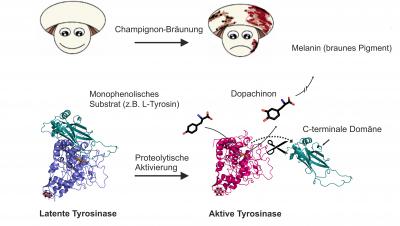
Since 2012, it has become established that six different tyrosinases (PPO1 to 6) exist within the mushroom, two of which (PPO3 and PPO4) occur in larger quantities. The enzyme responsible for the mechanism of food spoilage is formed within eukaryotes (organisms that have a nucleus) as an inactive precursor during the developmental phase of an organism. This precursor is then activated via specific chemical cleavage. At this cleavage site, the protein segment covering part of the enzyme active site is removed and the substrates (tyrosine and other monophenols) can be accessed and take part in key chemical reactions.
New Method of Isolation and unique reagent leads to success
None of the previously established methods of isolation present in the literature could be successfully applied for PPO4. For the first time, at the Institute for Biophysical Chemistry of the University of Vienna, a method was developed that allows for the one stage isolation of latent tyrosinase from their natural source. The enzyme characterization was undertaken at the Department of Chemistry with close cooperation with the Institute of Mass Spectrometry lead by Andreas Rizzi, both within the University of Vienna. After sufficiently large quantities were extracted from pure PPO4, the researchers were able to identify and optimize appropriate crystallization conditions which produced well formed protein crystals. This was only possible with the use of a relatively unusual co-crystallization reagent, a polyoxometalate of the Anderson type.
Integral for medicine and biotechnology
The PhD student Stephan Mauracher worked at the University of Vienna, taking an essential part in this project as part of the University Initiative termed "Functional Molecules". Following this research it has been made possible to purify the enzyme in sufficient quantities for characterization. Ulrich Kortz, working at the Jacobs University of Bremen was responsible for synthesizing the polyoxometalate used and was a key proponent of its usage as an additive for protein crystallization. The research project was then continued as FWF Initiative. "This research has allowed for the crystallization and three-dimensional structure of PPO4 to be resolved", says Anette Rompel.
INFORMATION:
Publication in Phytochemistry: S. G. Mauracher, C. Molitor, C. Michael, M. Kragl, A. Rizzi and A. Rompel: High level proteinpurification allows the unambiguous polypeptide determination of latent isoform PPO4 of mushroom tyrosinase. Phytochemistry 99 (2014) 14-25.
Publication in Acta Crystallographica Section F – Structural Biology and Crystallization Communication: S. G. Mauracher, C. Molitor, R. Al-Oweini, U. Kortz and A. Rompel: Crystallization and preliminary X-ray crystallographic analysis of latent isoform PPO4 mushroom (Agaricus bisporus) tyrosinase. Acta Cryst. F70 (2014) 263-266.
Publication in Acta Crystallographica Section D – Biological Crystallography: S. G. Mauracher, C. Molitor, R. Al-Oweini, U. Kortz and A Rompel: Latent and active abPPO4 mushroom tyrosinase cocrystallized with hexatungstotellurate(VI) in a single crystal. Acta Cryst. Sect. D70 (August 29, 2014) 2301-2315.
Scientific contact
Univ.-Prof. Dr. Annette Rompel
Institute of Biophysical Chemistry
Chemistry Faculty
University of Vienna
T +43-1-4277-525 02
annette.rompel@univie.ac.at
http://www.bpc.univie.ac.at
Press contact
Mag. Alexandra Frey
Press Office of the University of Vienna
Research and teaching
T +43-1-4277-175 33
M +43-664-602 77-175 33
alexandra.frey@univie.ac.at
The University of Vienna, founded in 1365, is one of the oldest and largest universities in Europe. About 9,500 employees, 6,700 of who are academic employees, work at 15 faculties and four centres. This makes the University of Vienna Austria's largest research and education institution. About 92,000 national and international students are currently enrolled at the University of Vienna. With more than 180 degree programmes, the University offers the most diverse range of studies in Austria. The University of Vienna is also a major provider of continuing education. In 2015, the Alma Mater Rudolphina Vindobonensis celebrates its 650th Anniversary. http://www.univie.ac.at
The research team of Annette Rompel from the Institute for Biophysical Chemistry, University of Vienna explore the mechanisms behind the "browning reaction" during the spoilage of mushrooms. The researchers were able to demonstrate that the enzyme responsible is already formed prior to fungal spoiling. The detailed study is published online in the well renowned journals, Phytochemistry and Acta Crystallographica.
Understanding the mechanism of enzyme tyrosinase pigmentation is currently of both medical as well as technological interest. The copper-containing enzyme is present in animals and humans and is essential for the protective pathway against UV radiation, it also simultaneously provides the elucidation and potential means with which to prevent the spoilage of food. Mushrooms were selected for the study due to their low cost and ready availability. In addition they are also a valuable target for researchers, largely because of their high enzyme content, fungi are ideal sources for potential studies of tyrosinase. The mushrooms therefore serve as a model organism for the study of the pathway involved in food spoilage.
Elucidation of an inactive precursor
Since 2012, it has become established that six different tyrosinases (PPO1 to 6) exist within the mushroom, two of which (PPO3 and PPO4) occur in larger quantities. The enzyme responsible for the mechanism of food spoilage is formed within eukaryotes (organisms that have a nucleus) as an inactive precursor during the developmental phase of an organism. This precursor is then activated via specific chemical cleavage. At this cleavage site, the protein segment covering part of the enzyme active site is removed and the substrates (tyrosine and other monophenols) can be accessed and take part in key chemical reactions.
New Method of Isolation and unique reagent leads to success
None of the previously established methods of isolation present in the literature could be successfully applied for PPO4. For the first time, at the Institute for Biophysical Chemistry of the University of Vienna, a method was developed that allows for the one stage isolation of latent tyrosinase from their natural source. The enzyme characterization was undertaken at the Department of Chemistry with close cooperation with the Institute of Mass Spectrometry lead by Andreas Rizzi, both within the University of Vienna. After sufficiently large quantities were extracted from pure PPO4, the researchers were able to identify and optimize appropriate crystallization conditions which produced well formed protein crystals. This was only possible with the use of a relatively unusual co-crystallization reagent, a polyoxometalate of the Anderson type.
Integral for medicine and biotechnology
The PhD student Stephan Mauracher worked at the University of Vienna, taking an essential part in this project as part of the University Initiative termed "Functional Molecules". Following this research it has been made possible to purify the enzyme in sufficient quantities for characterization. Ulrich Kortz, working at the Jacobs University of Bremen was responsible for synthesizing the polyoxometalate used and was a key proponent of its usage as an additive for protein crystallization. The research project was then continued as FWF Initiative. "This research has allowed for the crystallization and three-dimensional structure of PPO4 to be resolved", says Anette Rompel.
INFORMATION:
Publication in Phytochemistry: S. G. Mauracher, C. Molitor, C. Michael, M. Kragl, A. Rizzi and A. Rompel: High level proteinpurification allows the unambiguous polypeptide determination of latent isoform PPO4 of mushroom tyrosinase. Phytochemistry 99 (2014) 14-25.
Publication in Acta Crystallographica Section F – Structural Biology and Crystallization Communication: S. G. Mauracher, C. Molitor, R. Al-Oweini, U. Kortz and A. Rompel: Crystallization and preliminary X-ray crystallographic analysis of latent isoform PPO4 mushroom (Agaricus bisporus) tyrosinase. Acta Cryst. F70 (2014) 263-266.
Publication in Acta Crystallographica Section D – Biological Crystallography: S. G. Mauracher, C. Molitor, R. Al-Oweini, U. Kortz and A Rompel: Latent and active abPPO4 mushroom tyrosinase cocrystallized with hexatungstotellurate(VI) in a single crystal. Acta Cryst. Sect. D70 (August 29, 2014) 2301-2315.
Scientific contact
Univ.-Prof. Dr. Annette Rompel
Institute of Biophysical Chemistry
Chemistry Faculty
University of Vienna
T +43-1-4277-525 02
annette.rompel@univie.ac.at
http://www.bpc.univie.ac.at
Press contact
Mag. Alexandra Frey
Press Office of the University of Vienna
Research and teaching
T +43-1-4277-175 33
M +43-664-602 77-175 33
alexandra.frey@univie.ac.at
The University of Vienna, founded in 1365, is one of the oldest and largest universities in Europe. About 9,500 employees, 6,700 of who are academic employees, work at 15 faculties and four centres. This makes the University of Vienna Austria's largest research and education institution. About 92,000 national and international students are currently enrolled at the University of Vienna. With more than 180 degree programmes, the University offers the most diverse range of studies in Austria. The University of Vienna is also a major provider of continuing education. In 2015, the Alma Mater Rudolphina Vindobonensis celebrates its 650th Anniversary. http://www.univie.ac.at