(Press-News.org) Physicists working on the National Spherical Torus Experiment (NSTX) at the Princeton Plasma Physics Laboratory are now one step closer to solving one of the grand challenges of magnetic fusion research—how to reduce the effect that the hot plasma has on fusion machine walls (or how to tame the plasma-material interface). Some heat from the hot plasma core of a fusion energy device escapes the plasma and can interact with reactor vessel walls. This not only erodes the walls and other components, but also contaminates the plasma—all challenges for practical fusion. One method to protect machine walls involves divertors, chambers outside the plasma into which the plasma heat exhaust (and impurities) flow. A new divertor concept, called the "snowflake," has been shown to significantly reduce the interaction between hot plasma and the cold walls surrounding it.
Strong magnetic fields shape the hot plasma in the form of a donut in a magnetic fusion plasma reactor called a tokamak. As confined plasma particles move along magnetic field lines inside the tokamak, some particles and heat escape because of instabilities in the plasma. Surrounding the hot plasma is a colder plasma layer, the scrape-off layer, which forms the plasma-material interface. In this layer, escaped particles and heat flow along an "open" magnetic field line to a separate part of the vessel and enter a "divertor chamber." If the
plasma striking the divertor surface is too hot, melting of the plasma-facing components and loss of coolant can occur. Under such undesirable conditions, the plasma-facing component lifetime would also be an issue, as they would tend to wear off too quickly.
While the conventional magnetic X-point divertor concept has existed for three decades, a very recent theoretical idea and supporting calculations by Dr. D.D. Ryutov from Lawrence Livermore National Laboratory have indicated that a novel magnetic divertor—the "snowflake divertor"—would have much improved heat handling characteristics for the plasma-material interface. The name is derived from the appearance of magnetic field lines forming this novel magnetic interface.
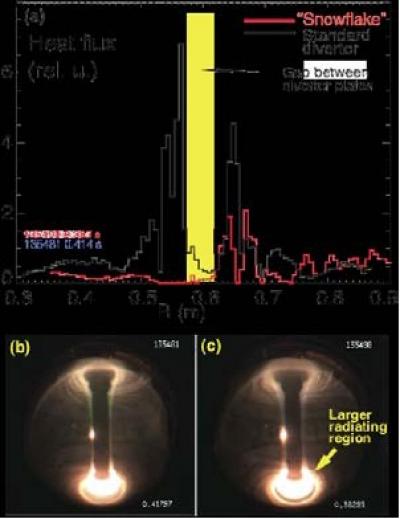
This magnetic configuration was recently realized in NSTX and fully confirmed the theoretical predictions. The snowflake divertor configuration was created by using only two or three existing magnetic coils. This achievement is an important result for future tokamak reactors that will operate with few magnetic coils. Because the snowflake divertor configuration flares the scrape-off layer at the divertor surface, the peak heat load is considerably reduced, as was confirmed by the divertor heat flux on NSTX. The plasma in the snowflake divertor, instead of heating the divertor surface on impact, radiated the heat away, cooled down and did not erode the plasma-facing components as much, thus extending their lifetime. Plasma TV images show more divertor radiation in the snowflake divertor plasmas in comparison with the standard plasmas. Importantly, the snowflake divertor did not have an impact on the high performance and confinement of the high-temperature core plasma, and even reduced the impurity contamination level of the main plasma.
These highly encouraging results provide further support for the snowflake divertor as a viable plasma-material interface for future tokamak devices and for fusion development applications.
INFORMATION:
Taming thermonuclear plasma with a snowflake
News from the 52nd annual meeting of the APS Division of Plasma Physics
2010-11-09
ELSE PRESS RELEASES FROM THIS DATE:
Vacuum arcs spark new interest
2010-11-09
Whenever two pieces of metal at different voltages are brought near each other, as when an appliance is plugged into a live socket, there is a chance there will be an arc between them. Most of the arcs people see are a breakdown of the gas between the metal surfaces, but this type of breakdown can also occur in a vacuum. This vacuum breakdown, which until recently has not been well understood, has implications for applications from particle accelerators to fusion reactors.
As part of an effort to understand the maximum accelerating field in particle accelerators, scientists ...
PIT(-1)ting good and bad outcomes against each other in breast cancer
2010-11-09
The outlook for patients with breast cancer is determined in part by whether or not their tumor has spread to other sites in the body. A team of researchers, led by Roman Perez-Fernandez and colleagues, at the University of Santiago de Compostela, Spain, has now identified in a subset of patients with breast cancer, a marker associated with the occurrence of tumors at distant sites; a finding that they hope might help predict a patient's outlook more accurately. Specifically, the team found that in patients with breast cancer that was accompanied by the presence of tumor ...
JCI online early table of contents: Nov. 8, 2010
2010-11-09
EDITOR'S PICK: PIT(-1)ting good and bad outcomes against each other in breast cancer
The outlook for patients with breast cancer is determined in part by whether or not their tumor has spread to other sites in the body. A team of researchers, led by Roman Perez-Fernandez and colleagues, at the University of Santiago de Compostela, Spain, has now identified in a subset of patients with breast cancer, a marker associated with the occurrence of tumors at distant sites; a finding that they hope might help predict a patient's outlook more accurately. Specifically, the team ...
Research into adolescent sexual habits reveals surprising findings
2010-11-09
Females are more likely to have an unprotected first sexual encounter than their male counterparts.
This finding was a surprise to Nicole Weller, an Arizona State University graduate student working toward her doctoral degree in sociology, who presented preliminary findings on research she is conducting on the relationship between early sex education and the onset of sexual activity at the 138th annual American Public Health Association Social Justice Meeting and Expo in Denver on Monday, Nov. 8. Weller is a student in the School of Social and Family Dynamics in the College ...
PPIs and antiplatelet drugs can be used together after careful consideration of risks and benefits
2010-11-09
Using proton pump inhibitors (PPIs) and antiplatelet drugs (thienopyridines) together is an appropriate way of treating patients with cardiovascular (CV) disease who are at high risk of upper gastrointestinal (GI) bleeds, despite recent concerns about an adverse interaction between these two types of drugs, according to an Expert Consensus Document released jointly today by the American College of Cardiology Foundation (ACCF), the American College of Gastroenterology (ACG), and the American Heart Association (AHA).
The potential benefits of antiplatelet therapy for patients ...
Silent vascular disease accompanies cognitive decline in healthy aging
2010-11-09
(SACRAMENTO, Calif.) — Older people who are leading active, healthy lifestyles often have silent vascular disease that can be seen on brain scans that affect their ability to think, according to a new study led by UC Davis researchers and published online today in the Archives of Neurology, one of the JAMA Archives journals.
"This study shows that silent vascular disease is really common as we get older and it influences our thinking abilities," said Charles DeCarli, professor of neurology in the School of Medicine at UC Davis and director of the UC Davis Alzheimer's ...
Although less prevalent, physician-industry relationships remain common
2010-11-09
A new survey finds that, while the number of physicians who report having relationships with pharmaceutical manufacturers or other industrial companies has dropped in recent years, the vast majority of them still maintain such relationships. The study, conducted by the Mongan Institute for Health Policy (IHP) at Massachusetts General Hospital (MGH), appears in the Nov. 8 Archives of Internal Medicine and also documents changes in the frequency of particular types of relationships.
"While physician-industry relationships have decreased significantly since 2004, they ...
Alternative treatment for preventing relapse of certain type of vasculitis appears less effective
2010-11-09
In a comparison of treatments for maintaining remission of a certain type of vasculitis (inflammation of blood vessels), the immunosuppressant mycophenolate mofetil, regarded as an alternative to the drug often used to prevent relapse, azathioprine, was less effective, according to a study that will appear in the December 1 print edition of JAMA. The study is being released early online to coincide with its presentation at the American College of Rheumatology annual scientific meeting.
"Relapses of antineutrophil cytoplasmic antibody (ANCA)-associated vasculitis (AAV) ...
Survey suggests that many physicians still have relationships with industry
2010-11-09
Relationships with drug manufacturers, device companies and other medical companies appear to be have decreased since 2004 but remain common among physicians, according to a report in the November 8 issue of Archives of Internal Medicine, one of the JAMA/Archives journals.
"The medical profession has embraced the importance of placing patient welfare ahead of financial benefits to physicians in clinical decision making," the authors write as background information in the article. "One tenet of medical professionalism is managing conflicts of interest related to physician-industry ...
Starting dialysis earlier may be harmful for some patients
2010-11-09
Beginning dialysis therapy earlier in the development of advanced kidney disease appears to be associated with a greater risk of death for some patients in the following year, according to a report posted online today that will be published in the March 14 print issue of Archives of Internal Medicine, one of the JAMA/Archives journals.
Dialysis—a procedure in which a machine performs the blood-filtering functions of the kidneys—should help patients with advanced kidney disease live longer, reduce their illness burden and improve their quality of life, according to background ...
LAST 30 PRESS RELEASES:
Local water supply crucial to success of hydrogen initiative in Europe
New blood test score detects hidden alcohol-related liver disease
High risk of readmission and death among heart failure patients
Code for Earth launches 2026 climate and weather data challenges
Three women named Britain’s Brightest Young Scientists, each winning ‘unrestricted’ £100,000 Blavatnik Awards prize
Have abortion-related laws affected broader access to maternal health care?
Do muscles remember being weak?
Do certain circulating small non-coding RNAs affect longevity?
How well are international guidelines followed for certain medications for high-risk pregnancies?
New blood test signals who is most likely to live longer, study finds
Global gaps in use of two life-saving antenatal treatments for premature babies, reveals worldwide analysis
Bug beats: caterpillars use complex rhythms to communicate with ants
High-risk patients account for 80% of post-surgery deaths
Celebrity dolphin of Venice doesn’t need special protection – except from humans
Tulane study reveals key differences in long-term brain effects of COVID-19 and flu
The long standing commercialization challenge of lithium batteries, often called the dream battery, has been solved.
New method to remove toxic PFAS chemicals from water
The nanozymes hypothesis of the origin of life (on Earth) proposed
Microalgae-derived biochar enables fast, low-cost detection of hydrogen peroxide
Researchers highlight promise of biochar composites for sustainable 3D printing
Machine learning helps design low-cost biochar to fight phosphorus pollution in lakes
Urine tests confirm alcohol consumption in wild African chimpanzees
Barshop Institute to receive up to $38 million from ARPA-H, anchoring UT San Antonio as a national leader in aging and healthy longevity science
Anion-cation synergistic additives solve the "performance triangle" problem in zinc-iodine batteries
Ancient diets reveal surprising survival strategies in prehistoric Poland
Pre-pregnancy parental overweight/obesity linked to next generation’s heightened fatty liver disease risk
Obstructive sleep apnoea may cost UK + US economies billions in lost productivity
Guidelines set new playbook for pediatric clinical trial reporting
Adolescent cannabis use may follow the same pattern as alcohol use
Lifespan-extending treatments increase variation in age at time of death
[Press-News.org] Taming thermonuclear plasma with a snowflakeNews from the 52nd annual meeting of the APS Division of Plasma Physics