PRESS-NEWS.org - Press Release Distribution
PRESS RELEASES DISTRIBUTION

New plant species a microcosm of biodiversity

New plant species a microcosm of biodiversity
2014-02-07
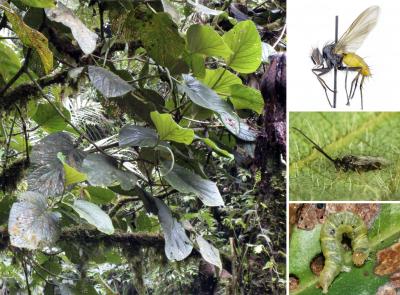
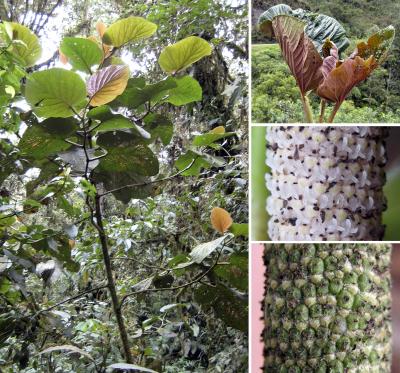
(Press-News.org) Biologists working in the Andes mountains of Ecuador have described a new plant species, a wild relative of black pepper, that is in itself a mini biodiversity hotspot. The new species, Piper kelleyi, is the sole home of an estimated 40-50 insect species, most of which are entirely dependent on this plant species for survival. This discovery is part of a larger project which focuses on the influence of plant-produced chemical compounds on biodiversity. The study was published in the open access journal PhytoKeys.

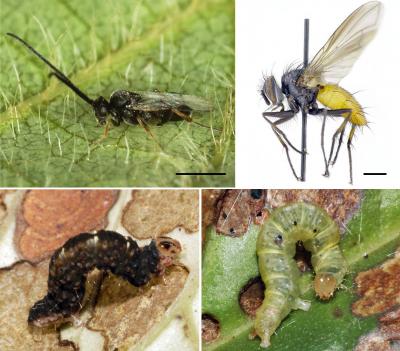
The chemical compounds produced by plants are source of plants' unique flavors, aromas, and colors. What's less appreciated is that these compounds often have important medicinal or toxic properties, and are the plant's natural way to resist pesky herbivores. Black pepper and its wild relatives produce a wide diversity of chemical compounds, many of which are known to be biologically active (in fact, several compounds from the new species are currently under evaluation, and show promise as possible anti-cancer drugs). These compounds are known to deter most herbivores, but a certain group of caterpillars has been able to overcome their toxicity and, as a result, most species of the genus feed only on a single species of wild black pepper. To make matters more complex, each of these caterpillars typically has one to several predatory wasp and/or fly species that attack only that caterpillar species.

Our team of scientists has made nearly 30,000 observations of over 100 black pepper relatives over 20+ years, and the new plant species described here supports the largest number of specialized caterpillar and predator species recorded for species in the black pepper family to date. Many of these insect species were discovered as a result of our investigations and are new to science (many remain unnamed). Piper kelleyi supports an estimated 40-50 species of specialized herbivores and predators, which makes this newly described plant species, in itself, a veritable biodiversity hotspot. Are there any vertebrate species that depend on this plant? Nobody knows, but relatives of black pepper are often important food sources for vertebrates, such as bats and birds, that specialize on their fruits or feed on associated insects.

This finding has conservation implications as well. The insect species that make up this unusually large assemblage are, for the most part, entirely dependent on the new plant species and, if the plant were to disappear, all of its associated animal species would too.

Evidence suggests that the unique compounds produced by a plant species, or the unique combination of these compounds, help drive the evolution of biological diversity, not only among the herbivores that feed directly on the plants, but among higher trophic levels as well. The discovery of our new species, along with its large cohort of dependent insects, lends considerable support to the hypothesis that a suite of new species of herbivores and predators of those herbivores evolves in response to the evolution of novel plant-produced chemical compounds.

INFORMATION: Original source:

Tepe EJ, Rodríguez-Castañeda G, Glassmire AE, Dyer LA (2014) Piper kelleyi, a hotspot of ecological interactions and a new species from Ecuador and Peru. PhytoKeys 34: 19-32. doi: 10.3897/phytokeys.34.6376

[Attachments] See images for this press release:
New plant species a microcosm of biodiversity New plant species a microcosm of biodiversity 2 New plant species a microcosm of biodiversity 3

ELSE PRESS RELEASES FROM THIS DATE:

Avian flu variant stalks Egypt

Avian flu variant stalks Egypt
2014-02-07
Since its first identification in Asia, highly pathogenic avian influenza—H5N1—has caused significant alarm in the scientific community. While the virus' primary target is birds—tens of millions have already died from it—it is capable of infecting mammals, including humans, causing serious illness and a frightening rate of mortality. In a new study, Matthew Scotch, a researcher at Arizona State University's Biodesign Institute, tracks the spread of an H5N1 variant in Egypt—a country recently identified as a major epicenter for the virus. In results recently appearing ...

Substance in photosynthesis was at work in ancient, methane-producing microbes

Substance in photosynthesis was at work in ancient, methane-producing microbes
2014-02-07
An international team of researchers led by scientists at Virginia Tech and the University of California, Berkeley has discovered that a process that turns on photosynthesis in plants likely developed on Earth in ancient microbes 2.5 billion years ago, long before oxygen became available. The research offers new perspective on evolutionary biology, microbiology, and the production of natural gas, and may shed light on climate change, agriculture, and human health. "By looking at this one mechanism that was not previously studied, we will be able to develop new basic ...

Finding could explain age-related decline in motor function

Finding could explain age-related decline in motor function
2014-02-07
SAN ANTONIO (Feb. 6, 2014) — Scientists from the School of Medicine at The University of Texas Health Science Center at San Antonio have found a clue as to why muscles weaken with age. In a study published Feb. 5 in The Journal of Neuroscience, they report the first evidence that "set points" in the nervous system are not inalterably determined during development but instead can be reset with age. They observed a change in set point that resulted in significantly diminished motor function in aging fruit flies. "The body has a set point for temperature (98.6 degrees), ...

Gender influences symptoms of genetic disorder

2014-02-07
A genetic disorder that affects about 1 in every 2,500 births can cause a bewildering array of clinical problems, including brain tumors, impaired vision, learning disabilities, behavioral problems, heart defects and bone deformities. The symptoms and their severity vary among patients affected by this condition, known as neurofibromatosis type 1 (NF1). Now, researchers at Washington University School of Medicine in St. Louis have identified a patient's gender as a clear and simple guidepost to help health-care providers anticipate some of the effects of NF1. The scientists ...

The fatality rate among hard drug users is 14 times higher than for the general population

2014-02-07
A new study analyses the risk factors and excess mortality among heroin and cocaine consumers admitted to treatment in Spain. The results reveal that the fatality rate among consumers of both drugs is 14.3 times higher than for the general population, while among those only using cocaine, it is 5.1 times higher. In Spain the majority of deaths related to cocaine are not correctly certified and therefore up until now very few studies have been carried out that analyse the consequences of consuming these drugs in terms of mortality. "Death certificates rarely include ...

Smithsonian reports GMO soybean pollen threatens Mexican honey sales

2014-02-07
Mexico is the fourth largest honey producer and fifth largest honey exporter in the world. A Smithsonian researcher and colleagues helped rural farmers in Mexico to quantify the genetically modified organism (GMO) soybean pollen in honey samples rejected for sale in Germany. Their results will appear Feb. 7 in the online journal, Scientific Reports. David Roubik, senior staff scientist at the Smithsonian Tropical Research Institute, and colleagues developed the ability to identify pollen grains in honey in Panama and in Mexico during the 1980s and 1990s when they studied ...

Fish biomass in the ocean is 10 times higher than estimated

Fish biomass in the ocean is 10 times higher than estimated
2014-02-07
With a stock estimated at 1,000 million tons so far, mesopelagic fish dominate the total biomass of fish in the ocean. However, a team of researchers with the participation of the Spanish National Research Council (CSIC) has found that their abundance could be at least 10 times higher. The results, published in Nature Communications journal, are based on the acoustic observations conducted during the circumnavigation of the Malaspina Expedition. Mesopelagic fishes, such as lantern fishes (Myctophidae) and cyclothonids (Gonostomatidae), live in the twilight zone of the ...

'Steak-knife' teeth reveal ecology of oldest land predators

Steak-knife teeth reveal ecology of oldest land predators
2014-02-07
The first top predators to walk on land were not afraid to bite off more than they could chew, a University of Toronto Mississauga study has found. Graduate student and lead author Kirstin Brink along with Professor Robert Reisz from U of T Mississauga's Department of Biology suggest that Dimetrodon, a carnivore that walked on land between 298 million and 272 million years ago, was the first terrestrial vertebrate to develop serrated ziphodont teeth. According to the study published in Nature Communications, ziphodont teeth, with their serrated edges, produced a more-efficient ...

Study reveals record rise in insulin use

2014-02-07
"Understanding the pattern of insulin use is limited by a lack of data characterising the prevalence of insulin use in the UK," according to Craig Currie, Professor of Applied Pharmacoepidemiology at Cardiff University's School of Medicine, who led the study alongside colleagues from the University of Bristol. "Given the limitations, our study sought to calculate – for the first time – the best possible estimate of the rates of insulin for type 1 and type 2 diabetes." In this retrospective study the team examined the number of patients receiving prescriptions for ...

Rett syndrome genetic variants now available for advance testing, diagnosis & research

2014-02-07
Philadelphia, PA, February 7, 2014 – Despite the identification of gene mutations in methyl CpG binding protein 2 (MECP2) being linked to Rett syndrome (RS), research has been hindered by the lack of commercially available reference materials. Through collaboration between the Centers for Disease Control and Prevention (CDC) and members of the clinical-laboratory and non-profit–research communities, 35 DNA samples containing many common RS genetic variants have now been characterized and made publicly available, eliminating a major stumbling-block for investigators and ...

LAST 30 PRESS RELEASES:

Scientists identify smooth regional trends in fruit fly survival strategies

Antipathy toward snakes? Your parents likely talked you into that at an early age

Sylvester Cancer Tip Sheet for Feb. 2026

Online exposure to medical misinformation concentrated among older adults

Telehealth improves access to genetic services for adult survivors of childhood cancers

Outdated mortality benchmarks risk missing early signs of famine and delay recognizing mass starvation

Newly discovered bacterium converts carbon dioxide into chemicals using electricity

Flipping and reversing mini-proteins could improve disease treatment

Scientists reveal major hidden source of atmospheric nitrogen pollution in fragile lake basin

Biochar emerges as a powerful tool for soil carbon neutrality and climate mitigation

Tiny cell messengers show big promise for safer protein and gene delivery

AMS releases statement regarding the decision to rescind EPA’s 2009 Endangerment Finding

Parents’ alcohol and drug use influences their children’s consumption, research shows

Modular assembly of chiral nitrogen-bridged rings achieved by palladium-catalyzed diastereoselective and enantioselective cascade cyclization reactions

Promoting civic engagement

AMS Science Preview: Hurricane slowdown, school snow days

Deforestation in the Amazon raises the surface temperature by 3 °C during the dry season

Model more accurately maps the impact of frost on corn crops

How did humans develop sharp vision? Lab-grown retinas show likely answer

Sour grapes? Taste, experience of sour foods depends on individual consumer

At AAAS, professor Krystal Tsosie argues the future of science must be Indigenous-led

From the lab to the living room: Decoding Parkinson’s patients movements in the real world

Research advances in porous materials, as highlighted in the 2025 Nobel Prize in Chemistry

Sally C. Morton, executive vice president of ASU Knowledge Enterprise, presents a bold and practical framework for moving research from discovery to real-world impact

Biochemical parameters in patients with diabetic nephropathy versus individuals with diabetes alone, non-diabetic nephropathy, and healthy controls

Muscular strength and mortality in women ages 63 to 99

Adolescent and young adult requests for medication abortion through online telemedicine

Researchers want a better whiff of plant-based proteins

Pioneering a new generation of lithium battery cathode materials

A Pitt-Johnstown professor found syntax in the warbling duets of wild parrots

[Press-News.org] New plant species a microcosm of biodiversity