Scientists generate 3D structure for the malaria parasite genome
UC Riverside-led research could help identify new anti-malaria strategies
Published 2014-04-04 · Original archive entry · Explore research explainers
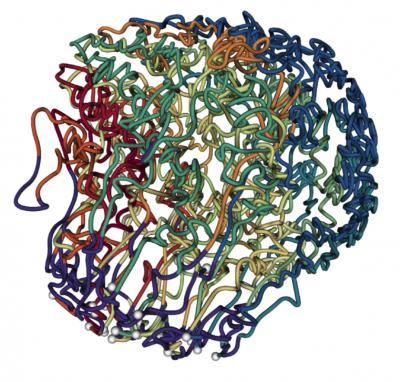
RIVERSIDE, Calif. — A research team led by a cell biologist at the University of California, Riverside has generated a 3D model of the human malaria parasite genome at three different stages in the parasite's life cycle — the first time such 3D architecture has been generated during the progression of the life cycle of a parasite.
The parasite that causes malaria in humans is Plasmodium falciparum. The female Anopheles mosquito transmits P. falciparum from an infected human to healthy individuals, spreading malaria in the process. According to the World Health Organization, an estimated 207 million people were infected with malaria in 2012, leading to 627,000 deaths.
"Understanding the spatial organization of chromosomes is essential to comprehend the regulation of gene expression in any eukaryotic cell," said Karine Le Roch, an associate professor of cell biology and neuroscience, who led the study.
Her research team also found that those genes that need to be highly expressed in the malaria parasite — for example, genes involved in translation — tend to cluster in the same area of the cell nucleus, while genes that need to be tightly repressed — for example, genes involved in virulence — are found elsewhere in the 3D structure in a "repression center." The 3D structure for the malaria parasite genome revealed one major repression center.
Virulence genes in the malaria parasite are a large family of genes that are responsible for the parasite's survival inside humans. Le Roch's team found that these genes, all organized into one repression center in a distinct area in the nucleus, seem to drive the full genome organization of the parasite.
Video here
Study results appeared online last week in Genome Research, an international, peer-reviewed journal that features outstanding original research providing novel insights into the genome biology of all organisms. The research paper will appear in print in the June issue of the journal.
"We successfully mapped all physical interactions between genetic elements in the parasite nucleus," Le Roch said. "To do so, we used a 'chromosome conformation capture method,' followed by high throughput sequencing technology — a recently developed methodology to analyze the organization of chromosomes in the natural state of the cell. We then used the maps of all physical interactions to generate a 3D model of the genome for each stage of the parasite life cycle analyzed."
To understand the biology of an organism or any cell type, scientists need to understand not only the information encoded in the genome sequence but also how the sequence is compacted and physically organized in each cell/tissue, and how changes in the 3D genome architecture can play a critical role in regulating gene expression, chromosome morphogenesis and genome stability. In human cells, changes in chromosome organization and compaction can lead to diseases such as cancer.
"If we understand how the malaria parasite genome is organized in the nucleus and which components control this organization, we may be able to disrupt this architecture and disrupt, too, the parasite development," Le Roch said. "We know that the genome architecture is critical in regulating gene expression and, more important, in regulating genes that are critical for parasite virulence. Now we can more carefully search for components or drugs that can disrupt this organization, helping in the identification of new anti-malaria strategies."
Le Roch's lab is now looking at other stages of the malaria life cycle in order to identify components responsible for the 3D genome architecture.
"The importance of the genome architecture was initially thought to be critical for only higher eukaryotes," she explained. "But we found, to our surprise, that the genome architecture is closely linked to virulence even in the case of the malaria parasite."
INFORMATION: Le Roch was joined in the study by Evelien M. Bunnik (co-first author of the research paper), Sebastian M. Bol, Jacques Prudhomme at UC Riverside; Ferhat Ay (co-first author of the research paper) and William Stafford Noble at the University of Washington; Nelle Varoquaux (co-first author of the research paper) and Jean-Phillippe Vert at Mines ParisTech, France.
The study was supported by grants to Le Roch and Noble from the National Institutes of Health, and other grants to Ay, Bunnik and Vert.
The University of California, Riverside is a doctoral research university, a living laboratory for groundbreaking exploration of issues critical to Inland Southern California, the state and communities around the world. Reflecting California's diverse culture, UCR's enrollment has exceeded 21,000 students. The campus opened a medical school in 2013 and has reached the heart of the Coachella Valley by way of the UCR Palm Desert Center. The campus has an annual statewide economic impact of more than $1 billion. A broadcast studio with fiber cable to the AT&T Hollywood hub is available for live or taped interviews. UCR also has ISDN for radio interviews. To learn more, call (951) UCR-NEWS.
The parasite that causes malaria in humans is Plasmodium falciparum. The female Anopheles mosquito transmits P. falciparum from an infected human to healthy individuals, spreading malaria in the process. According to the World Health Organization, an estimated 207 million people were infected with malaria in 2012, leading to 627,000 deaths.
"Understanding the spatial organization of chromosomes is essential to comprehend the regulation of gene expression in any eukaryotic cell," said Karine Le Roch, an associate professor of cell biology and neuroscience, who led the study.
Her research team also found that those genes that need to be highly expressed in the malaria parasite — for example, genes involved in translation — tend to cluster in the same area of the cell nucleus, while genes that need to be tightly repressed — for example, genes involved in virulence — are found elsewhere in the 3D structure in a "repression center." The 3D structure for the malaria parasite genome revealed one major repression center.
Virulence genes in the malaria parasite are a large family of genes that are responsible for the parasite's survival inside humans. Le Roch's team found that these genes, all organized into one repression center in a distinct area in the nucleus, seem to drive the full genome organization of the parasite.
Video here
Study results appeared online last week in Genome Research, an international, peer-reviewed journal that features outstanding original research providing novel insights into the genome biology of all organisms. The research paper will appear in print in the June issue of the journal.
"We successfully mapped all physical interactions between genetic elements in the parasite nucleus," Le Roch said. "To do so, we used a 'chromosome conformation capture method,' followed by high throughput sequencing technology — a recently developed methodology to analyze the organization of chromosomes in the natural state of the cell. We then used the maps of all physical interactions to generate a 3D model of the genome for each stage of the parasite life cycle analyzed."
To understand the biology of an organism or any cell type, scientists need to understand not only the information encoded in the genome sequence but also how the sequence is compacted and physically organized in each cell/tissue, and how changes in the 3D genome architecture can play a critical role in regulating gene expression, chromosome morphogenesis and genome stability. In human cells, changes in chromosome organization and compaction can lead to diseases such as cancer.
"If we understand how the malaria parasite genome is organized in the nucleus and which components control this organization, we may be able to disrupt this architecture and disrupt, too, the parasite development," Le Roch said. "We know that the genome architecture is critical in regulating gene expression and, more important, in regulating genes that are critical for parasite virulence. Now we can more carefully search for components or drugs that can disrupt this organization, helping in the identification of new anti-malaria strategies."
Le Roch's lab is now looking at other stages of the malaria life cycle in order to identify components responsible for the 3D genome architecture.
"The importance of the genome architecture was initially thought to be critical for only higher eukaryotes," she explained. "But we found, to our surprise, that the genome architecture is closely linked to virulence even in the case of the malaria parasite."
INFORMATION: Le Roch was joined in the study by Evelien M. Bunnik (co-first author of the research paper), Sebastian M. Bol, Jacques Prudhomme at UC Riverside; Ferhat Ay (co-first author of the research paper) and William Stafford Noble at the University of Washington; Nelle Varoquaux (co-first author of the research paper) and Jean-Phillippe Vert at Mines ParisTech, France.
The study was supported by grants to Le Roch and Noble from the National Institutes of Health, and other grants to Ay, Bunnik and Vert.
The University of California, Riverside is a doctoral research university, a living laboratory for groundbreaking exploration of issues critical to Inland Southern California, the state and communities around the world. Reflecting California's diverse culture, UCR's enrollment has exceeded 21,000 students. The campus opened a medical school in 2013 and has reached the heart of the Coachella Valley by way of the UCR Palm Desert Center. The campus has an annual statewide economic impact of more than $1 billion. A broadcast studio with fiber cable to the AT&T Hollywood hub is available for live or taped interviews. UCR also has ISDN for radio interviews. To learn more, call (951) UCR-NEWS.