PRESS-NEWS.org - Press Release Distribution
PRESS RELEASES DISTRIBUTION

New ultrasound device may add in detecting risk for heart attack, stroke

New ultrasound device may add in detecting risk for heart attack, stroke
2014-04-24
(Press-News.org) Researchers from North Carolina State University and the University of North Carolina at Chapel Hill have developed a new ultrasound device that could help identify arterial plaque that is at high risk of breaking off and causing heart attack or stroke.

At issue is the plaque that builds up in arteries as we age. Some types of plaque are deemed "vulnerable," meaning that they are more likely to detach from the artery wall and cause heart attack or stroke.

"Existing state-of-the-art technologies are capable of determining if plaque is present in the arteries, but can't tell whether it's vulnerable. And that makes it difficult to assess a patient's risk," says Dr. Paul Dayton, co-author of a paper on the new device and professor in the joint biomedical engineering department at NC State and Chapel Hill. "Our goal was to develop something that could effectively identify which plaques are vulnerable."

There are two ultrasound techniques that can help identify vulnerable plaques, but both depend on the use of contrast agents called "microbubbles."

The first technique is to identify "vasa vasorum" in arteries. These are clusters of small blood vessels that often infiltrate arterial plaque, and which are considered indicators that a plaque is vulnerable. When microbubbles are injected into an artery, they follow the flow of the blood. If vasa vasorum are present, the microbubbles will flow through these blood vessels as well, effectively highlighting them on ultrasound images.

The second technique is called molecular imaging, and relies on the use of "targeted" microbubbles. These microbubbles attach themselves to specific molecules that are more likely to be found in vulnerable plaques, making the plaques stand out on ultrasound images.

"The problem is that existing intravascular ultrasound technology does not do a very good job in detecting contrast agents," says Dr. Xiaoning Jiang, an NC State associate professor of mechanical and aerospace engineering, an adjunct professor of biomedical engineering and co-author of the paper.

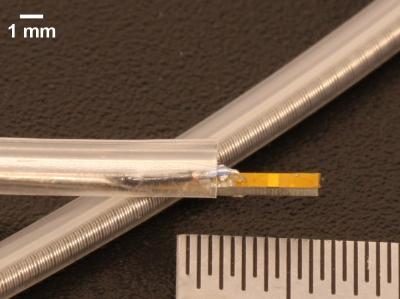
"So we've developed a dual-frequency intravascular ultrasound transducer which transmits and receives acoustic signals," Jiang says. "Operating on two frequencies allows us to do everything the existing intravascular ultrasound devices can do, but also makes it much easier for us to detect the contrast agents – or microbubbles – used for molecular imaging and vasa vasorum detection."

The prototype device has performed well in laboratory testing, but the researchers say they are continuing to optimize the technology. They hope to launch pre-clinical studies in the near future.

INFORMATION: The paper, "A preliminary engineering design of intravascular dual-frequency transducers for contrast enhanced acoustic angiography and molecular imaging," is published in the May issue of IEEE Transactions on Ultrasonics, Ferroelectrics, and Frequency Control. Lead author of the paper is Jianguo Ma, a mechanical engineering Ph.D. student at NC State. The paper was co-authored by Heath Martin, a Ph.D. student in the joint biomedical engineering program.

The research was supported by the National Institutes of Health, under grant 1R01EB015508.

[Attachments] See images for this press release:
New ultrasound device may add in detecting risk for heart attack, stroke

ELSE PRESS RELEASES FROM THIS DATE:

New study links inflammation in those with PTSD to changes in microRNA

2014-04-24
With a new generation of military veterans returning home from Iraq and Afghanistan, post-traumatic stress disorder (PTSD) has become a prominent concern in American medical institutions and the culture at-large. Estimates indicate that as many as 35 percent of personnel deployed to Iraq and Afghanistan suffer from PTSD. New research from the University of South Carolina School of Medicine is shedding light on how PTSD is linked to other diseases in fundamental and surprising ways. The rise in PTSD has implications beyond the impact of the psychiatric disorder and its ...

Your T-shirt's ringing: Telecommunications in the spaser age

Your T-shirts ringing: Telecommunications in the spaser age
2014-04-24
A new version of "spaser" technology being investigated could mean that mobile phones become so small, efficient, and flexible they could be printed on clothing. A team of researchers from Monash University's Department of Electrical and Computer Systems Engineering (ECSE) has modelled the world's first spaser (surface plasmon amplification by stimulated emission of radiation) to be made completely of carbon. A spaser is effectively a nanoscale laser or nanolaser. It emits a beam of light through the vibration of free electrons, rather than the space-consuming electromagnetic ...

Protecting olive oil from counterfeiters

2014-04-24
Just a few grams of the new substance are enough to tag the entire olive oil production of Italy. If counterfeiting were suspected, the particles added at the place of origin could be extracted from the oil and analysed, enabling a definitive identification of the producer. "The method is equivalent to a label that cannot be removed," says Robert Grass, lecturer in the Department of Chemistry and Applied Biosciences at ETH Zurich. The worldwide need for anti-counterfeiting labels for food is substantial. In a joint operation in December 2013 and January 2014, Interpol ...

Breast cancer replicates brain development process

2014-04-24
New research led by a scientist at the University of York reveals that a process that forms a key element in the development of the nervous system may also play a pivotal role in the spread of breast cancer. A research team, led by Dr Will Brackenbury, a Medical Research Council Fellow in the Department of Biology at York, has studied how voltage-gated sodium channels assist in the metastasis of cancerous tumours. These channels are found in the membranes of excitable cells, such as neurons, where they are involved in transmission of electrical impulses. However, the ...

Two new US turtle species described

Two new US turtle species described
2014-04-24
The alligator snapping turtle is the largest river turtle in North America, weighing in at up to 200 pounds and living almost a century. Now researchers from Florida and the University of Vermont have discovered that it is not one species — but three. Examining museum specimens and wild turtles, the scientists uncovered deep evolutionary divisions in this ancient reptile. Once heavily hunted for turtle meat — alligator snapper was the main ingredient of Campbell's Turtle Soup in the 1960s — the riverine populations have been deeply depleted and are of conservation concern. ...

Bake your own droplet lens

Bake your own droplet lens
2014-04-24
WASHINGTON, April 24—A droplet of clear liquid can bend light, acting as a lens. Now, by exploiting this well-known phenomenon, researchers have developed a new process to create inexpensive high quality lenses that will cost less than a penny apiece. Because they're so inexpensive, the lenses can be used in a variety of applications, including tools to detect diseases in the field, scientific research in the lab and optical lenses and microscopes for education in classrooms. "What I'm really excited about is that it opens up lens fabrication technology," says Steve ...

How a plant beckons the bacteria that will do it harm

How a plant beckons the bacteria that will do it harm
2014-04-24
RICHLAND, Wash. – A common plant puts out a welcome mat to bacteria seeking to invade, and scientists have discovered the mat's molecular mix. The study published this week in the Proceedings of the National Academy of Sciences reveals new targets during the battle between microbe and host that researchers can exploit to protect plants. The team showed that the humble and oft-studied plant Arabidopsis puts out a molecular signal that invites an attack from a pathogen. It's as if a hostile army were unknowingly passing by a castle, and the sentry stood up and yelled, ...

When things get glassy, molecules go fractal

When things get glassy, molecules go fractal
2014-04-24
DURHAM, N.C. -- Colorful church windows, beads on a necklace and many of our favorite plastics share something in common -- they all belong to a state of matter known as glasses. School children learn the difference between liquids and gases, but centuries of scholarship have failed to produce consensus about how to categorize glass. Now, combining theory and numerical simulations, researchers have resolved an enduring question in the theory of glasses by showing that their energy landscapes are far rougher than previously believed. The findings appear April 24 in the ...

Beauty Beast Virgin Hair Announces Opening of its Boutique Virgin Hair Showroom

2014-04-24
Beauty Beast Virgin Hair announces that its boutique is now open for business. Beauty Beast Virgin Hair is open Tuesday through Friday from 10am-6pm and Saturdays from 9am-5pm inside Le Prive Salon Studios located at 2800 Spring Rd S.E. Suite J-305, Atlanta, GA 30339. Mondays are open by appointment. The location brings a unique solution and customized service for stylists, salons and consumers by providing high end 100% Brazilian, Indian, Malaysian, and Peruvian virgin hair extensions. In store, Beauty Beast Virgin Hair carries full stock of lengths 12inches-30inches of ...

Bacon Crazed AlphaDogs Spotted at Blue Ribbon Bacon Festival

2014-04-24
Just mentioning the word bacon leaves most people's mouth watering and conjures up endless images of how to best enjoy this highly versatile and tasty snack. In the feature-length reality-style mockumentary State Of Bacon, filmmaker Jason Cook takes audiences inside the fun and wacky Blue Ribbon Bacon Festival that brings out some of the most bacon-crazed Americans you will ever meet. Held annually in Des Moines, IA the festival has doubled in size every year with tickets selling out in just minutes. Having worked with AlphaDogs colorist, Sean Stack on previous projects, ...

LAST 30 PRESS RELEASES:

AI machine learning can optimize patient risk assessments

Efficacy of immunosuppressive regimens for survival of stem cell-derived grafts

Glowing bacterial sensors detect gut illness in mice before symptoms emerge

GLP-1 RAs and prior major adverse limb events in patients with diabetes

Life-course psychosocial stress and risk of dementia and stroke in middle-aged and older adults

Cells have a built-in capacity limit for copying DNA, and it could impact cancer treatment

Study finds longer hospital stays and higher readmissions for young adults with complex childhood conditions

Study maps how varied genetic forms of autism lead to common features

New chip-sized, energy-efficient optical amplifier can intensify light 100 times

New light-based platform sets the stage for future quantum supercomputers

Pesticides significantly affect soil life and biodiversity

Corals sleep like us, but their symbiosis does not rest

Huayuan biota decodes Earth’s first Phanerozoic mass extinction

Beyond Polymers: New state-of-the-art 3D micro and nanofabrication technique overcomes material limitations

New platform could develop vaccines faster than ever before

TF-rs1049296 C>T variant modifies the association between hepatic iron stores and liver fibrosis in metabolic dysfunction-associated steatotic liver disease

ASH publishes clinical practice guidelines on diagnosis of light chain amyloidosis

SLAS receives grant from Alfred P. Sloan Foundation to develop lab automation educational guidelines

Serum interleukin-8 for differentiating invasive pulmonary aspergillosis from bacterial pneumonia in patients with HBV-associated acute-on-chronic liver failure

CIIS and the Kinsey Institute present "Desire on the Couch," an exhibition examining psychology and sexuality

MRI scan breakthrough could spare thousands of heart patients from risky invasive tests

Kraft Center at Mass General Brigham launches 2nd Annual Kraft Prize for Excellence and Innovation in Community Health

New tool shows how to enter and change pneumocystis fungi

Applications of artificial intelligence and smart devices in metabolic dysfunction-associated steatotic liver disease

New clinical trial demonstrates that eating beef each day does not affect risk factors for type 2 diabetes

Powering AI from space, at scale

New Watson College seed grants encourage interdisciplinary research

A new immune evasion pathway in cancer reveals statins as immunotherapy boosters

Understanding how smart polymer solutions transition to gels around body temperature

Thermal transport modulation in YbN-alloyed ALN thin films to the glassy limit

[Press-News.org] New ultrasound device may add in detecting risk for heart attack, stroke