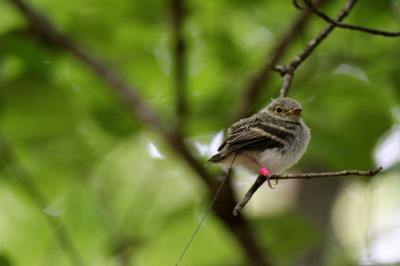
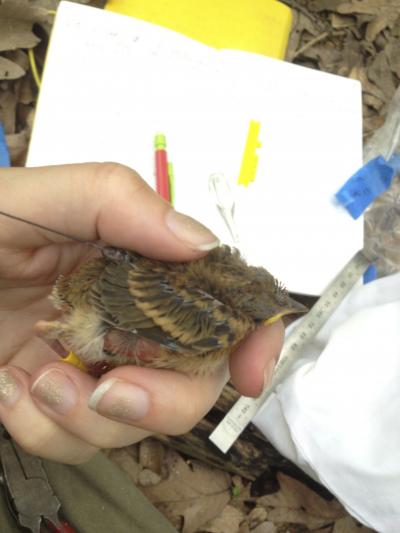
(Press-News.org) Nearly one-third of songbird species across North America are experiencing long-term declines. Scientists have spent years researching potential causes for these population declines, focusing on the birds when they have just hatched as well as when they are adults. Now, researchers from the University of Missouri and the U.S. Department of Agriculture have found that songbirds are vulnerable to environmental dangers particularly when they are juveniles, shortly after they have left their parents' nests. Frank Thompson, a scientist with the USDA Forest Service and an associate cooperative professor in the MU College of Agriculture, Food and Natural Resources (CAFNR), worked with several colleagues to find that the majority of juvenile bird deaths occur in the first three weeks after they leave the nest.
"Just like teenagers leaving home to live on their own for the first time, these juvenile birds are inexperienced and vulnerable to the outside world," said Thompson. "It is important for these young birds to find acceptable habitats and shelter for them to survive on their own. Therefore, it is important for conservationists to find ways to provide the right habitats for these birds to survive during what is an important, yet vulnerable, time in their development."
Thompson says juvenile birds often seek different types of habitats compared to their parents. He says that juvenile songbirds often prefer denser foliage such as shrub land and young forest, compared to more open, older forests where their parents may have nested.
"It is important for conservation groups and land managers to know exactly what types of habitats need to be provided in order to protect these birds," Thompson said. "Providing habitats needed by breeding adult birds won't make much of a difference if those birds don't survive long enough to reach adulthood because they don't have adequate shelter when they are young. This approach is part of a growing focus on full-cycle conservation for migrant song birds"
Thompson says many studies have looked into mortality rates for fully grown birds as well as chicks that have just hatched, but not enough work has been done on juvenile birds that have just left the nest and are becoming independent. He recommends further study on this important life stage for songbirds in order to better understand specific causes for high mortality rates.
INFORMATION:
Thompson's study was co-authored by W. Andrew Cox, a former post-doctoral fellow in the MU Department of Fisheries and Wildlife Sciences in CAFNR, Allison Cox, and John Faaborg, a professor of biological sciences at MU.
The study was published in the Journal of Wildlife Management.
'Teenage' songbirds experience high mortality due to many causes, MU study finds
It is important to preserve smaller foliage with nests for young birds, MU expert says
2014-05-08
ELSE PRESS RELEASES FROM THIS DATE:
Hepatitis C virus: How viral proteins interact in human cells
2014-05-08
Viruses use human cells in order to multiply and spread. This process involves interactions with cellular host factors as well as virus-virus interactions. For example interactions among viral proteins are essential for the assembly of newly produced infectious virions.
Interaction network explains viral mechanisms and opens up possibilities for new treatments
Hepatitis C virus (HCV) forms a precursor protein, which is processed into ten viral proteins. Scientists at the Institute of Virology at the Helmholtz Zentrum have now discovered how these proteins interact with ...
Promising role for interleukin-10 in scarless wound healing
2014-05-08
New Rochelle, NY, May 8, 2014—The powerful anti-inflammatory compound interleukin-10 (IL-10) plays a crucial role in regenerative, scarless healing of fetal skin. Studies of IL-10 in postnatal skin wounds have demonstrated its promise as an anti-scarring therapeutic agent, as described in a Critical Review article published in Advances in Wound Care, a monthly peer-reviewed journal from Mary Ann Liebert, Inc., publishers and an Official Journal of the Wound Healing Society. The article is available free on the Advances in Wound Care website.
In "Regenerative Wound Healing: ...
Detecting trace amounts of explosives with light
2014-05-08
University of Adelaide research may help in the fight against terrorism with the creation of a sensor that can detect tiny quantities of explosives with the use of light and special glass fibres.
Published in the journal Sensors and Actuators B: Chemical, the researchers describe a novel optical fibre sensor which can detect explosives in concentrations as low as 6.3 ppm (parts per million). It requires an analysis time of only a few minutes.
"Traditionally explosives detection has involved looking for metals that encase them such as in land mines," says project leader ...
'Parent' cells reset the cell division clock
2014-05-08
Melbourne researchers have overturned a 40-year-old theory on when and how cells divide, showing that 'parent' cells program a cell division time for their offspring that is different from their own.
Scientists from the Walter and Eliza Hall Institute have shown that both phases of the cell cycle contribute to the overall change in division time rather than one staying fixed in duration as previously thought. They have developed these findings into a new model that helps scientists predict how a population of cells has divided.
Their research could impact our understanding ...
Low-carbohydrate diet reduced inflammation
2014-05-08
A low-carbohydrate diet, but not a low-fat diet, reduces inflammation in patients with type 2 diabetes, according to research at Linköping University in Sweden.
It is known that patients with type 2 diabetes have higher levels of inflammation than those who do not have the disease, and it is believed that this may contribute to a higher risk of cardiovascular disease and other complications. In a clinical trial at Linköping University a low-carbohydrate diet was compared with a traditional low-fat diet in 61 patients with type 2 diabetes. Only patients in the low-carbohydrate ...
Public perceive alcohol adverts breach regulatory code, research finds
2014-05-08
A majority of the UK general public perceive alcohol adverts to breach the Advertising Standards Authority's Broadcast Committee of Advertising Practice (BCAP) Code suggesting that the current regulatory system for UK television is inadequate, research from The University of Manchester shows.
Researchers surveyed 373 adults, aged 18-74 years, showing them one of seven adverts that had been broadcast in the previous month on leading commercial television channels.
Overall 75 per cent of the participants rated the adverts as breaching at least one rule from the BCAP Code ...
Beetles that taste like mustard
2014-05-08
Almost all herbivorous insects are specialized to feed on specific host plants and have adapted to their chemical defenses. Flea beetles are important pests of cabbage and other cruciferous plants, such as mustard, horseradish and rapeseed. These plants use a sophisticated defense system, known as the mustard oil bomb, to get rid of their enemies : If plant tissues are wounded, glucosinolates and an enzyme known as myrosinase come into contact, and, as a result, toxic metabolites are formed which deter most insects. This defensive mechanism, however, has no negative effect ...
Pesticides: Research provides new insights into their effects on shrimps and snails
2014-05-08
Ground breaking research by an international team of scientists has resulted in greater understanding of the effects of pesticides on aquatic invertebrates such as shrimps and snails.
Research published in the journal Environmental Science & Technology by a team of scientists from the UK, Switzerland and Finland provides an important new approach for systematically measuring and modelling the sensitivity of aquatic invertebrates to various pesticides.
Aquatic invertebrate species are abundant in European freshwaters and play an important role in the decomposition of organic ...
Luminescent nanocrystal tags enable rapid detection of multiple pathogens in a single test
2014-05-08
WEST LAFAYETTE, Ind. — A research team using tunable luminescent nanocrystals as tags to advance medical and security imaging have successfully applied them to high-speed scanning technology and detected multiple viruses within minutes.
The research, led by Macquarie University in Sydney, Australia and Purdue University, builds on the team's earlier success in developing a way to control the length of time light from a luminescent nanocrystal lingers, which introduced the dimension of time in addition to color and brightness in optical detection technology.
Detection ...
Cedars-Sinai study: Common drug restores blood flow in deadly form of muscular dystrophy
2014-05-08
LOS ANGELES (May 7, 2014) – Cedars-Sinai Heart Institute researchers have found that a commonly prescribed drug restores blood flow to oxygen-starved muscles of boys with Duchenne muscular dystrophy, a genetic muscle-wasting disease that rarely is seen in girls but affects one in 3,500 male babies, profoundly shortening life expectancy. It is the most common fatal disease that affects children.
Muscle weakness begins in early childhood, often causing deformity of the arms, legs and spine. Heart and respiratory muscles often begin to fail before children reach early teen ...
LAST 30 PRESS RELEASES:
University of Ottawa Heart Institute, the University of Ottawa and McGill University launch ARCHIMEDES to advance health research in Canada
The world’s largest brain research prize awarded for groundbreaking discoveries on how we sense touch and pain
Magnetofluids help to overcome challenges in left atrial appendage occlusion
Brain-clearing cells offer clues to slowing Alzheimer’s disease progression
mRNA therapy restores fertility in genetically infertile mice
Cloaked stem cells evade immune rejection in mice, pointing to a potential universal donor cell line
Growth in telemedicine has not improved mental health care access in rural areas, study finds
Pitt scientists engineer “living eye drop” to support corneal healing
Outcomes of older adults with advanced cancer who prefer quality of life vs prolonging survival
Lower music volume levels in fitness class and perceived exercise intensity
Of crocodiles, counting and conferences
AERA announces 2026 award winners in education research
Saving two lives with one fruit drop
Photonic chips advance real-time learning in spiking neural systems
Share of migratory wild animal species with declining populations despite UN treaty protections worsens from 44% to 49% in two years; 24% face extinction, up 2%
One in 20 babies experiences physical abuse, global review finds
Tundra tongue: The science behind a very cold mistake
Targeting a dangerous gut infection
Scientists successfully harvest chickpeas from “moon dirt”
Teen aggression a warning sign for faster aging later in life
Study confirms food fortification is highly cost-effective in fighting hidden hunger across 63 countries
Special issue elevates disease ecology in marine management
A kaleidoscope of cosmic collisions: the new catalogue of gravitational signals from LIGO, Virgo and KAGRA
New catalog more than doubles the number of gravitational-wave detections made by LIGO, Virgo, and KAGRA observatories
Antifibrotic drug shows promise for premature ovarian insufficiency
Altered copper metabolism is a crucial factor in inflammatory bone diseases
Real-time imaging of microplastics in the body improves understanding of health risks
Reconstructing the world’s ant diversity in 3D
UMD entomologist helps bring the world’s ant diversity to life in 3D imagery
ESA’s Mars orbiters watch solar superstorm hit the Red Planet
[Press-News.org] 'Teenage' songbirds experience high mortality due to many causes, MU study findsIt is important to preserve smaller foliage with nests for young birds, MU expert says