The breathing sand
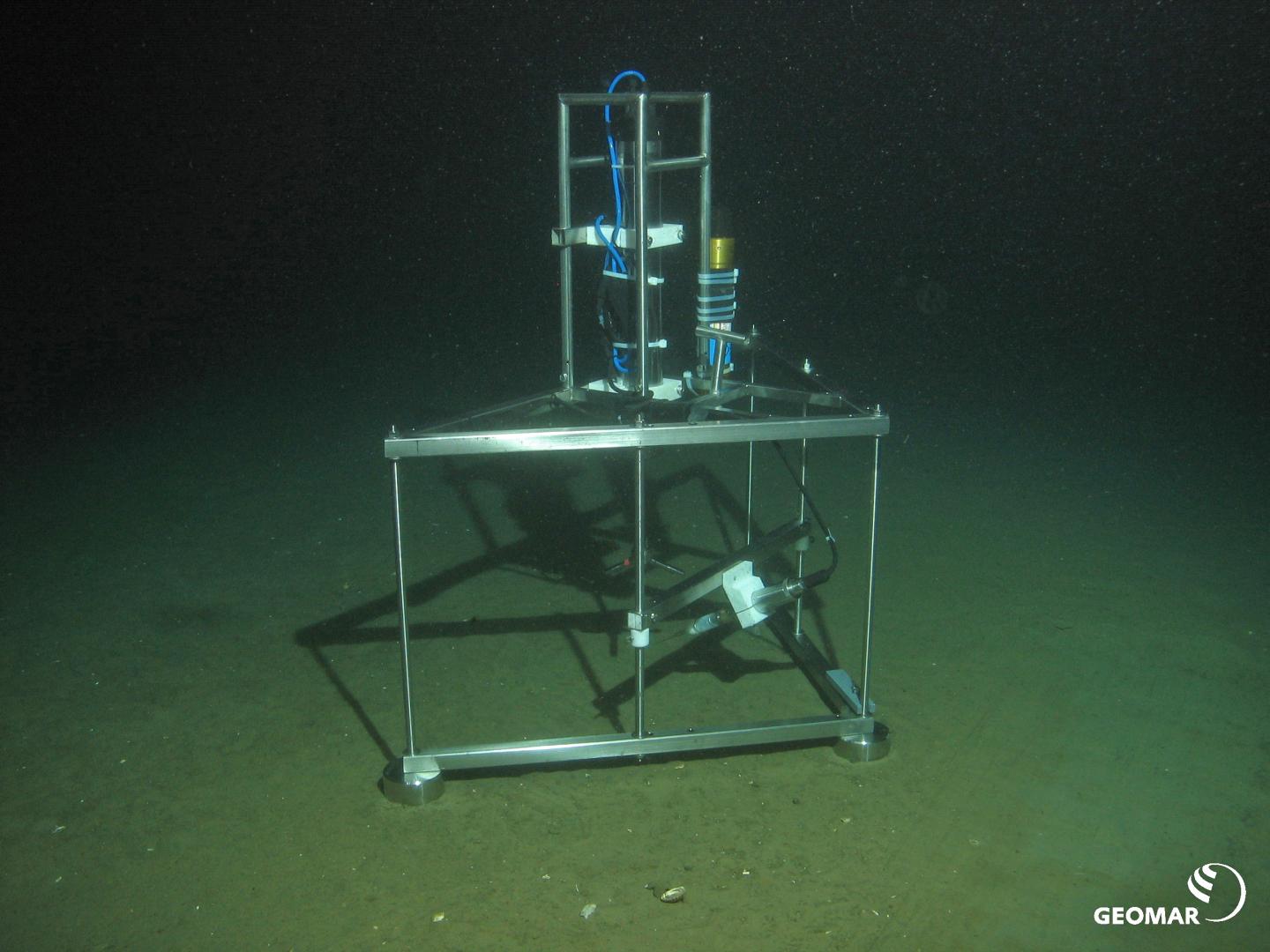
"The so-called 'Eddy Correlation' technique detects the flow of oxygen through these small turbulences over an area of several square meters. It considers both the mixing of sediments by organisms living in it and the hydrodynamics of the water above the rough sea floor", Dr. Peter Linke, a marine biologist at GEOMAR, explains. "Previous methods overlooked only short periods or disregarded important parameters. Now we can create a more realistic picture." The new method also takes into account the fact that even small objects such as shells or ripples shaped by wave action or currents are able to impact the oxygen exchange in permeable sediments.
On the expedition CE0913 with the Irish research vessel CELTIC EXPLORER, scientists used the underwater robot ROV KIEL 6000 to place three different instruments within the "Tommeliten" area belonging to Norway: Two "Eddy Correlation Landers" recorded the strength of oxygen fluxes over three tidal cycles. Information about the distribution of oxygen in the sediment was collected with a "Profiler Lander", a seafloor observatory with oxygen sensors and flow meters. A "Benthic chamber" isolated 314 square centimetres of sediment and took samples from the overlying water over a period of 24 hours to determine the oxygen consumption of the sediment.
"The combination of traditional tools with the 'Eddy Correlation' technique has given us new insights into the dynamics of the exchange of substances between the sea water and the underlying sediment. A variety of factors determine the timing and amount of oxygen available. Currents that provide the sandy sediment with oxygen, but also the small-scale morphology of the seafloor, ensure that small benthic organisms are able to process carbon or other nutrients. The dependencies are so complex that they can be decrypted only by using special methods", Dr. Linke summarizes. Therefore, detailed measurements in the water column and at the boundary to the seafloor as well as model calculations are absolutely necessary to understand basic functions and better estimate future changes in the cycle of materials. "With conventional methods, for example, we would never have been able to find that the loose sandy sediment stores oxygen brought in by the currents for periods of less water movement and less oxygen introduction."
INFORMATION:
Original publication:
McGinnis, D. F., S. Sommer, A. Lorke, R. N. Glud, P. Linke (2014): Quantifying tidally driven benthic oxygen exchange across permeable sediments: An aquatic eddy correlation study. Journal of Geophysical Research: Oceans, doi:10.1002/2014JC010303.
Links:
GEOMAR Helmholtz Centre for Ocean Research Kiel
Eddy correlation information page
Leibniz Institute of Freshwater Ecology and Inland Fisheries, IGB
University of Southern Denmark
University of Koblenz-Landau
Scottish Marine Institute
Aarhus University
Images:
High resolution images can be downloaded at http://www.geomar.de/n2110-e.
Video footage is available on request.
Contact:
Dr. Peter Linke (GEOMAR FB2-MG), Tel. 0431 600-2115, plinke@geomar.de
Maike Nicolai (GEOMAR, Kommunikation & Medien), Tel. 0431 600-2807, mnicolai@geomar.de