PRESS-NEWS.org - Press Release Distribution
PRESS RELEASES DISTRIBUTION

Boston Children's Hospital study reveals first 6 months best for stimulating heart growth

Boston Children's Hospital study reveals first 6 months best for stimulating heart growth
2015-04-28
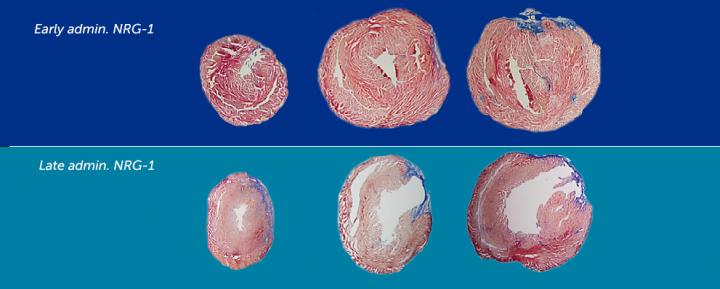
(Press-News.org) Boston, Mass (April 27, 2015) -- In a recent issue of Science Translational Medicine, Brian Polizzotti, PhD, Bernhard Kuhn, MD, Sangita Choudhury, PhD, and colleagues affiliated with the Boston Children's Hospital's Translational Research Center report that the optimal window of time to stimulate heart muscle cell regeneration (cardiomyocyte proliferation) in humans is the first six months of life. "Our results suggest that early administration of neuregulin may provide a targeted and multipronged approach to prevent heart failure in infants with CHD. Beginning treatment as early as possible could save these hearts from long-term damage and symptoms of heart failure later in childhood," says Polizzotti. The same group of Boston Children's Hospital researchers has proven that child hearts are more prone to cardiomyocyte proliferation than adult hearts are. They have also shown that the drug neruegulin stimulates cell cycling and improves overall heart function in adult mice with injured hearts. Neuregulin is currently under investigation as a drug treatment for heart failure in adults, but corresponding studies for pediatric applications had not been attempted before now. While heart attacks account for most instances of heart failure in adults, congenital heart disease (CHD) is the number one cause of heart failure in children. Based on their previous research, Polizzotti and Kuhn hypothesized that neuregulin would be just as effective against the unique forms of cardiac damage that cause heart failure in children. Polizzotti and his team compared three groups of mice subject to the same kinds of cardiac damage present in many types of CHD (namely, increased scarring and a decreased ejection fraction, which is a measure of how much blood is pumped through the heart per contraction). One group of mice received their first neuregulin injections at birth, another received their first injections five days after birth, and a control group received daily injections of a neutral protein serum. The mice given neuregulin from birth were found to have a sustained increase in heart function, as observed by both echocardiogram and MRI. The researchers also discovered that in the early administration group, stimulated proliferation of uninjured cardiomyocytes resulted in the formation of an additional 224,000 new heart cells. "We estimate that thirty-eight percent of the additional cardiomyocytes were present due to cardioprotection, while sixty-two percent were the result of regeneration," says Polizzotti. After the mouse trial, Polizzotti and colleagues tested their hypothesis on human heart cells. They focused specifically on one type of heart disease, Tetrology of Fallot (TOF), which typically requires surgery soon after birth. Heart muscle cells were collected at the time of surgery and then cultured for three days with either neuregulin or a harmless serum. The results mirrored those from the mouse study: neuregulin stimulated cardiomyocytes to regenerate in the diseased heart muscle of infants less than 6 months old. Polizzotti plans to take this research farther by testing neuregulin in hearts with other types of CHD. "It will be interesting to see if the results from animal studies translate to live pediatric patients with diseased heart muscle," says Polizzotti.

INFORMATION:

About Boston Children's Hospital Boston Children's Hospital is home to the world's largest research enterprise based at a pediatric medical center, where its discoveries have benefited both children and adults since1869. More than 1,100 scientists, including seven members of the National Academy of Sciences, 14 members of the Institute of Medicine and 14 members of the Howard Hughes Medical Institute comprise Boston Children's research community. Founded as a 20-bed hospital for children, Boston Children's today is a 395-bed comprehensive center for pediatric and adolescent health care. Boston Children's is also the primary pediatric teaching affiliate of Harvard Medical School.

For more information about research and clinical innovation at Boston Children's Hospital visit: http://vectorblog.org To learn more about pediatric health visit our Thriving blog: http://childrenshospitalblog.org Join the social discussion and tweet us @BostonChildrens
Follow Boston Children's Hospital on Facebook: http://on.bchil.org/1mJ9fxf
Follow Boston Children's Hospital on Youtube: http://on.bchil.org/1oJib5B

[Attachments] See images for this press release:
Boston Children's Hospital study reveals first 6 months best for stimulating heart growth

ELSE PRESS RELEASES FROM THIS DATE:

Genetic markers for fetal overgrowth syndrome discovered

2015-04-28
Humans and cattle share a similar epigenetic fetal overgrowth disorder that occurs more commonly following assisted reproduction procedures. In humans, this disorder is called Beckwith-Wiedemann syndrome (BWS), and in cattle it is called large offspring syndrome (LOS) and can result in the overgrowth of fetuses and enlarged babies. This naturally occurring, but rare syndrome can cause physical abnormalities in humans and cattle and often results in the deaths of newborn calves and birth-related injuries to their mothers. Now, researchers at the University of Missouri ...

Study shows diversity of habitat needed around spotted owl reserves

2015-04-28
CHESTER, Calif. - A study just published this week shows many bird species, including several of high conservation concern, aren't getting the habitat they need due to a focus on promoting California Spotted Owl habitat in the northern Sierra Nevada. The study, published in the science journal, PLoS ONE, tracked different bird species' use of areas inside and outside Spotted Owl reserves for two years in Plumas and Lassen National Forests. The results show 17 species avoided the reserves, including species of conservation concern like Yellow Warblers and Olive-sided ...

Emergency department treatment for opioid addiction better than referrals

2015-04-28
New Haven, Conn. -- Yale researchers conducted the first known randomized trial comparing three treatment strategies for opioid-dependent patients receiving emergency care. They found that patients given the medication buprenorphine were more likely to engage in addiction treatment and reduce their illicit opioid use. Dependence on prescription and illicit opioids is an epidemic that continues to grow in the United States and globally. Drug overdoses account for more deaths each day than car crashes. "This is a huge public health problem," said first author Dr. Gail D'Onofrio, ...

Windows that act like an LCD Screen

Windows that act like an LCD Screen
2015-04-28
WASHINGTON, DC, April 28, 2015 -- The secret desire of urban daydreamers staring out their office windows at the sad brick walls of the building opposite them may soon be answered thanks to transparent light shutters developed by a group of researchers at Pusan National University in South Korea. A novel liquid crystal technology allows displays to flip between transparent and opaque states -- hypothetically letting you switch your view in less than a millisecond from urban decay to the Chesapeake Bay. Their work appears this week in the journal AIP Advances, from AIP ...

New IVF device may improve fertility treatment

New IVF device may improve fertility treatment
2015-04-28
WASHINGTON, D.C., April 28, 2015--For couples struggling to conceive the old-fashioned way, in vitro fertilization (IVF) provides an alternate route to starting a family. When eggs are mixed with sperm in test tubes, the fertilized eggs to grow into embryos that can be implanted inside the uterus of a woman who will carry them to term. IVF often works miracles for infertile couples, a fact for which its inventor won a Nobel Prize a few years ago. However, the procedure can be time-consuming, costly, and emotionally draining, often requiring multiple implantation cycles ...

Tracking exploding lithium-ion batteries in real-time

2015-04-28
What happens when lithium-ion batteries overheat and explode has been tracked inside and out for the first time by a UCL-led team using sophisticated 3D imaging. Understanding how Li-ion batteries fail and potentially cause a dangerous chain reaction of events is important for improving their design to make them safer to use and transport, say the scientists behind the study. Hundreds of millions of these rechargeable batteries are manufactured and transported each year as they are integral to modern living, powering mobile phones, laptops, cars and planes. Although ...

Scientists discover salty aquifer, previously unknown microbial habitat under Antarctica

Scientists discover salty aquifer, previously unknown microbial habitat under Antarctica
2015-04-28
HANOVER, N.H. - Using an airborne imaging system for the first time in Antarctica, scientists have discovered a vast network of unfrozen salty groundwater that may support previously unknown microbial life deep under the coldest, driest desert on our planet. The findings shed new light on ancient climate change on Earth and provide strong evidence that a similar briny aquifer could support microscopic life on Mars. The study appears in the journal Nature Communications. It is available through open access. A PDF of the study, photos and video also are available on request. ...

Two-week international diet swap shows potential effects of food on colon cancer risk

2015-04-28
PITTSBURGH, April 28, 2015 - African-Americans and Africans who swapped their typical diets for just two weeks similarly exchanged their respective risks of colon cancer as reflected by alterations of their gut bacteria, according to an international study led by researchers at the University of Pittsburgh School of Medicine published online today in Nature Communications. Principal investigator Stephen O'Keefe, M.D., professor of medicine, Division of Gastroenterology, Hepatology and Nutrition, Pitt School of Medicine, observed while practicing in South Africa that his ...

UT research uncovers lakes, signs of life under Antarctica's dry valleys

UT research uncovers lakes, signs of life under Antarcticas dry valleys
2015-04-28
KNOXVILLE--Many view Antarctica as a frozen wasteland. Turns out there are hidden interconnected lakes underneath its dry valleys that could sustain life and shed light on ancient climate change. Jill Mikucki, a University of Tennessee, Knoxville, microbiology assistant professor, was part of a team that detected extensive salty groundwater networks in Antarctica using a novel airborne electromagnetic mapping sensor system called SkyTEM. The research, funded by the National Science Foundation, provides compelling evidence that the underground lakes and brine-saturated ...

Studies in cell transplantation show beneficial effects for variety of serious conditions

2015-04-28
Putnam Valley, NY. (April 28, 2015) - Five studies from the current special issue of Cell Transplantation 24(4) devoted to work presented at the 21st meeting of the American Society for Neural Therapy and Repair (ASNTR) in 2014, a society for scientists focused on understanding the causes of, and developing cell and gene therapy and biopharmaceuticals for neurological injury and disease, are currently freely available on-line at: http://www.ingentaconnect.com/content/cog/ct/2015/00000024/00000004. MSCs promote improvement in patient with complete spinal cord injury Complete ...

LAST 30 PRESS RELEASES:

Study finds banning energy disconnections shouldn’t destabilise markets

Researchers identify novel RNA linked to cancer patient survival

Poverty intervention program in Bangladesh may reinforce gender gaps, study shows

Novel approach to a key biofuel production step captures an elusive energy source

‘Ghost’ providers hinder access to health care for Medicaid patients

Study suggests far fewer cervical cancer screenings are needed for HPV‑vaccinated women

NUS CDE researchers develop new AI approach that keeps long-term climate simulations stable and accurate

UM School of Medicine launches clinical trial of investigative nasal spray medicine to prevent illnesses from respiratory viruses

Research spotlight: Use of glucose-lowering SGLT2i drugs may help patients with gout and diabetes take fewer medications

Genetic system makes worker cells more resilient producers of nanostructures for advanced sensing, therapeutics

New AI model can assist with early warning for coral bleaching risk

Highly selective asymmetric 1,6-addition of aliphatic Grignard reagents to α,β,γ,δ-unsaturated carbonyl compounds

Black and Latino teens show strong digital literacy

Aging brains pile up damaged proteins

Optimizing robotic joints

Banning lead in gas worked. The proof is in our hair

Air pollution causes social instability in ant colonies

Why we sleep poorly in new environments: A brain circuit that keeps animals awake 

Some tropical land may experience stronger-than-expected warming under climate change

Detecting early-stage cancers with a new blood test measuring epigenetic instability

Night owl or early bird? Study finds sleep categories aren’t that simple

Psychological therapies for children who speak English as an additional language can become “lost in translation”, study warns

20 Years of Prizes: Vilcek Foundation Honors 14 New Immigrants and Visionaries

How light pollution disrupts orientation in moths

Eduardo Miranda awarded 2026 Bruce Bolt Medal

Renowned cell therapy expert establishes new laboratory at Weill Cornell Medicine

The Spanish Biophysical Society highlights a study by the EHU’s spectroscopy group

Exploring how age influences social preferences

How experiences in the womb affect alcohol drinking in adulthood

Surgical innovation cuts ovarian cancer risk by nearly 80%

[Press-News.org] Boston Children's Hospital study reveals first 6 months best for stimulating heart growth