PRESS-NEWS.org - Press Release Distribution
PRESS RELEASES DISTRIBUTION

Low-fat diet results in more fat loss than low-carb diet in humans
Low-fat diet results in more fat loss than low-carb diet in humans
2015-08-13
(Press-News.org) A study from the US National Institutes of Health presents some of the most precise human data yet on whether cutting carbs or fat has the most benefits for losing body fat. In a paper published August 13 in Cell Metabolism, the researchers show how, contrary to popular claims, restricting dietary fat can lead to greater body fat loss than carb restriction, even though a low-carb diet reduces insulin and increases fat burning.

Since 2003, Kevin Hall, PhD--a physicist turned metabolism researcher at the National Institute of Diabetes and Digestive and Kidney Diseases--has been using data from dozens of controlled feeding studies conducted over decades of nutrition research to build mathematical models of how different nutrients affect human metabolism and body weight.

He noticed that despite claims about carbohydrate versus fat restriction for weight loss, nobody had ever measured what would happen if carbs were selectively cut from the diet while fat remained at a baseline or vice versa. His model simulations showed that only the carb-restricted diet would lead to changes in the amount of fat burned by the body, whereas the reduced-fat diet would lead to greater overall body fat loss, but he needed the human data to back it up.

"A lot of people have very strong opinions about what matters for weight loss, and the physiological data upon which those beliefs are based are sometimes lacking," Hall says. "I wanted to rigorously test the theory that carbohydrate restriction is particularly effective for losing body fat since this idea has been influencing many people's decisions about their diets."

Studying the effects of diet on weight loss is often confounded by the difficulty in measuring what people actually eat--participants may not adhere to meal plans, misjudge amounts, or are not truthful in follow-up surveys. To counter this, Hall and colleagues confined 19 consenting adults with obesity to a metabolic ward for a pair of 2-week periods, over the course of which every morsel of food eaten was closely monitored and controlled.

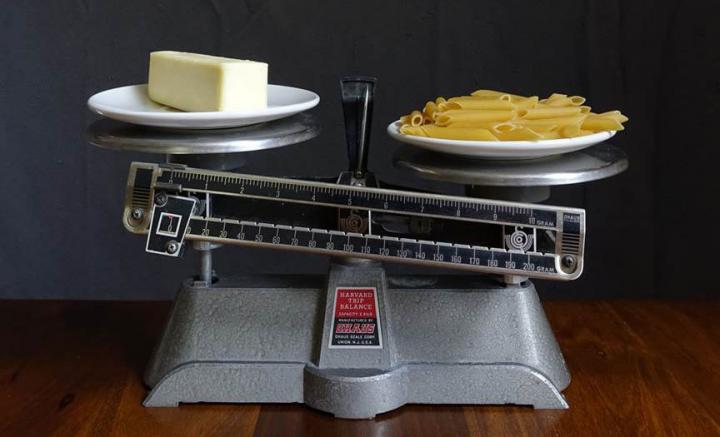
To keep the variables simple, the two observation periods were like two sides of a balance scale: during the first period, 30% of baseline calories were cut through carb restriction alone, while fat intake remained the same. During the second period the conditions were reversed. Each day, the researchers measured how much fat each participant ate and burned and used this information to calculate the rate of body fat loss.

At the end of the two dieting periods, the mathematical model proved to be correct. Body fat lost with dietary fat restriction was greater compared with carbohydrate restriction, even though more fat was burned with the low-carb diet. However, over prolonged periods the model predicted that the body acts to minimize body fat differences between diets that are equal in calories but varying widely in their ratio of carbohydrate to fat.

"There is one set of beliefs that says all calories are exactly equal when it comes to body fat loss and there's another that says carbohydrate calories are particularly fattening, so cutting those should lead to more fat loss," Hall says. "Our results showed that, actually, not all calories are created equal when it comes to body fat loss, but over the long term, it's pretty close."

Hall does caution against making sweeping conclusions about how to diet from this study. The study's purpose was to explore the physiology of how equal calorie reductions of fat versus carbs affect the human body. The research is limited by its sample size; only 19 people could be enrolled due to the expense of such research and the restrictiveness of the carefully controlled protocol. However, this study clearly reaches statistical significance. In addition,, the menu that the participants followed does not emulate normal dieting and does not account for what diet would be easier to eat over extended periods.

"We are trying to do very careful studies in humans to better understand the underlying physiology that will one day be able to help generate better recommendations about day-to-day dieting," Hall says. "But there is currently a gap between our understanding of the physiology and our ability to make effective diet recommendations for lasting weight loss."

Hall recommends that for now, the best diet is the one that you can stick to. His lab will next investigate how reduced-carbohydrate and reduced-fat diets affect the brain's reward circuitry, as well as its response to food stimuli. He hopes these results might inform why people respond differently to different diets.

INFORMATION:

This work was supported by the Intramural Research Program of the National Institutes of Health and the National Institute of Diabetes and Digestive and Kidney Diseases.

Cell Metabolism, Hall et al.: "Calorie for calorie, dietary fat restriction results in more body fat loss than carbohydrate restriction in people with obesity" http://dx.doi.org/10.1016/j.cmet.2015.07.021

Cell Metabolism, published by Cell Press, is a monthly journal that publishes reports of novel results in metabolic biology, from molecular and cellular biology to translational studies. The journal aims to highlight work addressing the molecular mechanisms underlying physiology and homeostasis in health and disease. For more information, please visit http://www.cell.com/cell-metabolism. To receive media alerts for Cell Metabolism or other Cell Press journals, contact press@cell.com.


[Attachments] See images for this press release:
Low-fat diet results in more fat loss than low-carb diet in humans

ELSE PRESS RELEASES FROM THIS DATE:

Exercise-induced hormone irisin is not a 'myth'

2015-08-13
Irisin, a hormone linked to the positive benefits of exercise, was recently questioned to exist in humans. Two recent studies pointed to possible flaws in the methods used to identify irisin, with commercially available antibodies. In Cell Metabolism on August 13, the Harvard scientists who discovered irisin address this contentious issue by showing that human irisin circulates in the blood at nanogram levels and increases during exercise. Senior study author Bruce Spiegelman of Dana-Farber Cancer Institute and Harvard Medical School says that the confusion over irisin ...

Newly discovered cells regenerate liver tissue without forming tumors

2015-08-13
The mechanisms that allow the liver to repair and regenerate itself have long been a matter of debate. Now researchers at University of California, San Diego School of Medicine have discovered a population of liver cells that are better at regenerating liver tissue than ordinary liver cells, or hepatocytes. The study, published August 13 in Cell, is the first to identify these so-called "hybrid hepatocytes," and show that they are able to regenerate liver tissue without giving rise to cancer. While most of the work described in the study was done in mouse models, the researchers ...

Alert to biologists: Ribosomes can translate the 'untranslated region' of messenger RNA

Alert to biologists: Ribosomes can translate the untranslated region of messenger RNA
2015-08-13
In what appears to be an unexpected challenge to a long-accepted fact of biology, Johns Hopkins researchers say they have found that ribosomes -- the molecular machines in all cells that build proteins -- can sometimes do so even within the so-called untranslated regions of the ribbons of genetic material known as messenger RNA (mRNA). "This is an exciting find that generates a whole new set of questions for researchers," says Rachel Green, Ph.D., a Howard Hughes Medical Institute investigator and professor of molecular biology and genetics at the Johns Hopkins University ...

NIH-developed Epstein-Barr virus vaccine elicits potent neutralizing antibodies in animals

2015-08-13
Researchers from the National Institute of Allergy and Infectious Diseases (NIAID), part of the National Institutes of Health, and their collaborators have developed an experimental, nanoparticle-based vaccine against Epstein-Barr virus (EBV) that can induce potent neutralizing antibodies in vaccinated mice and nonhuman primates. Microscopic particles, known as nanoparticles, are being investigated as potential delivery vehicles for vaccines. The scientists' findings suggest that using a structure-based vaccine design and self-assembling nanoparticles to deliver a viral ...

NIH study finds cutting dietary fat reduces body fat more than cutting carbs

2015-08-13
In a recent study, restricting dietary fat led to body fat loss at a rate 68 percent higher than cutting the same number of carbohydrate calories when adults with obesity ate strictly controlled diets. Carb restriction lowered production of the fat-regulating hormone insulin and increased fat burning as expected, whereas fat restriction had no observed changes in insulin production or fat burning. The research was conducted at the National Institute of Diabetes and Digestive and Kidney Diseases (NIDDK), part of the National Institutes of Health. Results were published ...

New technology could reduce wind energy costs

2015-08-13
Engineers from the University of Sheffield have developed a novel technique to predict when bearings inside wind turbines will fail which could make wind energy cheaper. The method, published in the journal Proceedings of the Royal Society A and developed by Mechanical Engineering research student Wenqu Chen, uses ultrasonic waves to measure the load transmitted through a ball bearing in a wind turbine. The stress on wind turbine is recorded and then engineers can forecast its remaining service life. When a bearing is subject to a load, its thickness is reduced by ...

Critically endangered species successfully reproduced using frozen sperm

2015-08-13
Black-footed ferrets, a critically endangered species native to North America, have renewed hope for future survival thanks to successful efforts by a coalition of conservationists, including scientists at Lincoln Park Zoo, to reproduce genetically important offspring using frozen semen from a ferret who has been dead for approximately 20 years. The sire, "Scarface," as he is affectionately called by the team, was one of the last 18 black-footed ferrets to exist in the world in the 1980s. Eight kits, including offspring of Scarface, were born recently, significantly increasing ...

Newly discovered brain network recognizes what's new, what's familiar

Newly discovered brain network recognizes whats new, whats familiar
2015-08-13
One of the more heartbreaking realities of Alzheimer's is the moment when a loved one struggling with the disease no longer fully recognizes a family member or close friend who is caring for them. Now, new research from Washington University in St. Louis has identified a novel learning and memory brain network that processes incoming information based on whether it's something we've experienced previously or is deemed to be altogether new and unknown, helping us recognize, for instance, whether the face before us is that of a familiar friend or a complete stranger. Forthcoming ...

Multigene panel testing for hereditary breast/ovarian cancer risk assessment

2015-08-13
Multigene testing of women negative for BRCA1 and BRCA2 found some of them harbored other harmful genetic mutations, most commonly moderate-risk breast and ovarian cancer genes and Lynch syndrome genes, which increase ovarian cancer risk, according to an article published online by JAMA Oncology. Multigene panel genetic tests are increasingly recommended for patients evaluated for a predisposition to hereditary breast/ovarian cancer (HBOC). However, the rapid introduction of these tests has raised concerns because many of the tested genes are low- to moderate-risk genes ...

Screening for breast/ovarian cancer risk genes other than BRCA1/2 is clinically valuable

2015-08-13
A study by researchers at three academic medical centers has shown that screening women with a suspected risk of hereditary breast or ovarian cancer for risk-associated genes other than BRCA1 and 2 provides information that can change clinical recommendations for patients and their family members. The report from a team led by a Massachusetts General Hospital (MGH) Cancer Center investigator is being published in the August issue of JAMA Oncology. "The traditional approach has been to test most women with suspected hereditary risk for breast and/or ovarian cancer for ...

LAST 30 PRESS RELEASES:

Power in motion: transforming energy harvesting with gyroscopes

Ketamine high NOT related to treatment success for people with alcohol problems, study finds

1 in 6 Medicare beneficiaries depend on telehealth for key medical care

Maps can encourage home radon testing in the right settings

Exploring the link between hearing loss and cognitive decline

Machine learning tool can predict serious transplant complications months earlier

Prevalence of over-the-counter and prescription medication use in the US

US child mental health care need, unmet needs, and difficulty accessing services

Incidental rotator cuff abnormalities on magnetic resonance imaging

Sensing local fibers in pancreatic tumors, cancer cells ‘choose’ to either grow or tolerate treatment

Barriers to mental health care leave many children behind, new data cautions

Cancer and inflammation: immunologic interplay, translational advances, and clinical strategies

Bioactive polyphenolic compounds and in vitro anti-degenerative property-based pharmacological propensities of some promising germplasms of Amaranthus hypochondriacus L.

AI-powered companionship: PolyU interfaculty scholar harnesses music and empathetic speech in robots to combat loneliness

Antarctica sits above Earth’s strongest “gravity hole.” Now we know how it got that way

Haircare products made with botanicals protects strands, adds shine

Enhanced pulmonary nodule detection and classification using artificial intelligence on LIDC-IDRI data

Using NBA, study finds that pay differences among top performers can erode cooperation

Korea University, Stanford University, and IESGA launch Water Sustainability Index to combat ESG greenwashing

Molecular glue discovery: large scale instead of lucky strike

Insulin resistance predictor highlights cancer connection

Explaining next-generation solar cells

Slippery ions create a smoother path to blue energy

Magnetic resonance imaging opens the door to better treatments for underdiagnosed atypical Parkinsonisms

National poll finds gaps in community preparedness for teen cardiac emergencies

One strategy to block both drug-resistant bacteria and influenza: new broad-spectrum infection prevention approach validated

Survey: 3 in 4 skip physical therapy homework, stunting progress

College students who spend hours on social media are more likely to be lonely – national US study

Evidence behind intermittent fasting for weight loss fails to match hype

How AI tools like DeepSeek are transforming emotional and mental health care of Chinese youth

[Press-News.org] Low-fat diet results in more fat loss than low-carb diet in humans