PRESS-NEWS.org - Press Release Distribution
PRESS RELEASES DISTRIBUTION

Suomi NPP satellite sees rapidly intensifying Hurricane Jimena

Suomi NPP satellite sees rapidly intensifying Hurricane Jimena
2015-08-28
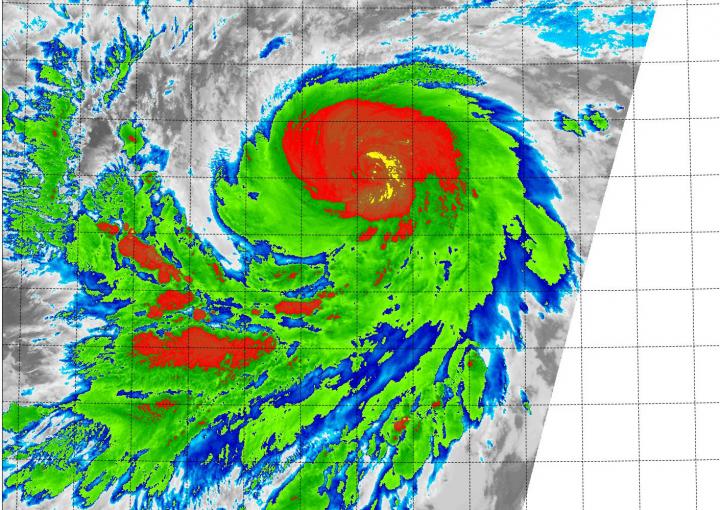
(Press-News.org) NASA-NOAA's Suomi NPP satellite flew over Hurricane Jimena in the Eastern Pacific and saw the strongest thunderstorms building up quickly, especially in the northern quadrant of the storm. Jimena intensified rapidly overnight on August 27 and early August 28 and the National Hurricane Center expects it to become a major hurricane.

The Visible Infrared Imaging Radiometer Suite or VIIRS instrument aboard the satellite provided infrared data of the storm that showed the coldest cloud top temperatures, which indicate the strongest thunderstorms were in Jimena's northern quadrant. Cloud top temperatures there were colder than -63 Fahrenheit (-53 Celsius).

VIIRS is a scanning radiometer that collects visible and infrared imagery and "radiometric" measurements. Basically it means that VIIRS data is used to measure cloud and aerosol properties, ocean color, and ocean and land surface temperatures.

Forecaster Berg at the National Hurricane Center (NHC) noted that microwave data has shown an eye beneath the central dense overcast, and a more definitive eye is just now becoming apparent in infrared satellite imagery.

At 11 a.m. EDT (8 a.m. PDT)/1500 UTC on August 28, the center of Hurricane Jimena was located near latitude 12.4 North and longitude 122.0 West. That puts the center about 1,075 miles (1,720 km) southwest of the southern tip of Baja California, Mexico.

Jimena was moving toward the west near 12 mph (19 kph), and this motion is expected to continue through early Saturday, August 29. The estimated minimum central pressure is 979 millibars.

The NHC noted that Jimena has been rapidly intensifying, and maximum sustained winds had increased to near 90 mph (150 kph) with higher gusts. Additional strengthening is forecast during the next 48 hours, and Jimena is expected to become a major hurricane tonight, August 28.

A peak intensity is expected in about 48 hours, when NHC expects Jimena's maximum sustained winds to reach 145 mph (125 knots), making it a powerful Category 4 hurricane on the Saffir-Simpson Scale. Thereafter, Jimena will gradually weaken due to a slightly drier environment and lower oceanic heat content values.

INFORMATION:


[Attachments] See images for this press release:
Suomi NPP satellite sees rapidly intensifying Hurricane Jimena

ELSE PRESS RELEASES FROM THIS DATE:

Artificial leaf harnesses sunlight for efficient fuel production

Artificial leaf harnesses sunlight for efficient fuel production
2015-08-28
Generating and storing renewable energy, such as solar or wind power, is a key barrier to a clean-energy economy. When the Joint Center for Artificial Photosynthesis (JCAP) was established at Caltech and its partnering institutions in 2010, the U.S. Department of Energy (DOE) Energy Innovation Hub had one main goal: a cost-effective method of producing fuels using only sunlight, water, and carbon dioxide, mimicking the natural process of photosynthesis in plants and storing energy in the form of chemical fuels for use on demand. Over the past five years, researchers at ...

CPR: It's not always a lifesaver, but it plays one on TV

2015-08-28
If you think that performing CPR on a person whose heart has stopped is a surefire way to save their life, you may be watching too much TV. The truth is more depressing than fiction, according to a new study by University of Southern California Davis School of Gerontology researchers. While medical dramas Grey's Anatomy and House show cardiopulmonary resuscitation saving a patient's life nearly 70 percent of the time, the real immediate survival rate is nearly half that - around 37 percent. Researchers also found another discrepancy between reality and TV: Half of ...

Moffitt makes important steps toward developing a blood test to catch pancreatic cancer early

2015-08-28
TAMPA, Fla. - Pancreatic cancer is the fourth most common cause of cancer-related death in the United States and has a 5-year survival rate of only 6 percent, which is the lowest rate of all types of cancer according to the American Cancer Society. This low survival rate is partially attributed to the difficulty in detecting pancreatic cancer at an early stage. According to a new 'proof of principle' study published in Aug. 27 issue of Cancer Prevention Research, Moffitt Cancer Center researchers hope to improve pancreatic cancer survival rates by identifying markers in ...

Staying safe in sandy beaches

2015-08-28
Beach sand contains all kinds of microorganisms, including those that can harm human health. Yet current guidelines are focused exclusively on monitoring the levels of microbes in the water. Now, an international panel of scientists is recommending monitoring the sand at recreational beaches, to minimize health risks for beachgoers. Their advice is based on the general consensus reached during the international conference "Trends in Environmental Microbiology and Public Health," held in Lisbon Portugal in September 2014. "Beach sands accumulate contaminants and people ...

New embryo image processing technology could assist in IVF implantation success rates

2015-08-28
A collaboration between biologists and engineers at Monash University has led to the development of a new non-invasive image processing technique to visualise embryo formation. Researchers were able to see, for the first time, the movement of all of the cells in living mammalian embryos as they develop under the microscope. This breakthrough has important implications for IVF (in vitro fertilisation) treatments and pre-implantation genetic diagnosis (PGD). In the future, this approach could help with embryo selection before the embryo is implanted back into the uterus to ...

Neurobiology: Light-activated learning

2015-08-28
A German-French team has developed a light-sensitive switch that regulates a protein implicated in the neurobiology of synaptic plasticity. The agent promises to shed new light on the phenomenology of learning, memory and neurodegeneration. Learning is made possible by the fact that the functional connections between nerve cells in the brain are subject to constant remodeling. As a result of activation-dependent modification of these links ('synaptic plasticity'), circuits that are repeatedly stimulated "learn" to transmit signals ever more efficiently. This process is ...

Lack of folic acid enrichment in Europe causes mortality among fetuses

2015-08-28
This news release is available in German. A new international study shows that 5,000 foetuses in Europe annually are affected by spina bifida and other severe defects on the central nervous system. Seventy per cent of these pregnancies are terminated, while increased mortality and serious diseases affect the children who are born. At least half of the cases can be avoided by adding folic acid to staple foods as is already being done in seventy non-European countries. A lack of folic acid enrichment in Europe is the cause of several thousand cases of foaetal abnormalities ...

The alien within: Fetal cells influence maternal health during pregnancy (and long after)

The alien within: Fetal cells influence maternal health during pregnancy (and long after)
2015-08-28
Parents go to great lengths to ensure the health and well-being of their developing offspring. The favor, however, may not always be returned. Dramatic research has shown that during pregnancy, cells of the fetus often migrate through the placenta, taking up residence in many areas of the mother's body, where their influence may benefit or undermine maternal health. The presence of fetal cells in maternal tissue is known as fetal microchimerism. The term alludes to the chimeras of ancient Greek myth--composite creatures built from different animal parts, like the goat-lion-serpent ...

Future climate models greatly affected by fungi and bacteria

2015-08-28
When a plant dies, its leaves and branches fall to the ground. Decomposition of soil organic matter is then mainly carried out by fungi and bacteria, which convert dead plant materials into carbon dioxide and mineral nutrients. Until now, scientists have thought that high quality organic materials, such as leaves that are rich in soluble sugars, are mainly decomposed by bacteria. Lower quality materials, such as cellulose and lignin that are found in wood, are mainly broken down by fungi. Previous research has also shown that organic material that is broken down by ...

Physics meets biology to defeat aging

2015-08-28
The scientific team of a new biotech company Gero in collaboration with one of the leading academics in the field of aging Prof. Robert J. Shmookler Reis (current world record holder in life extension for model animals - 10 fold for nematodes) has recently brought new insights into biology of aging and age-related diseases, primarily, around the stability and stress resistance of certain gene regulatory networks. The work has just been published as "Stability analysis of a model gene network links aging, stress resistance, and negligible senescence" in Scientific Reports ...

LAST 30 PRESS RELEASES:

Elucidating liquid-liquid phase separation under non-equilibrium conditions

Fecal microbiome and bile acid profiles differ in preterm infants with parenteral nutrition-associated cholestasis

The Institute of Science and Technology Austria (ISTA) receives €5 million donation for AI research

Study finds link between colorblindness and death from bladder cancer

Tailored treatment approach shows promise for reducing suicide and self-harm risk in teens and young adults

Call for papers: AI in biochar research for sustainable land ecosystems

Methane eating microbes turn a powerful greenhouse gas into green plastics, feed, and fuel

Hidden nitrogen in China’s rice paddies could cut fertilizer use

Texas A&M researchers expose hidden risks of firefighter gear in an effort to improve safety and performance

Wood burning in homes drives dangerous air pollution in winter

The Journal of Nuclear Medicine Ahead-of-Print Tip Sheet: January 23, 2026

ISSCR statement in response to new NIH policy on research using human fetal tissue (Notice NOT-OD-26-028)

Biologists and engineers follow goopy clues to plant-wilting bacteria

What do rats remember? IU research pushes the boundaries on what animal models can tell us about human memory

Frontiers Science House: did you miss it? Fresh stories from Davos – end of week wrap

Watching forests grow from space

New grounded theory reveals why hybrid delivery systems work the way they do

CDI scientist joins NIH group to improve post-stem cell transplant patient evaluation

Uncovering cancer's hidden oncRNA signatures: From discovery to liquid biopsy

Multiple maternal chronic conditions and risk of severe neonatal morbidity and mortality

Interactive virtual assistant for health promotion among older adults with type 2 diabetes

Ion accumulation in liquid–liquid phase separation regulates biomolecule localization

Hemispheric asymmetry in the genetic overlap between schizophrenia and white matter microstructure

Research Article | Evaluation of ten satellite-based and reanalysis precipitation datasets on a daily basis for Czechia (2001–2021)

Nano-immunotherapy synergizing ferroptosis and STING activation in metastatic bladder cancer

Insilico Medicine receives IND approval from FDA for ISM8969, an AI-empowered potential best-in-class NLRP3 inhibitor

Combined aerobic-resistance exercise: Dual efficacy and efficiency for hepatic steatosis

Expert consensus outlines a standardized framework to evaluate clinical large language models

Bioengineered tissue as a revolutionary treatment for secondary lymphedema

Forty years of tracking trees reveals how global change is impacting Amazon and Andean Forest diversity

[Press-News.org] Suomi NPP satellite sees rapidly intensifying Hurricane Jimena