HKBU and CUHK launch Spermine Risk Score for prostate cancer diagnosis
Published 2021-02-08 · Original archive entry · Explore research explainers
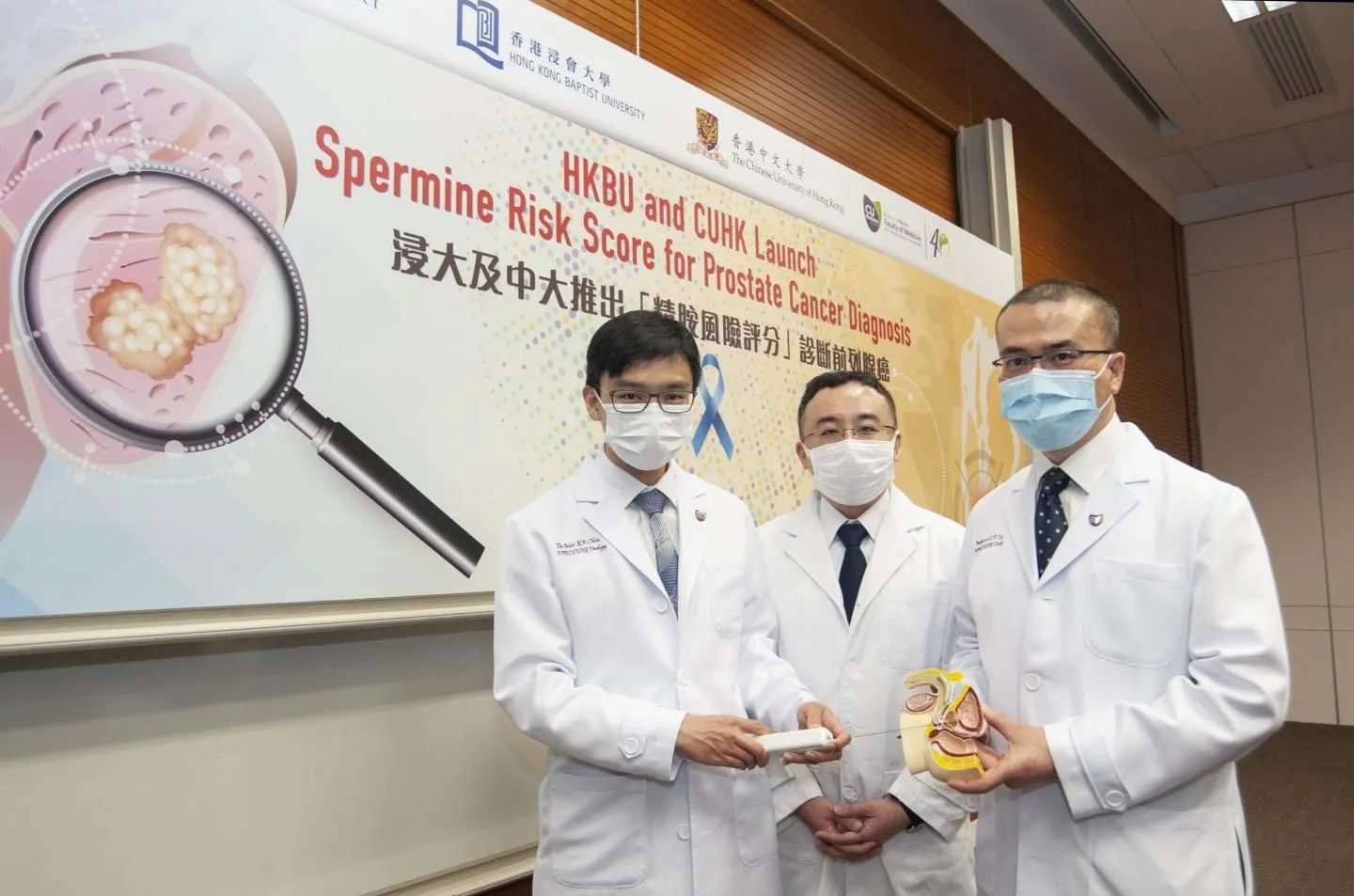
Researchers from Hong Kong Baptist University (HKBU) and the Faculty of Medicine at The Chinese University of Hong Kong (CU Medicine) have jointly developed the Spermine Risk Score which, coupled with the use of a urine test, provides a non-invasive and more reliable method for the diagnosis of prostate cancer. In a study conducted by the researchers, about 37% of the patients, who were ultimately found to have no prostate cancer, can avoid undergoing a prostate biopsy procedure. The findings have just been published in the scientific journal Prostate Cancer and Prostatic Diseases.
Demand for more reliable and non-invasive diagnosis
Prostate cancer is the third most common and the fourth most fatal cancer for the male population in Hong Kong. It results from the abnormal and uncontrolled growth of the prostate gland. Two medical procedures are commonly used for its diagnosis, namely the digital rectal examination (DRE) and the serum prostate-specific antigen (PSA) test.
DRE is performed by a doctor who uses a gloved finger to check the back portion of the prostate. Its accuracy highly depends on the skill and experience of the doctor. The PSA test, a kind of blood test, is a more popular alternative. For the Asian population, individuals with a PSA level higher than 4 ng/mL are normally interpreted as having a high risk of prostate cancer, and a prostate biopsy for further confirmation is usually recommended. According to the Centre for Health Protection of the Department of Health, about three out of four men in this group do not have prostate cancer. However, the patients have to bear the risk of complications due to the invasive nature of the prostate biopsy procedure.
Prostate cancer patients have lower spermine levels
In search of a more reliable and non-invasive method for prostate cancer diagnosis, Professor Gary Wong Ka-leung, Professor and Head of the Department of Chemistry at HKBU, and Professor Ng Chi-fai and Dr Peter Chiu Ka-fung, Professor and Associate Professor respectively of the Division of Urology in the Department of Surgery at CU Medicine, have collaborated since 2014 to identify a new biomarker to supplement the PSA test. They found that prostate cancer patients in general have lower levels of spermine, a biogenic molecule in their urine, which offers a clue for the diagnosis of prostate cancer.
To investigate the diagnostic performance of spermine, the research team recruited 905 patients between 2015 and 2019 to participate in a study. All of them had elevated PSA levels and/or abnormal DRE, with a prostate biopsy scheduled.
Score to estimate prostate cancer risk
Among the 905 patients, 600 of them who had PSA levels ranging from 4 to 20 ng/mL were included in the analysis. Their urine samples were collected before they underwent a biopsy procedure. The biopsy results showed that out of the 600 patients, 185 (30.8%) were diagnosed with prostate cancer.
At the same time, the urine samples of these 600 patients were also analysed. The results found that about 49% of the patients with spermine levels in the lowest quartile had prostate cancer, which was nearly triple the number of patients in the highest quartile (17%). The research team then used the urine spermine level figures and three other clinical parameters, namely DRE, PSA level and prostate volume, to develop the Spermine Risk Score, with the objective of offering a more accurate estimation of patients' prostate cancer risk.
The higher the Spermine Risk Score, the greater the patient's risk of developing prostate cancer. Only patients with Spermine Risk Scores higher than 6.2 will be advised to undergo the biopsy procedure. Based on Spermine Risk Scores calculated with data collected from the study, about 37% of the non-cancer patients could have avoided the biopsy procedure. Moreover, the negative predictive value of the Spermine Risk Score for significant prostate cancer is 95%, which means the chance of no significant cancer is 95% if the value of the Score is negative.
Promising approach for prostate cancer diagnosis
Dr Chiu concluded the findings by highlighting that, "This study confirms that urine spermine and the Spermine Risk Score are effective at identifying men at higher risk of prostate cancer and the test could help reduce the number of unnecessary biopsies."
"It is the ?rst prospective study to investigate the efficacy of urine spermine in prostate cancer detection. It successfully demonstrated that the Spermine Risk Score, developed based on patients' urine spermine levels and other clinical parameters, can serve as a novel and promising approach to address the limitations of the diagnostic methods currently in use," said Professor Wong.
"Although there are a number of blood and urine adjuncts to guide prostate biopsy decisions in patients with elevated PSA levels, urine spermine is a convenient non-invasive test that doesn't require another blood test or attentive DRE before specimen collection. Thus it minimises any potential complications associated with the procedures," said Professor Ng.
Demand for more reliable and non-invasive diagnosis
Prostate cancer is the third most common and the fourth most fatal cancer for the male population in Hong Kong. It results from the abnormal and uncontrolled growth of the prostate gland. Two medical procedures are commonly used for its diagnosis, namely the digital rectal examination (DRE) and the serum prostate-specific antigen (PSA) test.
DRE is performed by a doctor who uses a gloved finger to check the back portion of the prostate. Its accuracy highly depends on the skill and experience of the doctor. The PSA test, a kind of blood test, is a more popular alternative. For the Asian population, individuals with a PSA level higher than 4 ng/mL are normally interpreted as having a high risk of prostate cancer, and a prostate biopsy for further confirmation is usually recommended. According to the Centre for Health Protection of the Department of Health, about three out of four men in this group do not have prostate cancer. However, the patients have to bear the risk of complications due to the invasive nature of the prostate biopsy procedure.
Prostate cancer patients have lower spermine levels
In search of a more reliable and non-invasive method for prostate cancer diagnosis, Professor Gary Wong Ka-leung, Professor and Head of the Department of Chemistry at HKBU, and Professor Ng Chi-fai and Dr Peter Chiu Ka-fung, Professor and Associate Professor respectively of the Division of Urology in the Department of Surgery at CU Medicine, have collaborated since 2014 to identify a new biomarker to supplement the PSA test. They found that prostate cancer patients in general have lower levels of spermine, a biogenic molecule in their urine, which offers a clue for the diagnosis of prostate cancer.
To investigate the diagnostic performance of spermine, the research team recruited 905 patients between 2015 and 2019 to participate in a study. All of them had elevated PSA levels and/or abnormal DRE, with a prostate biopsy scheduled.
Score to estimate prostate cancer risk
Among the 905 patients, 600 of them who had PSA levels ranging from 4 to 20 ng/mL were included in the analysis. Their urine samples were collected before they underwent a biopsy procedure. The biopsy results showed that out of the 600 patients, 185 (30.8%) were diagnosed with prostate cancer.
At the same time, the urine samples of these 600 patients were also analysed. The results found that about 49% of the patients with spermine levels in the lowest quartile had prostate cancer, which was nearly triple the number of patients in the highest quartile (17%). The research team then used the urine spermine level figures and three other clinical parameters, namely DRE, PSA level and prostate volume, to develop the Spermine Risk Score, with the objective of offering a more accurate estimation of patients' prostate cancer risk.
The higher the Spermine Risk Score, the greater the patient's risk of developing prostate cancer. Only patients with Spermine Risk Scores higher than 6.2 will be advised to undergo the biopsy procedure. Based on Spermine Risk Scores calculated with data collected from the study, about 37% of the non-cancer patients could have avoided the biopsy procedure. Moreover, the negative predictive value of the Spermine Risk Score for significant prostate cancer is 95%, which means the chance of no significant cancer is 95% if the value of the Score is negative.
Promising approach for prostate cancer diagnosis
Dr Chiu concluded the findings by highlighting that, "This study confirms that urine spermine and the Spermine Risk Score are effective at identifying men at higher risk of prostate cancer and the test could help reduce the number of unnecessary biopsies."
"It is the ?rst prospective study to investigate the efficacy of urine spermine in prostate cancer detection. It successfully demonstrated that the Spermine Risk Score, developed based on patients' urine spermine levels and other clinical parameters, can serve as a novel and promising approach to address the limitations of the diagnostic methods currently in use," said Professor Wong.
"Although there are a number of blood and urine adjuncts to guide prostate biopsy decisions in patients with elevated PSA levels, urine spermine is a convenient non-invasive test that doesn't require another blood test or attentive DRE before specimen collection. Thus it minimises any potential complications associated with the procedures," said Professor Ng.
INFORMATION: