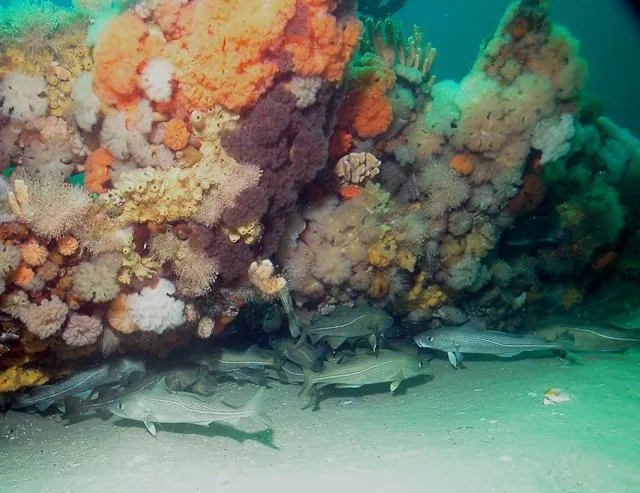
(Press-News.org) Overfishing likely did not cause the Atlantic cod, an iconic species, to evolve genetically and mature earlier, according to a study led by Rutgers University and the University of Oslo - the first of its kind - with major implications for ocean conservation.
"Evolution has been used in part as an excuse for why cod and other species have not recovered from overfishing," said first author END
Overfishing of Atlantic cod likely did not cause genetic changes
Study suggests reducing fishing and addressing environmental changes would help cod recover
2021-04-05
ELSE PRESS RELEASES FROM THIS DATE:
Sex differences in brain in response to midlife stress linked to fetal stress exposures
2021-04-05
BOSTON - Men and women whose mothers experienced stressful events during pregnancy regulate stress differently in the brain 45 years later, results of a long-term study demonstrate.
In a unique sample of 40 men and 40 women followed from the womb into their mid-forties, the brain imaging study showed that exposure during fetal development to inflammation-promoting natural substances called cytokines, produced by mothers under negative stress, results in sex-associated differences in how the adult brain responds to negative stressful situations more than 45 years after ...
Biodiversity's healthy byproduct -- nutrient-rich seafood
2021-04-05
High levels of biodiversity in aquatic settings offers a wide range of vitamins, minerals, and fatty acids crucial for human health, a range of nutrients that are lacking in ecosystems where the number of species have been reduced by overfishing, pollution, or climate change, researchers report April 5 in the journal Proceedings of the National Academy of Sciences.
"What we found is that biodiversity is crucial to human health," said Yale's Joey Bernhardt, a G. Evelyn Hutchinson Postdoctoral Fellow in the Department of Ecology and Evolutionary Biology and co-author of the paper.
While humans can achieve their protein requirements even with seafood from less-diverse systems, ...
A diversity of wildlife is good for our health
2021-04-05
A growing body of evidence suggests that biodiversity loss increases our exposure to both new and established zoonotic pathogens. Restoring and protecting nature is essential to preventing future pandemics. So reports a new Proceedings of the National Academy of Sciences (PNAS) paper that synthesizes current understanding about how biodiversity affects human health and provides recommendations for future research to guide management.
Lead author Felicia Keesing is a professor at Bard College and a Visiting Scientist at Cary Institute of Ecosystem Studies. She explains, "There's a persistent myth ...
To intervene or not to intervene? That is the future climate question
2021-04-05
EAST LANSING, Mich. - Nine of the hottest years in human history have occurred in the past decade. Without a major shift in this climate trajectory, the future of life on Earth is in question, which poses a new question: Should humans, whose fossil fueled society is driving climate change, use technology to put the brakes on global warming?
Michigan State University community ecologist Phoebe Zarnetske is co-lead of the Climate Intervention Biology Working Group, a team of internationally recognized experts in climate science and ecology that is bringing science to bear on the question and consequences of geoengineering a cooler Earth.
The group's ...
For 80% of Americans with resolved drug problem, significant personal achievements
2021-04-05
BOSTON - Addiction is associated with social exclusion, loss of access to resources, and general disengagement from civic life. Now, a study recently published in the journal Psychology of Addictive Behaviors and led by David Eddie, PhD, of the Massachusetts General Hospital's Recovery Research Institute has found that the majority of Americans who have resolved an alcohol or other drug problem report achievements related to self-improvement, family engagement, and civic and economic participation since resolving their addiction. Additionally, it appears these achievements accumulate with time in addiction recovery.
Incorporating data from the Recovery Research Institute's landmark 2017 National Recovery Study, which indicated ...
Surprising disconnect between physical characteristics and genetic ancestry in certain
2021-04-05
A new study by Stanford University biologists finds an explanation for the idea that physical characteristics such as skin pigmentation are "only skin deep." Using genetic modeling, the team has found that when two populations with distinct traits combine over generations, traits of individuals within the resulting "admixed" population come to reveal very little about individuals' ancestry. Their findings were published March 27 in a special edition of the American Journal of Physical Anthropology on race and racism.
"When two founding groups first come together, a visible physical trait that differed between those founders initially carries information about the genetic ancestry of admixed individuals," says Jaehee Kim, a postdoctoral research fellow in biology at Stanford and first author ...
Understanding how cancer can relapse
2021-04-05
In the fight against cancers, activating mutations in the RAS family of genes stand in the way of finding viable treatment options. Now, scientists at the University of Missouri and Yale University have discovered that one of these mutations -- oncogenic RAS or RASV12 -- is also responsible for the regrowth of cancer cells following genotoxic therapy treatment, or drugs that cause damage to a cancer cell's DNA in order to eliminate it from the body.
"Most of our knowledge of how cells respond to DNA damage is mainly derived from studies looking at the single cell level," said Yves Chabu, an assistant professor in the MU College of Arts and Science. "Therefore, we don't know much about how tumor cells respond to DNA damage in the broader ...
How climate change affects Colombia's coffee production
2021-04-05
URBANA, Ill. ¬- If your day started with a cup of coffee, there's a good chance your morning brew came from Colombia. Home to some of the finest Arabica beans, the country is the world's third largest coffee producer. Climate change poses new challenges to coffee production in Colombia, as it does to agricultural production anywhere in the world, but a new University of Illinois study shows effects vary widely depending on where the coffee beans grow.
"Colombia is a large country with a very distinct geography. The Andes Mountains cross the country from its southwest to northeast corner. Colombian coffee is currently growing in areas with different altitude levels, and climate impacts will likely be very different for low ...
Contraceptive planning is essential to optimal health for women with heart disease
2021-04-05
Pregnancy can increase the risk of morbidity and mortality in women with cardiovascular disease; however, many cardiologists are not having pre-pregnancy contraception discussions with their patients of child-bearing age. There is a need to provide evidence-based guidance for contraceptive safety and effectiveness and pregnancy planning options for this high-risk patient group, according to a paper published in the Journal of the American College of Cardiology (JACC). This paper is one of a five-part JACC focus seminar series addressing a wide range of topics in the emerging cardio-obstetrics field.
Prior research has found that 68% of females have had sex at least once by the time they were 17, ...
Amazing integration of technology and art: a 3D LotusMenu in your palm
2021-04-05
A recent study proposed a three-dimensional LotusMenu that can "bloom in the palm". With this menu, even if you are not Nezha, you can also control your own lotus.
The research paper is titled: "LotusMenu: A 3D Menu using Wrist and Elbow Rotation Inspired by Chinese Traditional Symbol". It's published in SCIENCE CHINA Information Sciences recently, written by Associate Professor Lu Fei's human-computer interaction research team from Beijing University of Posts and Telecommunications. Based on the metaphor of the traditional lotus pattern, the researchers ...
LAST 30 PRESS RELEASES:
Unsupervised strategies for naïve animals: New model of adaptive decision making inspired by baby chicks, turtles and insects
How cities primed spotted lanternflies to thrive in the US
UK polling clerks struggle to spot fake IDs, study reveals
How mindfulness can support GenAI use in transforming project management
Physical fitness of transgender and cisgender women is comparable, current evidence suggests
Duplicate medical records linked to 5-fold heightened risk of inpatient death
Air ambulance pre-hospital care may make surviving critical injury more likely
Significant gaps persist in regional UK access to 24/7 air ambulance services
Reproduction in space, an environment hostile to human biology
Political division in the US surged from 2008 onwards, study suggests
No need for rare earths or liquid helium! Cryogenic cooling material composed solely of abundant elements
Urban light pollution alters nighttime hormones in sharks, study shows
Pregnancy, breastfeeding associated with higher levels of cognitive function for postmenopausal women
Tiny dots, big impact: Using light to scrub industrial dyes from our water
Scientists uncover how biochar microzones help protect crops from toxic cadmium
Graphene-based materials show promise for tackling new environmental contaminants
Where fires used to be frequent, old forests now face high risk of devastating blazes
Emotional support from social media found to reduce anxiety
Backward walking study offers potential new treatment to improve mobility and decrease falls in multiple sclerosis patients
Top recognition awarded to 11 stroke researchers for science, brain health contributions
New paper proposes a framework for assessing the trustworthiness of research
Porto Summit drives critical cooperation on submarine cable resilience
University of Cincinnati Cancer Center tests treatment using ‘glioblastoma-on-a-chip’ and wafer technology
IPO pay gap hiding in plain sight: Study reveals hidden cost of ‘cheap stock’
It has been clarified that a fungus living in our body can make melanoma more aggressive
Paid sick leave as disease prevention
Did we just see a black hole explode? Physicists at UMass Amherst think so—and it could explain (almost) everything
Study highlights stressed faults in potential shale gas region in South Africa
Human vaginal microbiome is shaped by competition for resources
Test strip breakthrough for accessible diagnosis
[Press-News.org] Overfishing of Atlantic cod likely did not cause genetic changesStudy suggests reducing fishing and addressing environmental changes would help cod recover