Study evaluates biomarker criteria for assessing Alzheimer's risk
Community-based autopsy study of well-characterized older adults provides valuable data on influential research tool
Published 2021-04-26 · Original archive entry · Explore research explainers
One of the biggest challenges in Alzheimer's research is to identify biomarkers that can identify people who are at risk of developing dementia. Biomarkers could be used to screen people so they might be helped before they develop dementia.
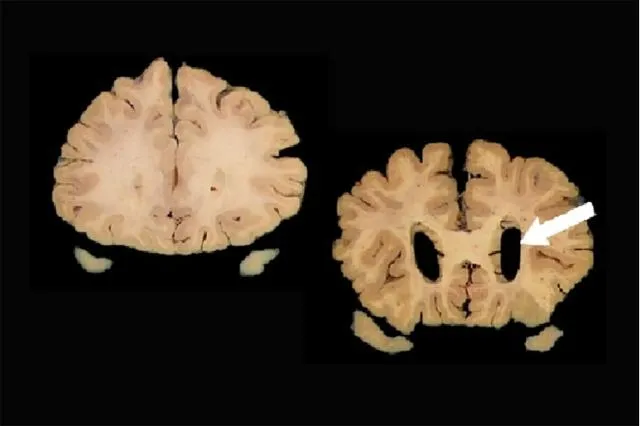
Researchers have focused primarily on three such biomarkers. Two are Alzheimer's-related proteins, amyloid and tau. Amyloid forms clumps in brains, and tau forms skeins of filaments called neurofibrillary tangles. Both can be detected in cerebral spinal fluid or by specialized positron emission tomography (PET) scans. The third marker, brain atrophy, can be seen with CT or MRI scans.
To guide researchers, the National Institute on Aging and the Alzheimer's Association have endorsed a research tool based on these three biomarkers called the AT(N) framework--A, for amyloid, T for tau, and (N) for neurodegeneration or atrophy. The hope was that the framework would provide a standard tool to assess an asymptomatic person's risk of developing dementia.
A new study by researchers in Seattle suggests a subset of people classified by this approach as having the highest risk for dementia will not develop dementia in their lifetime.
"We used autopsy data to approximate AT(N) biomarker categories from our well-characterized sample, and looked at dementia rates for people in each category," said END
Researchers have focused primarily on three such biomarkers. Two are Alzheimer's-related proteins, amyloid and tau. Amyloid forms clumps in brains, and tau forms skeins of filaments called neurofibrillary tangles. Both can be detected in cerebral spinal fluid or by specialized positron emission tomography (PET) scans. The third marker, brain atrophy, can be seen with CT or MRI scans.
To guide researchers, the National Institute on Aging and the Alzheimer's Association have endorsed a research tool based on these three biomarkers called the AT(N) framework--A, for amyloid, T for tau, and (N) for neurodegeneration or atrophy. The hope was that the framework would provide a standard tool to assess an asymptomatic person's risk of developing dementia.
A new study by researchers in Seattle suggests a subset of people classified by this approach as having the highest risk for dementia will not develop dementia in their lifetime.
"We used autopsy data to approximate AT(N) biomarker categories from our well-characterized sample, and looked at dementia rates for people in each category," said END