PRESS-NEWS.org - Press Release Distribution
PRESS RELEASES DISTRIBUTION

Reduced microbial stability linked to soil carbon loss in active layer under alpine permafrost degra

Reduced microbial stability linked to soil carbon loss in active layer under alpine permafrost degra
2021-06-16
(Press-News.org) Chinese researchers have recently discovered links between reduction in microbial stability and soil carbon loss in the active layer of degraded alpine permafrost on the Qinghai-Tibet Plateau (QTP).

The researchers, headed by Prof. CHEN Shengyun from the Northwest Institute of Eco-Environment and Resources (NIEER) of the Chinese Academy of Sciences (CAS), and XUE Kai from University of Chinese Academy of Sciences, conducted a combined in-depth analysis of soil microbial communities and their co-occurrence networks in the active permafrost layer along an extensive gradient of permafrost degradation.

The QTP encompasses the largest extent of high-altitude mountain permafrost in the world. This permafrost is different than high-latitude permafrost and stores massive soil carbon. An often ignored characteristic of permafrost is that the carbon pool in the active layer soil is more active and directly affected by climate change, compared to deeper layers.

Triggered by climate warming, permafrost degradation may decrease soil carbon stability and induce massive carbon loss, thus leading to positive carbon-climate feedback. However, microbial-mediated mechanisms for carbon loss from the active layer soil in degraded permafrost still remain unclear.

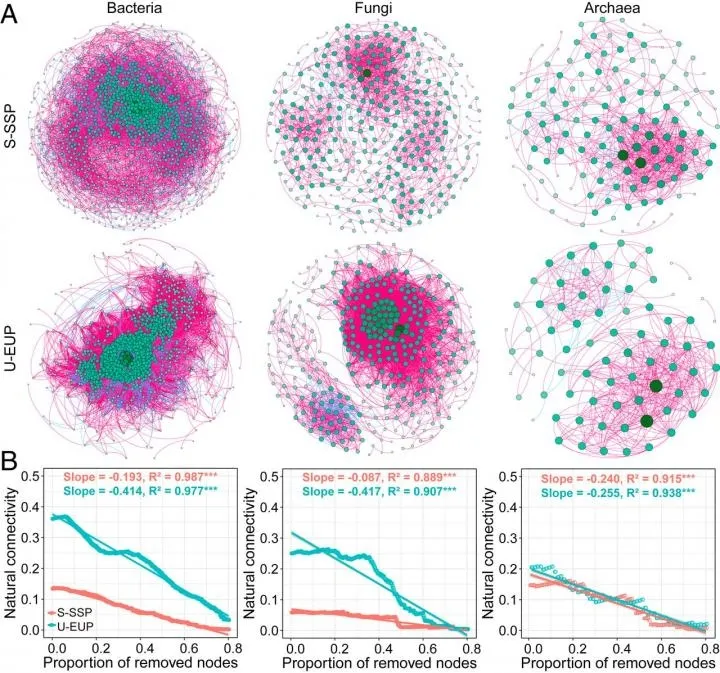
In this study, the researchers found that alpine permafrost degradation reduced the stability of active layer microbial communities as evidenced by increased sensitivity of microbial composition to environmental change, promoted destabilizing network properties and reduced resistance to node or edge attacking of the microbial network.

They discovered that soil organic carbon loss in severely degraded permafrost is associated with increased microbial dissimilarity, thereby potentially contributing to a positive carbon feedback in alpine permafrost on the QTP.

INFORMATION:

The results were published in PNAS in an article entitled "Reduced microbial stability in the active layer is associated with carbon loss under alpine permafrost degradation".

This research was financially supported by the National Natural Science Foundation of China, the Strategic Priority Research Program (A) of CAS and the Second Tibetan Plateau Scientific Expedition and Research Program.


[Attachments] See images for this press release:
Reduced microbial stability linked to soil carbon loss in active layer under alpine permafrost degra

ELSE PRESS RELEASES FROM THIS DATE:

How should governments offer subsidies for clean-energy heating?

2021-06-16
Greater Helsinki -- Transitioning to low-carbon energy production is the biggest climate challenge to overcome. Many countries are already looking to adopt clean heating solutions more widely, with the International Energy Agency projecting that by 2045 nearly half of global heating will be done with heat pumps. To ensure speedy uptake, governments are likely to offer subsidies to ensure these energy-efficient options actually make their way into homes and offices. A new study from Aalto University assesses the impact of heat pumps on energy consumption as well as how ...

New research finds ways to improve accuracy of Lateral Flow Tests

2021-06-16
Research published in the journal ACS Materials and Interfaces has provided new understanding of how false-negative results in Lateral Flow Tests occur and provides opportunity for simple improvements to be made. Lateral Flow Devices were introduced late in 2020 on a global scale to help detect novel coronavirus infection in individuals, with test results produced rapidly in half an hour or less. However, their potential has been somewhat hindered by inadequate sensitivity, with a high number of false-negative results. Using X-ray fluorescence imaging from Diamond Light Source, researchers from King's College London ...

Idea of COVID-19 'immunity passports' decreases people's compliance with restrictions

2021-06-16
Researchers from the University of Kent's School of Psychology have found that when people are presented with the idea of a Covid-19 "immunity passport", they show less willingness to follow social distancing and face covering guidelines. However, this willingness seems to return when people read more cautious information about Covid-19 immunity. PhD students Ricky Green and Mikey Biddlestone and Professor Karen Douglas asked participants from the UK and USA to imagine they had either recovered from Covid-19 or were currently infected. Participants asked to imagine ...

Convergent mechanism of aging discovered

Convergent mechanism of aging discovered
2021-06-16
Several different causes of ageing have been discovered, but the question remains whether there are common underlying mechanisms that determine ageing and lifespan. Researchers from the Max Planck Institute for Biology of Ageing and the CECAD Cluster of Excellence in Ageing research at the University Cologne have now come across folate metabolism in their search for such basic mechanisms. Its regulation underlies many known ageing signalling pathways and leads to longevity. This may provide a new possibility to broadly improve human health during ageing. In recent decades, ...

Developing countries pay steep economic & health costs because of high car air pollution

2021-06-16
In an international study published by the journal Environment International, the University of Surrey led an international team of air pollution experts in monitoring pollution hotspots in 10 global cities: Dhaka (Bangladesh); São Paulo (Brazil); Guangzhou (China); Medellín (Colombia); Cairo (Egypt); Addis Ababa (Ethiopia); Chennai (India); Sulaymaniyah (Iraq); Blantyre (Malawi); and Dar-es-Salaam (Tanzania). Surrey's Global Centre for Clean Air Research (GCARE) set out to investigate whether the amount of fine air pollution particles (PM2.5) drivers inhaled is connected to the duration drivers spend in pollution hotspots and socio-economic indicators such ...

Early encounter of microbes and fetal immune system during second trimester of gestation

Early encounter of microbes and fetal immune system during second trimester of gestation
2021-06-16
2 June 2021, Singapore - The human fetal immune system begins to develop early during gestation, however, factors responsible for fetal immune-priming remain elusive. Using multiple complementary approaches, Dr Florent Ginhoux from A*STAR's Singapore Immunology Network (SIgN), Professor Jerry Chan from KK Women's and Children's Hospital (KKH), Professor Salvatore Albani from the SingHealth Duke-NUS Translational Immunology Institute, with collaborators from Cambridge University explored potential exposure to microbial agents in-utero. The team identified live microbes across fetal organs that stimulate activation of fetal T-cells during the second trimester of gestation. Study published in scientific journal, Cell, on 24 June 2021. The team profiled microbes ...

Computers predict people's tastes in art

Computers predict peoples tastes in art
2021-06-16
Do you like the thick brush strokes and soft color palettes of an impressionist painting such as those by Claude Monet? Or do you prefer the bold colors and abstract shapes of a Rothko? Individual art tastes have a certain mystique to them, but now a new Caltech study shows that a simple computer program can accurately predict which paintings a person will like. The new study, appearing in the journal Nature Human Behaviour, utilized Amazon's crowdsourcing platform Mechanical Turk to enlist more than 1,500 volunteers to rate paintings in the genres of impressionism, cubism, abstract, and color field. The volunteers' answers were fed into a computer program and then, after this training period, the computer ...

Chatbots for dementia patients and caregivers need more work

2021-06-16
Chatbots hold promise for dementia patient or caregiver support, but are still in their infancy, finds a paper published in the Journal of Medical Internet Research. None of the interactive digital apps tested by medical researchers and a computer scientist performed well on all testing criteria, and all the apps contained linguistic biases and usability challenges. The authors conclude that until developers produce evidence-based chatbots that have undergone end user evaluation it will be hard to evaluate their potential to adequately educate and support dementia patients and their caregivers. "Dementia care is complex and no two cases of dementia are alike. Chatbots have the potential of providing ...

Ozone pollution has increased in Antarctica

2021-06-16
Ozone is a pollutant at ground level, but very high in the atmosphere's "ozone layer," it absorbs damaging ultraviolet radiation. Past studies have examined ozone levels in the Southern Hemisphere, but little is known about levels of the molecule in Antarctica over long periods. Now, researchers reporting in ACS' Environmental Science & Technology have analyzed more than 25 years of Antarctic data, finding that concentrations near the ground arose from both natural and human-related sources. Ozone gas has a sharp or acrid scent that sometimes accompanies smog or summer storms. It forms when sunlight ...

Urbanization drives antibiotic resistance on microplastics in Chinese river

2021-06-16
Microplastic pollution of waterways has become a huge concern, with the tiny pieces of plastic entering food webs and potentially having harmful effects on animals and people. In addition, microplastics can act as breeding grounds for antibiotic-resistant bacteria. Now, researchers reporting in Environmental Science & Technology have analyzed antibiotic-resistance genes (ARGs) on five types of microplastics at different locations along the Beilun River in China, finding much higher abundances in urban than rural regions. In rivers, major sources of microplastics include textile fibers from laundering, water bottle fragments, and films from bags and wrappers. Also prevalent in ...

LAST 30 PRESS RELEASES:

Making lighter work of calculating fluid and heat flow

Normalizing blood sugar can halve heart attack risk

Lowering blood sugar cuts heart attack risk in people with prediabetes

Study links genetic variants to risk of blinding eye disease in premature infants

Non-opioid ‘pain sponge’ therapy halts cartilage degeneration and relieves chronic pain

AI can pick up cultural values by mimicking how kids learn

China’s ecological redlines offer fast track to 30 x 30 global conservation goal

Invisible indoor threats: emerging household contaminants and their growing risks to human health

Adding antibody treatment to chemo boosts outcomes for children with rare cancer

Germline pathogenic variants among women without a history of breast cancer

Tanning beds triple melanoma risk, potentially causing broad DNA damage

Unique bond identified as key to viral infection speed

Indoor tanning makes youthful skin much older on a genetic level

Mouse model sheds new light on the causes and potential solutions to human GI problems linked to muscular dystrophy

The Journal of Nuclear Medicine ahead-of-print tip sheet: December 12, 2025

Smarter tools for peering into the microscopic world

Applications open for funding to conduct research in the Kinsey Institute archives

Global measure underestimates the severity of food insecurity

Child survivors of critical illness are missing out on timely follow up care

Risk-based vs annual breast cancer screening / the WISDOM randomized clinical trial

University of Toronto launches Electric Vehicle Innovation Ontario to accelerate advanced EV technologies and build Canada’s innovation advantage

Early relapse predicts poor outcomes in aggressive blood cancer

American College of Lifestyle Medicine applauds two CMS models aligned with lifestyle medicine practice and reimbursement

Clinical trial finds cannabis use not a barrier to quitting nicotine vaping

Supplemental nutrition assistance program policies and food insecurity

Switching immune cells to “night mode” could limit damage after a heart attack, study suggests

URI-based Global RIghts Project report spotlights continued troubling trends in worldwide inhumane treatment

Neutrophils are less aggressive at night, explaining why nighttime heart attacks cause less damage than daytime events

Menopausal hormone therapy may not pose breast cancer risk for women with BRCA mutations

Mobile health tool may improve quality of life for adolescent and young adult breast cancer survivors

[Press-News.org] Reduced microbial stability linked to soil carbon loss in active layer under alpine permafrost degra