Researchers hope a protein blueprint might aid infertility treatments
University of Cincinnati findings available in the scholarly journal for the Proceedings of the National Academy of Sciences
Published 2021-06-22 · Original archive entry · Explore research explainers
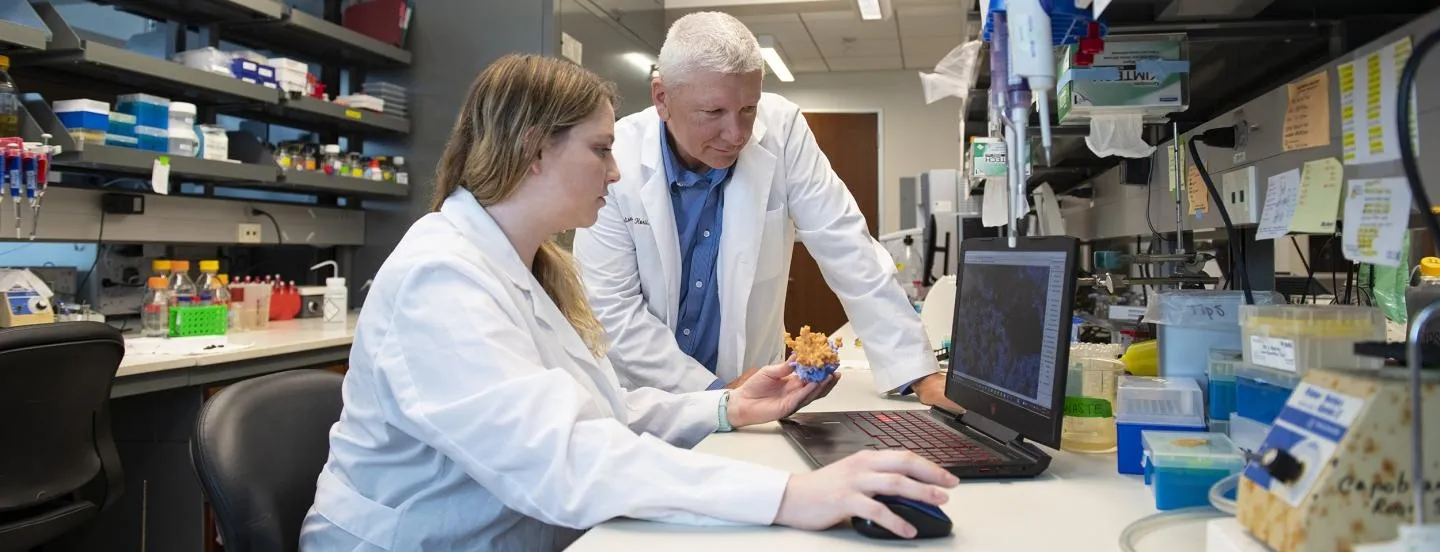
Researchers at the University of Cincinnati College of Medicine have developed a blueprint for a protein that plays an important role in the development and regulation of reproductive organs.
The knowledge advances our understanding of the protein anti-Müllerian hormone hormone (AMH), which helps form male reproductive organs and in females regulates follicle development and ovulation in the ovaries, explains Thomas Thompson, PhD, professor in the UC Department of Molecular Genetics, Biochemistry and Microbiology.
Scientists have been looking to regulate AMH because it might play a role in developing a novel contraceptive, aid in treatments for infertility and be useful in protecting the future fertility of women undergoing chemotherapy.
"AMH is unique in that it has a dedicated receptor," says Thompson. "This signaling module has a one-to-one relationship with a signaling receptor. What we have done in the study is define what that looks like and how those two interact. That helps us with trying to understand how we can therapeutically modulate the signaling molecule or the signaling receptor pair."
"When you introduce AMH signaling you can stop the ovarian follicles very early on from developing into eggs in the ovaries," says Thompson. "That's the angle where you have this for a potential contraceptive. If you can enhance AMH signaling you can stop the follicles from being selected for growth."
Researchers are also considering this for female cancer patients undergoing chemotherapy.
"Chemotherapy can damage follicles and cause less fertility over time," Thompson explains "If you can put the brakes on the reproductive process, you can actually protect the ovary and possibly maintain the ability to have children after chemotherapy."
Research findings from Thompson and lead author Kaitlin Hart, a doctoral student in UC Department of Pharmacology and Systems Physiology, are available online in the scholarly journal for the Proceedings of the National Academy of Sciences (PNAS).
Thompson and Hart worked closely with researchers from Harvard Medical School, including Nicholas Nagykery, Patricia Donahoe, MD, and David Pépin, PhD, who have tested AMH in animal models. Other collaborators from Monash University in Victoria, Melbourne, Australia, are William Stocker, PhD, Kelly Walton, PhD, and Craig Harrison, PhD.
"Preserving the fertility of women undergoing chemotherapy by protecting the follicles will have a big impact on the quality of life for women of reproductive age," says UC's Hart. "This becomes more important as more women have children at a later age and increased incidents of cancer occur in younger individuals."
Hart says a better understanding of how AMH interacts with its signaling receptor might also help scientists find a better treatment for polycystic ovary syndrome (PCOS), a hormonal disorder that leads to irregular menstrual periods, excess production of male hormones such as androgen and impeded ovulation in women of reproductive age.
The causes of PCOS are unknown, but it can also lead to Type 2 diabetes and heart disease. It's one of the most common causes of female infertility affecting up to 12% of women of reproductive age, according to the Centers for Disease Control and Prevention.
"There is no cure for PCOS and treatment options are extremely limited due to a lack of understanding of the disease," says Hart. "A group of researchers in France investigating AMH believe it is linked to PCOS with possibly too much AMH leading to infertility."
Animal well-being might also receive a boost with development of a contraceptive that uses AMH.
The knowledge UC researchers have advanced will benefit a project spearheaded by the Cincinnati Zoo & Botanical Garden to reduce the population of feral cats. Officials at the Cincinnati Zoo are working closely with the same researchers from Harvard Medical School who are collaborators on the research from Thompson's laboratory.
"They are developing AMH as a temporary nonsurgical sterilization option," explains Hart. "Instead of capturing cats to neuter, spay and release, you could deliver a therapy based on AMH that could achieve the same result with a single injection. We now understand the interaction between AMH and its receptor so we can contemplate targeted changes to the interfaces to increase that interaction and make AMH more potent."
Bill Swanson, DVM, PhD, director of animal research for the Cincinnati Zoo, adds that "early results have been promising and we are optimistic that this approach will be useful for reducing feral cat overpopulation."
The knowledge advances our understanding of the protein anti-Müllerian hormone hormone (AMH), which helps form male reproductive organs and in females regulates follicle development and ovulation in the ovaries, explains Thomas Thompson, PhD, professor in the UC Department of Molecular Genetics, Biochemistry and Microbiology.
Scientists have been looking to regulate AMH because it might play a role in developing a novel contraceptive, aid in treatments for infertility and be useful in protecting the future fertility of women undergoing chemotherapy.
"AMH is unique in that it has a dedicated receptor," says Thompson. "This signaling module has a one-to-one relationship with a signaling receptor. What we have done in the study is define what that looks like and how those two interact. That helps us with trying to understand how we can therapeutically modulate the signaling molecule or the signaling receptor pair."
"When you introduce AMH signaling you can stop the ovarian follicles very early on from developing into eggs in the ovaries," says Thompson. "That's the angle where you have this for a potential contraceptive. If you can enhance AMH signaling you can stop the follicles from being selected for growth."
Researchers are also considering this for female cancer patients undergoing chemotherapy.
"Chemotherapy can damage follicles and cause less fertility over time," Thompson explains "If you can put the brakes on the reproductive process, you can actually protect the ovary and possibly maintain the ability to have children after chemotherapy."
Research findings from Thompson and lead author Kaitlin Hart, a doctoral student in UC Department of Pharmacology and Systems Physiology, are available online in the scholarly journal for the Proceedings of the National Academy of Sciences (PNAS).
Thompson and Hart worked closely with researchers from Harvard Medical School, including Nicholas Nagykery, Patricia Donahoe, MD, and David Pépin, PhD, who have tested AMH in animal models. Other collaborators from Monash University in Victoria, Melbourne, Australia, are William Stocker, PhD, Kelly Walton, PhD, and Craig Harrison, PhD.
"Preserving the fertility of women undergoing chemotherapy by protecting the follicles will have a big impact on the quality of life for women of reproductive age," says UC's Hart. "This becomes more important as more women have children at a later age and increased incidents of cancer occur in younger individuals."
Hart says a better understanding of how AMH interacts with its signaling receptor might also help scientists find a better treatment for polycystic ovary syndrome (PCOS), a hormonal disorder that leads to irregular menstrual periods, excess production of male hormones such as androgen and impeded ovulation in women of reproductive age.
The causes of PCOS are unknown, but it can also lead to Type 2 diabetes and heart disease. It's one of the most common causes of female infertility affecting up to 12% of women of reproductive age, according to the Centers for Disease Control and Prevention.
"There is no cure for PCOS and treatment options are extremely limited due to a lack of understanding of the disease," says Hart. "A group of researchers in France investigating AMH believe it is linked to PCOS with possibly too much AMH leading to infertility."
Animal well-being might also receive a boost with development of a contraceptive that uses AMH.
The knowledge UC researchers have advanced will benefit a project spearheaded by the Cincinnati Zoo & Botanical Garden to reduce the population of feral cats. Officials at the Cincinnati Zoo are working closely with the same researchers from Harvard Medical School who are collaborators on the research from Thompson's laboratory.
"They are developing AMH as a temporary nonsurgical sterilization option," explains Hart. "Instead of capturing cats to neuter, spay and release, you could deliver a therapy based on AMH that could achieve the same result with a single injection. We now understand the interaction between AMH and its receptor so we can contemplate targeted changes to the interfaces to increase that interaction and make AMH more potent."
Bill Swanson, DVM, PhD, director of animal research for the Cincinnati Zoo, adds that "early results have been promising and we are optimistic that this approach will be useful for reducing feral cat overpopulation."
INFORMATION:
Funding for Thompson's research came from the National Institutes of Health and the Bill and Melinda Gates Foundation.
Disclosures: Pépin owns stock in Vertex Pharmaceuticals, Illumina, Gilead Sciences, Bionano Genomics, Biogen, Bluebird Bio, ImmunoGen, Pfizer and Bristol Myers Squibb. Pépin and Donahoe are co-inventors of U.S. patent application number 16/988248 for use of Müllerian hormone Inhibiting Substance (MIS) proteins for contraception and ovarian reserve preservation.