Experiment unlocks bizarre properties of strange metals
International team finds unusual electrical behavior in material that holds promise for new technology
Published 2023-03-11 · Original archive entry · Explore research explainers
Physicists are learning more about the bizarre behavior of “strange metals,” which operate outside the normal rules of electricity.
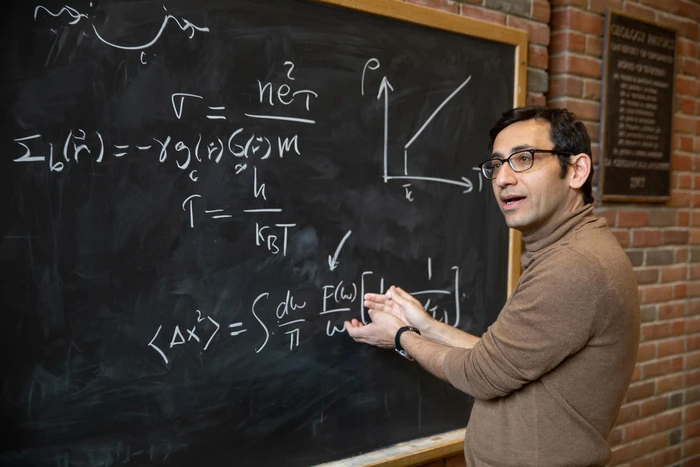
Theoretical physicist Yashar Komijani, an assistant professor at the University of Cincinnati, contributed to an international experiment using a strange metal made from an alloy of ytterbium, a rare earth metal. Physicists in a lab in Hyogo, Japan, fired radioactive gamma rays at the strange metal to observe its unusual electrical behavior.
Led by Hisao Kobayashi with the University of Hyogo and RIKEN, the study was published in the journal Science. The experiment revealed unusual fluctuations in the strange metal’s electrical charge.
“The idea is that in a metal, you have a sea of electrons moving in the background on a lattice of ions,” Komijani said. “But a marvelous thing happens with quantum mechanics. You can forget about the complications of the lattice of ions. Instead, they behave as if they are in a vacuum.”
Komijani for years has been exploring the mysteries of strange metals in relation to quantum mechanics.
“You can put something in a black box and I can tell you a lot about what’s inside it without even looking at it just by measuring things like resistivity, heat capacity and conductivity,” he said.
“But when it comes to strange metals, I have no idea why they are showing the behavior they do. The mystery is what is happening inside this strange system. That is the question.”
Strange metals are of interest to a wide range of physicists studying everything from particle physics to quantum mechanics. One reason is because of their oddly high conductivity, at least under extremely cold temperatures, which gives them potential as superconductors for quantum computing.
“The thing that is really exciting about these new results is that they provide a new insight into the inner machinery of the strange metal,” said study co-author Piers Coleman, a distinguished professor at Rutgers University.
“These metals provide the canvas for new forms of electronic matter — especially exotic and high temperature superconductivity,” he said.
Coleman said it’s too soon to speculate about what new technologies strange metals might inspire.
“It is said that after Michael Faraday discovered electromagnetism, the British Chancellor William Gladstone asked what it would be good for,” Coleman said. “Faraday answered that while he didn't know, he was sure that one day the government would tax it.”
Faraday’s discoveries opened a world of innovation.
“We feel a bit the same about the strange metal,” Coleman said. “Metals play such a central role today — copper, the archetypal conventional metal, is in all devices, all power lines, all around us.”
Coleman said strange metals one day could be just as ubiquitous in our technology.
The Japan experiment was groundbreaking in part because of the way that researchers created the gamma particles using a particle accelerator called a synchrotron.
“In Japan, they use a synchrotron like they have at CERN [the European Organization for Nuclear Research] that accelerates a proton and smashes it into a wall and it emits a gamma ray,” Komijani said. “So they have an on-demand source of gamma rays without using radioactive material.”
Researchers used spectroscopy to study the effects of gamma rays on the strange metal.
Researchers also examined the speed of the metal’s electrical charge fluctuations, which take just a nanosecond — a billionth of a second. That might seem incredibly fast, Komijani said.
“However, in the quantum world, a nanosecond is an eternity,” he said. “For a long time we have been wondering why these fluctuations are actually so slow. We came up with a theory with collaborators that there might be vibrations of the lattice and indeed that was the case.”
The study was funded in part by the National Science Foundation and the Department of Energy.
END
Theoretical physicist Yashar Komijani, an assistant professor at the University of Cincinnati, contributed to an international experiment using a strange metal made from an alloy of ytterbium, a rare earth metal. Physicists in a lab in Hyogo, Japan, fired radioactive gamma rays at the strange metal to observe its unusual electrical behavior.
Led by Hisao Kobayashi with the University of Hyogo and RIKEN, the study was published in the journal Science. The experiment revealed unusual fluctuations in the strange metal’s electrical charge.
“The idea is that in a metal, you have a sea of electrons moving in the background on a lattice of ions,” Komijani said. “But a marvelous thing happens with quantum mechanics. You can forget about the complications of the lattice of ions. Instead, they behave as if they are in a vacuum.”
Komijani for years has been exploring the mysteries of strange metals in relation to quantum mechanics.
“You can put something in a black box and I can tell you a lot about what’s inside it without even looking at it just by measuring things like resistivity, heat capacity and conductivity,” he said.
“But when it comes to strange metals, I have no idea why they are showing the behavior they do. The mystery is what is happening inside this strange system. That is the question.”
Strange metals are of interest to a wide range of physicists studying everything from particle physics to quantum mechanics. One reason is because of their oddly high conductivity, at least under extremely cold temperatures, which gives them potential as superconductors for quantum computing.
“The thing that is really exciting about these new results is that they provide a new insight into the inner machinery of the strange metal,” said study co-author Piers Coleman, a distinguished professor at Rutgers University.
“These metals provide the canvas for new forms of electronic matter — especially exotic and high temperature superconductivity,” he said.
Coleman said it’s too soon to speculate about what new technologies strange metals might inspire.
“It is said that after Michael Faraday discovered electromagnetism, the British Chancellor William Gladstone asked what it would be good for,” Coleman said. “Faraday answered that while he didn't know, he was sure that one day the government would tax it.”
Faraday’s discoveries opened a world of innovation.
“We feel a bit the same about the strange metal,” Coleman said. “Metals play such a central role today — copper, the archetypal conventional metal, is in all devices, all power lines, all around us.”
Coleman said strange metals one day could be just as ubiquitous in our technology.
The Japan experiment was groundbreaking in part because of the way that researchers created the gamma particles using a particle accelerator called a synchrotron.
“In Japan, they use a synchrotron like they have at CERN [the European Organization for Nuclear Research] that accelerates a proton and smashes it into a wall and it emits a gamma ray,” Komijani said. “So they have an on-demand source of gamma rays without using radioactive material.”
Researchers used spectroscopy to study the effects of gamma rays on the strange metal.
Researchers also examined the speed of the metal’s electrical charge fluctuations, which take just a nanosecond — a billionth of a second. That might seem incredibly fast, Komijani said.
“However, in the quantum world, a nanosecond is an eternity,” he said. “For a long time we have been wondering why these fluctuations are actually so slow. We came up with a theory with collaborators that there might be vibrations of the lattice and indeed that was the case.”
The study was funded in part by the National Science Foundation and the Department of Energy.
END
Attachments