Manchester graphene spin-out signs $1billion game-changing deal to help tackle global sustainability challenges
Landmark deal for the commercialisation of graphene
Published 2023-04-13 · Original archive entry · Explore research explainers
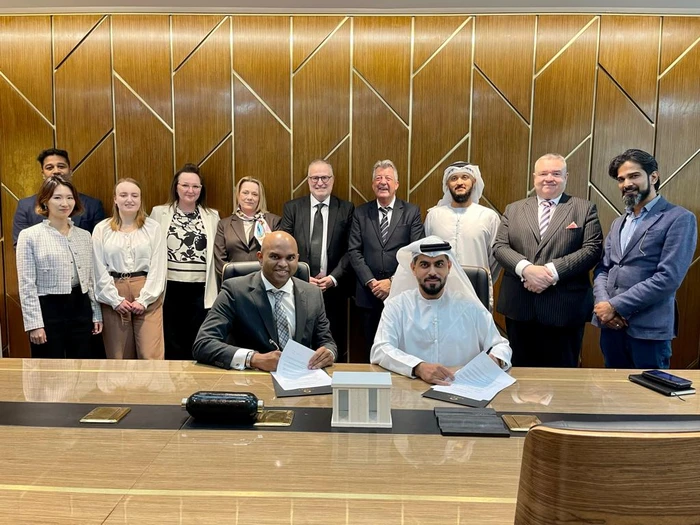
A spin-out company from the graphene innovation ecosystem at The University of Manchester has formed an international partnership that will spearhead an unprecedented scale-up of graphene-based technologies intended “to make a substantial impact on global CO2 emissions”.
UK-based Graphene Innovations Manchester Ltd (GIM), founded by University of Mancheser graduate Dr Vivek Koncherry, has signed a Memorandum of Understanding (MoU) with Quazar Investment Company to create a new company in the UAE. Graphene innovation has "
This agreement - which been hailed for its role in strengthening the relationship between the UK and UAE - will be one of the most ambitious projects to date to commercialise graphene as it fast-tracks cutting-edge R&D into large-scale manufacture – an investment vision worth a total of $1billion.
This new venture will develop and produce premium, environmentally-friendly products using advanced 2D materials, including breakthrough graphene-enhanced concrete that does not need cement or water and can be made using recycled materials.
Dr Vivek Koncherry, CEO of Graphene Innovations Manchester, based in Manchester’s Graphene Engineering Innovation Centre (GEIC), said: "We are proud to be associated with Quazar so that we can assemble a powerful world-class team to provide us the opportunity to massively deploy our graphene-based technologies.”
Waleed Al Ali, CEO of Quazar, who will be active in helping bring the new company to successful, large-scale commercialisation, said: "The new graphene company will take a global lead in making environmentally-friendly concrete and other products. We are glad that Quazar can play an active role in helping fulfil the UAE's His Highness Sheikh Saeed Bin Hamdan Bin Mohamed Al Nahyan's support for the UAE Vision 2030."
James Baker, CEO of Graphene@Manchester, added: “This agreement with our GEIC partner Graphene Innovations Manchester and Quazar is a seminal moment for the commercialisation of graphene as it demonstrates huge confidence in the potential for this advanced material to help lead our transition into a net zero world.
“It is also a very proud moment for the Graphene@Manchester community as it confirms that our innovation ecosystem is providing exactly the right platform to nurture pioneering R&D into graphene and other 2D materials that is world-class.
“Manchester is known as the ‘home of graphene’ – but increasingly, it’s also being recognised as the home to its commercialisation potential. We are therefore able to form international partnerships, such as those in the UAE, based on this reputation; and from this position of strength we can place our city-region and the UK more generally into graphene’s global economy.
“As Greater Manchester further develops its innovation and manufacturing potential – all underpinned with the University’s leadership in advanced materials - this city-regional will have great opportunities with access to international supply chains, foreign investment and global markets.”
James Baker added: "Graphene innovation has again been hailed for its role in strengthening the relationship between the UK and UAE."
The international graphene innovation ecosystem based at The University of Manchester has recently been cited as an exemplar in attracting inward investment into the local regional economy – and therefore helping to boost the UK’s ‘levelling up’ agenda.
The spotlight comes in a report entitled, The role of universities in driving overseas investment into UK Research and Development published by universities think-tank the Higher Education Policy Institute (HEPI).
A strategic partnership that is highlighted is the ambitious agreement between the University and Abu Dhabi-based Khalifa University of Science and Technology which aims to deliver a funding boost for graphene innovation to develop new sustainable technologies. Attracting international funding to the North-West region of Britain is also helping the UK government level-up R&D spending across the nation.
END
UK-based Graphene Innovations Manchester Ltd (GIM), founded by University of Mancheser graduate Dr Vivek Koncherry, has signed a Memorandum of Understanding (MoU) with Quazar Investment Company to create a new company in the UAE. Graphene innovation has "
This agreement - which been hailed for its role in strengthening the relationship between the UK and UAE - will be one of the most ambitious projects to date to commercialise graphene as it fast-tracks cutting-edge R&D into large-scale manufacture – an investment vision worth a total of $1billion.
This new venture will develop and produce premium, environmentally-friendly products using advanced 2D materials, including breakthrough graphene-enhanced concrete that does not need cement or water and can be made using recycled materials.
Dr Vivek Koncherry, CEO of Graphene Innovations Manchester, based in Manchester’s Graphene Engineering Innovation Centre (GEIC), said: "We are proud to be associated with Quazar so that we can assemble a powerful world-class team to provide us the opportunity to massively deploy our graphene-based technologies.”
Waleed Al Ali, CEO of Quazar, who will be active in helping bring the new company to successful, large-scale commercialisation, said: "The new graphene company will take a global lead in making environmentally-friendly concrete and other products. We are glad that Quazar can play an active role in helping fulfil the UAE's His Highness Sheikh Saeed Bin Hamdan Bin Mohamed Al Nahyan's support for the UAE Vision 2030."
James Baker, CEO of Graphene@Manchester, added: “This agreement with our GEIC partner Graphene Innovations Manchester and Quazar is a seminal moment for the commercialisation of graphene as it demonstrates huge confidence in the potential for this advanced material to help lead our transition into a net zero world.
“It is also a very proud moment for the Graphene@Manchester community as it confirms that our innovation ecosystem is providing exactly the right platform to nurture pioneering R&D into graphene and other 2D materials that is world-class.
“Manchester is known as the ‘home of graphene’ – but increasingly, it’s also being recognised as the home to its commercialisation potential. We are therefore able to form international partnerships, such as those in the UAE, based on this reputation; and from this position of strength we can place our city-region and the UK more generally into graphene’s global economy.
“As Greater Manchester further develops its innovation and manufacturing potential – all underpinned with the University’s leadership in advanced materials - this city-regional will have great opportunities with access to international supply chains, foreign investment and global markets.”
James Baker added: "Graphene innovation has again been hailed for its role in strengthening the relationship between the UK and UAE."
The international graphene innovation ecosystem based at The University of Manchester has recently been cited as an exemplar in attracting inward investment into the local regional economy – and therefore helping to boost the UK’s ‘levelling up’ agenda.
The spotlight comes in a report entitled, The role of universities in driving overseas investment into UK Research and Development published by universities think-tank the Higher Education Policy Institute (HEPI).
A strategic partnership that is highlighted is the ambitious agreement between the University and Abu Dhabi-based Khalifa University of Science and Technology which aims to deliver a funding boost for graphene innovation to develop new sustainable technologies. Attracting international funding to the North-West region of Britain is also helping the UK government level-up R&D spending across the nation.
END
Attachments