A key protein for repairing broken nerves
Published 2023-05-09 · Original archive entry · Explore research explainers
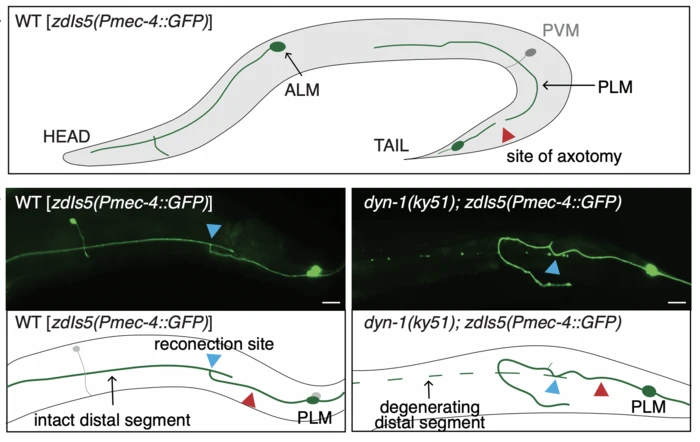
A study explores the role of the dynamin protein DYN-1 in axonal fusion. The axon is a long, thin protrusion of nerve cells that carries electrical impulses. Severed axons can be repaired by a highly efficient regrowth process known as axonal fusion. Previous research has shown that molecules involved in apoptosis—programmed cell death—are also involved in axonal repair. Because dynamin is involved in apoptosis, specifically in the recognition of dying cells, Brent Neumann and colleagues posited that dynamin might also be involved in axonal repair. The team severed axons in the model organism Caenorhabditis elegans, a multicellular nematode worm with just a few hundred neurons. In particular, the team used C. elegans carrying a genetic mutation with a mutant allele that results in temperature-sensitive loss of the DYN-1 protein: at 25 °C, DYN-1 degrades, whereas at 15 °C DYN-1 functions normally. Animals with this mutation showed a strong reduction in axonal fusion at the higher temperature, whereas C. elegans kept at 15 °C showed axonal fusion indistinguishable from control animals. The authors describe how DYN-1 controls levels of the transmembrane glycoprotein epithelial fusion failure-1 (EFF-1), which mediates the membrane fusion required to physically knit the axon back together. According to the authors, DYN-1 likely guides injury-induced reparative responses through multiple pathways.
END
END