(Press-News.org) Philadelphia, May 31, 2023 – About two-thirds of the risk for Alzheimer’s disease (AD) is thought to arise from genetic influences, but about a third could be influenced by environment and lifestyle, opening the door for behavioral interventions that could delay or prevent pathophysiological changes that occur with AD. Now a new study in a mouse model of AD examines the effects of environmental enrichment on AD symptom progression and pathology. The study appears in Biological Psychiatry, published by Elsevier.
Gerd Kempermann, PhD, from the German Center for Neurodegenerative Diseases in Dresden, Germany, and senior author of the study, emphasized the importance of studying the early stages of disease, when interventions might be most effective.
Dr. Kempermann commented, “AD does not start when the symptoms become obvious. There is a decades-long silent period, during which the pathology progresses undetected. Clinicians and researchers have become increasingly interested in what happens during this phase.”
To study this early pathology, Dr. Kempermann and colleagues used a mouse model of AD that replicates this silent period. The model contains several mutations associated with human AD in the gene encoding amyloid precursor protein (App). These AppNL-F mice develop toxic amyloid-beta plaques by age 6 months and cognitive impairment by 18 months.
Dr. Kempermann said, “However, we discovered that there are already subtle but important behavioral changes long before the first plaques appear, and the cognitive deficits become detectable.”
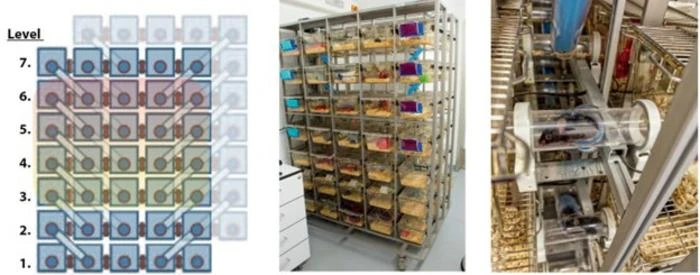
The mice were housed in an enriched environment, which consisted of 60 interconnected cages, from age 6 weeks to 23 weeks and were then moved to standard cages after 4 months. Living in the enriched environment improved several measures of metabolism, which are known risk factors for AD.
Dr. Kempermann explained, “The [AD model] mice in our study showed a reduction in individual behaviors. They became more similar and more rigid. As this individualization is to a large degree driven by individual behavior and depends on brain plasticity, we can conclude that the affected mice had behavioral deficits very early in the course of the disease. They did not respond normally to the offerings of their environment. This finding is important, because it will help us to understand how we can best tailor preventive measures during the pre-clinical phase. It also underscores that prevention has to start early.”
The researchers also examined markers of neurogenesis in the mice. Paradoxically, the AppNL-F mice had higher rates of neurogenesis than control mice, which is interpreted as a failing attempt at compensation and as paradoxically counterproductive. This overshooting compensation was normalized by exposure to enrichment.
John Krystal, MD, Editor of Biological Psychiatry, said of the work, "This novel study suggests that environmental enrichment may reduce the early accumulation of amyloid plaques in a mouse model of AD. This insight may suggest a strategy for delaying the development of symptoms associated with this disorder."
END
Tracking early signs of Alzheimer’s pathology in a mouse model
Behavioral interventions may alter trajectory, as reported in Biological Psychiatry
2023-05-31
ELSE PRESS RELEASES FROM THIS DATE:
New study highlights need for expanded application of prism adaptation treatment for spatial neglect
2023-05-31
East Hanover, NJ. May 31, 2023. A team of rehabilitation researchers discovered that prism adaptation therapy (PAT) was as beneficial for treating right-sided spatial neglect as left-sided spatial neglect in a cohort of individuals with stroke and traumatic and non-traumatic brain injuries. These novel findings and their clinical implications were reported in, “Prism adaptation treatment for right-sided and left-sided spatial neglect: A retrospective case-matched study,” (doi: 10.1016/j.arrct.2023.100263). The article was published open access on March 23, 2023, by the Archives of Rehabilitation Research and Clinical Translation. ...
Improving access to quality patient information
2023-05-31
In general, there is an issue around the quality of information about lupus on the internet. Rumours, unchecked data, and unconfirmed research all contribute to confusion and anxiety, and can lead to people taking the wrong actions for themselves and their disease. There is therefore a need for access to quality information about lupus.
Therapeutic patient education (TPE) is a key way to help people self-manage chronic conditions such as lupus. An essential component of TPE is access to valid information ...
Physiotherapy in your pocket
2023-05-31
Apps have become ubiquitous in many parts of life, including for health. For people with an RMD, personalized video exercises (PEV) may be useful to support rehabilitation and physical exercise.
In an abstract shared at the 2023 EULAR annual congress, Davergne and colleagues explore the effectiveness of PEV provided through Apps in supporting rehabilitation for people with disability. The impact was measured in terms of a range of outcomes, including the effect on functional capacity, confidence in exercise performance, use of care, health-related quality of life, adherence, and adverse events.
Data ...
CV risk in psoriatic arthritis
2023-05-31
“This evidence suggests that inflammation in PsA is not limited to skin and joints, but also involves the cardiovascular system”, says Nienke Kleinrensink, lead author on the abstract shared in a session on Comorbidities in RMD at the 2023 EULAR congress in Milan, Italy.
The new finding is based on work done at UMC Utrecht in the Netherlands. Part of the study was funded by Pfizer and Health Holland. The main objective was to investigate whether vascular inflammation is elevated in PsA patients. The team used positron emission tomography/computed tomography (PET/CT) in 75 people with PsA with active peripheral arthritis, ...
Cardiovascular considerations in RA
2023-05-31
The increased cardiovascular risks in RA include acute coronary syndromes (ACS). The extent to which DMARD-induced remission could reduce the risk of ACS in RA versus rates in the general population – and whether there are DMARD-specific beneficial effects on ACS risk – remain unknown. In a session titled, From hearts to lungs: comobidities in RA, Delcoigne and colleagues present new data on the risk of ACS in patients with RA who attained remission with methotrexate (MTX) or a tumor necrosis factor inhibitor (TNFi).
The researchers defined and pooled cohorts of RA patients from registers in Norway and Sweden. This included 14,488 treatment courses ...
A closer look into axial spondyloarthritis
2023-05-31
There is a large diagnostic delay for people with axial spondyloarthritis (axSpA). In 2008, the SPACE cohort started to assess the prevalence of axSpA – and the reliability of an early diagnosis in people with chronic back pain (CBP). Everyone taking part was under the age of 45, and with recent-onset CBP (over 3 months, and up to 2 years) of unknown origin. Now, Marques and colleagues present two abstracts of the 2-year primary outcome of the study at the EULAR congress.
The first abstract assesses the 2-year prevalence of an axSpA diagnosis among people with recent onset CBP who had been referred to a rheumatologist and investigates the sustainability of a baseline diagnosis ...
COVID and RA
2023-05-31
Studies on the long-term consequences of COVID-19 (long-COVID) in patients with inflammatory rheumatic diseases (iRD) are scarce. Where available data do exist, they tend to be heterogeneous and largely inconclusive. In addition, it is not known whether correctly classifying patients with iRD as long-COVID cases is complicated by increased background noise due to the occurrence of persistent symptoms that could be attributed to either long-COVID or iRD.
A team in the Netherlands aimed to compare the risk of developing long-COVID after infection with the Omicron ...
FMF: Factors associated with delayed diagnosis
2023-05-31
EULAR – The European Alliance of Associations for Rheumatology – held its 2023 annual congress in Milan, Italy. One of the abstracts chosen for presentation in the scientific session on Rheumatic and Musculoskeletal diseases (RMDs) in children and young people, focused on the factors associated with diagnostic delay in FMF, using data from the Juvenile Inflammatory Rheumatism (JIR) cohort.
Of 960 FMF patients enrolled, 80% received a diagnosis within 10 years of symptom onset; the remaining 20% had delayed diagnosis, and were significantly older with median age of 46.4 versus ...
Autoimmune diseases affect one in ten
2023-05-31
EULAR – the European Alliance of Associations for Rheumatology – works on a broad spectrum of autoimmune and auto-inflammatory diseases. A rise in the incidence of some of these has been described, raising the possibility that incidence might be impacted by environmental factors. But there is a lack of available data, and commonalities and differences between some individual diseases also remain poorly understood.
Conrad and colleagues aimed to clarify the picture by investigating 19 of the most common autoimmune diseases. Their work – shared at the 2023 EULAR congress in Milan, Italy – assesses trends over time, by sex, age, socioeconomic status, season ...
Exploring the role of AI in early RA
2023-05-31
Early inflammatory arthritis is often undifferentiated, but it may develop into established RA or another arthropathy.1 Alternatively, it may resolve spontaneously, or remain undifferentiated for indefinite periods. Erosion is a key prognostic factor which can be detected with magnetic resonance imaging (MRI).2 In addition, MRI allows direct visualization and assessment of (teno-) synovitis and bone marrow edema.3
Predicting early RA from MRI images of the hands and feet can help people access timely treatment, which may possibly ...
LAST 30 PRESS RELEASES:
Scientists show how to predict world’s deadly scorpion hotspots
ASU researchers to lead AAAS panel on water insecurity in the United States
ASU professor Anne Stone to present at AAAS Conference in Phoenix on ancient origins of modern disease
Proposals for exploring viruses and skin as the next experimental quantum frontiers share US$30,000 science award
ASU researchers showcase scalable tech solutions for older adults living alone with cognitive decline at AAAS 2026
Scientists identify smooth regional trends in fruit fly survival strategies
Antipathy toward snakes? Your parents likely talked you into that at an early age
Sylvester Cancer Tip Sheet for Feb. 2026
Online exposure to medical misinformation concentrated among older adults
Telehealth improves access to genetic services for adult survivors of childhood cancers
Outdated mortality benchmarks risk missing early signs of famine and delay recognizing mass starvation
Newly discovered bacterium converts carbon dioxide into chemicals using electricity
Flipping and reversing mini-proteins could improve disease treatment
Scientists reveal major hidden source of atmospheric nitrogen pollution in fragile lake basin
Biochar emerges as a powerful tool for soil carbon neutrality and climate mitigation
Tiny cell messengers show big promise for safer protein and gene delivery
AMS releases statement regarding the decision to rescind EPA’s 2009 Endangerment Finding
Parents’ alcohol and drug use influences their children’s consumption, research shows
Modular assembly of chiral nitrogen-bridged rings achieved by palladium-catalyzed diastereoselective and enantioselective cascade cyclization reactions
Promoting civic engagement
AMS Science Preview: Hurricane slowdown, school snow days
Deforestation in the Amazon raises the surface temperature by 3 °C during the dry season
Model more accurately maps the impact of frost on corn crops
How did humans develop sharp vision? Lab-grown retinas show likely answer
Sour grapes? Taste, experience of sour foods depends on individual consumer
At AAAS, professor Krystal Tsosie argues the future of science must be Indigenous-led
From the lab to the living room: Decoding Parkinson’s patients movements in the real world
Research advances in porous materials, as highlighted in the 2025 Nobel Prize in Chemistry
Sally C. Morton, executive vice president of ASU Knowledge Enterprise, presents a bold and practical framework for moving research from discovery to real-world impact
Biochemical parameters in patients with diabetic nephropathy versus individuals with diabetes alone, non-diabetic nephropathy, and healthy controls
[Press-News.org] Tracking early signs of Alzheimer’s pathology in a mouse modelBehavioral interventions may alter trajectory, as reported in Biological Psychiatry