(Press-News.org) Kyoto, Japan -- An old campaign slogan for cough syrup, "It tastes awful. And it works," seemed to imply that any sweet content might have diminished the medicinal effect.
Sweetness, in the case of cancer, appears as a chain of sugar molecules attached to proteins by beta1,4-galactosyltransferase-3, or B4GALT3 According to the Cancer Genome Atlas, a high expression of this enzyme is associated with noticeably shortened survival rates in several types of immunotherapy cancers, such as neuroblastoma, cervical, and bladder cancer. However, the specific role of B4GALT3 in the tumor immune microenvironment -- or TIME -- was still unknown.
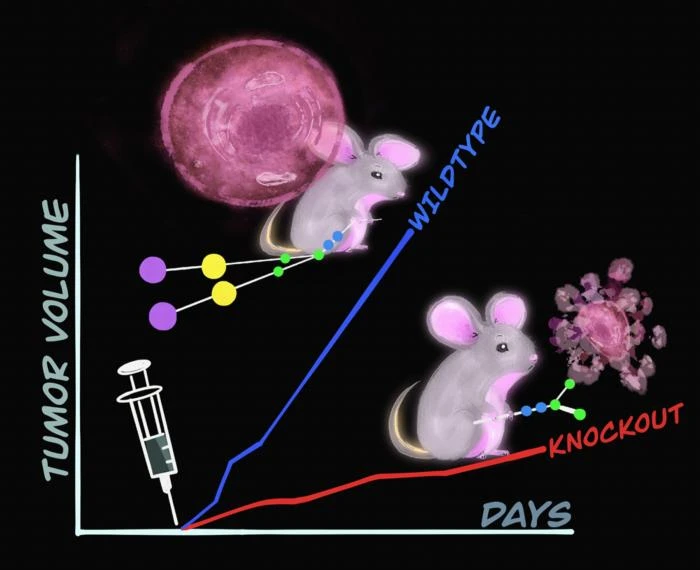
Now, a team of researchers at Kyoto University and Yokohama City University has found that B4GALT3 deficiency in mice TIME inhibits tumor growth. The study shows that a significant reduction of glycosylation -- a type of protein modification -- on T cell surfaces correlates with increases in CD8+ immune cells infiltrating tumors.
"In B4GALT3 knockout or KO mice, we demonstrated the potential of manipulating glycosylation of the T cell surface as a new approach to cancer immunotherapy," says Heng Wei of Kyoto University's Graduate School of Medicine.
By purifying membrane proteins and enzymatically cleaving them to enrich glycopeptides, the team could identify the sites and structures of glycans -- complex and highly branched sugar chains -- and the amount of glycoproteins. The role of glycans has attracted much attention in studies on cancer cells, which proliferate and metastasize, depending on their interaction with their microenvironment.
The team subcutaneously transplanted weakly immunogenic and strongly immunogenic tumor cells into B4GALT3 knockout and wild-type mice, to examine for tumor cell growth. Only the knockout mice suppressed the growth of strongly immunogenic tumor cells.
In addition, the increased CD8+ T cells in knockout mice secreted anti-cancer compounds Interferon-γ and Granzyme B.
"We found that the loss of B4GALT3 caused significant fluctuations in gene expression in the immune system, a discovery which has significantly changed the direction of our next phase of research," adds coauthor Chie Naruse.
"We have gained insight into the role of glycans in cancer progression and immune response, inspiring possibilities of B4GALT3-centered cancer therapies," says team leader Masahide Asano.
###
The paper "Beta-1,4-galactosyltransferase-3 deficiency suppresses the growth of. immunogenic tumors in mice" appeared on 9 October 2023 in Frontiers in Immunology, with doi: 10.3389/fimmu.2023.1272537
About Kyoto University
Kyoto University is one of Japan and Asia's premier research institutions, founded in 1897 and responsible for producing numerous Nobel laureates and winners of other prestigious international prizes. A broad curriculum across the arts and sciences at undergraduate and graduate levels complements several research centers, facilities, and offices around Japan and the world. For more information, please see: http://www.kyoto-u.ac.jp/en
END
Cancer's sweet Achilles heel
Unlocking the power of sugar chains holds a key to cancer immunotherapy
2023-10-26
ELSE PRESS RELEASES FROM THIS DATE:
Brain implant at OHSU successfully controls both seizures and OCD
2023-10-26
A patient at Oregon Health & Science University is the first in the world to benefit from a single stimulator implanted in the brain to effectively control two life-altering conditions: seizures caused by epilepsy and compulsive behavior caused by obsessive-compulsive disorder, or OCD.
Amber Pearson, 34, of Albany, said her seizures are under better control, but the relief from her psychiatric condition is profound.
“OCD is worse than having the seizures,” she said. “Epilepsy brings limitations to my life, but OCD controlled it.”
In the case study, published in the journal Neuron, co-authors from institutions across the ...
Brain injury expert says important changes still needed to law defining death despite reform pause
2023-10-26
After surveying the views expressed by 41 advocacy, medical, and transplant-focused organizations on the Uniform Determination of Death Act, a brain injury expert is calling for much-needed reforms to the legal definition of death in the United States. The recently announced pause by the Uniform Law Commission, which is spearheading revisions, is disappointing, the expert notes, but should not permanently stall practical fixes to longstanding problems with the Death Act.
“This study shows that most medical ...
Study examines racial differences in care among older Americans
2023-10-26
Older Black Americans are more likely to receive low value acute diagnostic tests than older White Americans, while older White Americans were more likely to receive low value screening tests and treatments, finds a study published by The BMJ today.
Low value care refers to services that provide little to no benefit yet have potential for harm, which can include laboratory tests, scans, and medication.
These differences were generally modest and were largely driven by differential treatment within health systems. But the researchers say the results “highlight ...
Industry payments to physicians linked to use of some non-recommended and low value drugs among cancer patients
2023-10-26
Patients with cancer whose oncologist receives payments from industry appear more likely to receive some non-recommended and low value treatments, finds a US study published by The BMJ today.
This finding raises potential concerns about quality of care, and the researchers say it may be appropriate to re-examine the current status of personal payments from the drug industry to physicians.
Research shows a consistent link between industry payments and prescribing behaviour, but whether payments to physicians have positive or negative consequences for patient care has not been evaluated empirically, say the ...
Hospitals accused of using foreign doctors as “cheap labour” in fellowship schemes
2023-10-26
English hospital trusts have been accused of using foreign doctors as “cheap labour” as part of fellowship schemes in which they can be paid less than trust-employed doctors and sent home if they become pregnant, an investigation by The BMJ has found.
Foreign doctors come to English hospital trusts as “fellows” as part of the Academy of Medical Royal Colleges’ Medical Training Initiative (MTI) scheme, explains investigations editor, Madlen Davies.
They work for two years in the NHS to gain experience that they will take back to their home countries afterwards. A proportion of fellows are sponsored, for example by their ...
Time to treat the climate and nature crisis as one indivisible global health emergency
2023-10-26
Over 200 health journals across the world have come together to simultaneously publish an editorial calling on world leaders and health professionals to recognise that climate change and biodiversity loss are one indivisible crisis and must be tackled together to preserve health and avoid catastrophe.
The authors say it’s a “dangerous mistake” to respond to the climate crisis and the nature crisis as if they were separate challenges, and urge the World Health Organization to declare this indivisible crisis as a global health emergency.
The editorial is published in leading titles from around ...
Vision via sound for the blind
2023-10-26
ustralian researchers have developed cutting-edge technology known as “acoustic touch” that helps people ‘see’ using sound. The technology has the potential to transform the lives of those who are blind or have low vision.
Around 39 million people worldwide are blind, according to the World Health Organisation, and an additional 246 million people live with low vision, impacting their ability to participate in everyday life activities.
The next generation smart glasses, which translate visual information into distinct sound icons, were developed by researchers from the University of Technology Sydney and the University of Sydney, ...
New study reveals inequities in access to mechanical circulatory support in US patients with cardiogenic shock
2023-10-26
SAN FRANCISCO – A new study presented today at TCT 2023 sought to evaluate the presence of racial, ethnic, and socioeconomic inequities in access to mechanical circulatory support in the United States among patients with cardiogenic shock (CS). The findings, published in the Journal of the Society for Cardiovascular Angiography & Interventions (JSCAI), revealed stark disparities, particularly among Black patients, that further highlight systemic inequities in access to lifesaving therapies.
CS is a life-threatening condition in which your heart suddenly cannot pump enough blood to meet the body’s needs. As a result, your ...
Breast cancer survivors: New training to treat 'chemo-brain'
2023-10-26
A form of computerised attention and memory training can improve impaired attention and memory issues in women treated for breast cancer, University of Reading researchers have found.
‘Chemo-brain’ refers to cognitive problems like forgetfulness, difficulty concentrating, and lapses in everyday attention, which are common side effects of breast cancer treatments including chemotherapy.
The findings, published in the journal Psycho-Oncology, suggest that an adaptive “dual memory tracking” training program may help breast cancer survivors cope ...
Pottery becomes water treatment device for Navajo Nation
2023-10-26
Large chunks of the Navajo Nation in the Southwest lack access to clean drinkable water, a trend that has been rising in many parts of the U.S. in recent years. A research team led by engineers with The University of Texas at Austin aims to change that.
The team has developed a new water filtration solution for members of the Navajo Nation, lining clay pots with pine tree resin collected from the Navajo Nation and incorporating tiny, silver-based particles that can be used to purify water to make it drinkable.
“Making water filtration technology cheap doesn’t solve ...
LAST 30 PRESS RELEASES:
Devastation of island land snails, especially in the Pacific
Microwaves help turn sugar industry waste into high-performance biochar
From craft dust to green gold: Turning palm handicraft waste into high value bio based chemicals
New roadmap shows how to turn farm nitrogen models into real world water quality gains
Heart damage is common after an operation and often goes unnoticed, but patients who see a cardiologist may be less likely to die or suffer heart disease as a result
New tool exposes scale of fake research flooding cancer science
Researchers identify new blood markers that may detect early pancreatic cancer
Scientists uncover why some brain cells resist Alzheimer's disease
The Lancet: AI-supported mammography screening results in fewer aggressive and advanced breast cancers, finds full results from first randomized controlled trial
New AI tool improves treatment of cancer patients after heart attack
Kandahar University highlights global disparities in neurosurgical workforce and access to care
Research spotlight: Discovering risk factors for long-term relapse in alcohol use disorder
As fossil fuel use declines, experts urge planning and coordination to prevent chaotic collapse
Scientists identify the antibody's hinge as a structural "control hub"
Late-breaking study establishes new risk model for surgery after TAVR
To reduce CO2 emissions, policy on carbon pricing, taxation and investment in renewable energy is key
Kissing the sun: Unraveling mysteries of the solar wind
Breathing new life into nanotubes for a cooler planet
Machine learning reveals how to maximize biochar yield from algae
Inconsistent standards may be undermining global tracking of antibiotic resistance
Helping hands: UBCO research team develops brace to reduce tremors
MXene nanomaterials enter a new dimension
Hippocampus does more than store memories: it predicts rewards, study finds
New light-based nanotechnology could enable more precise, less harmful cancer treatment
The heritability of human lifespan is roughly 50%, once external mortality is addressed
Tracking Finland’s ice fishers reveals how social information guides foraging decisions
DNA-protein crosslinks promote inflammation-linked premature aging and embryonic lethality in mice
Accounting for fossil energy’s “minimum viable scale” is central to decarbonization
Immunotherapy reduces plaque in arteries of mice
Using AI to retrace the evolution of genetic control elements in the brain
[Press-News.org] Cancer's sweet Achilles heelUnlocking the power of sugar chains holds a key to cancer immunotherapy