Photostimulation: non-invasive and effective therapeutic approach for Alzheimer’s disease
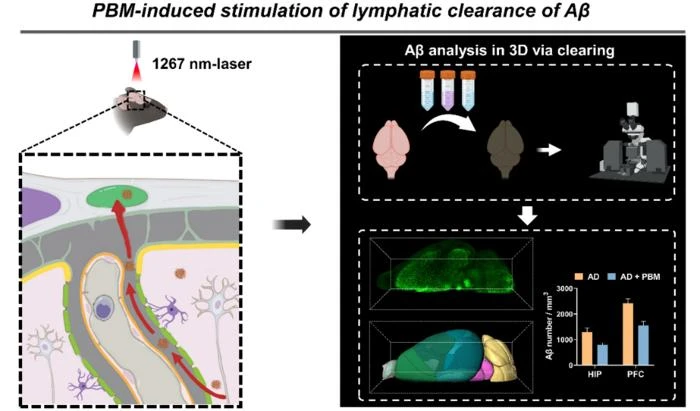
Alzheimer’s disease (AD) is an age-related neurodegenerative disorder. β-amyloid (Aβ) deposition in the brain is a crucial contributor to the pathogenesis of AD, mitigating excessive cerebral Aβ burden has been considered as a possible therapeutic strategy for AD. Meningeal lymphatic vessels (MLVs) are recently discovered structures responsible for exchanging soluble components between the cerebrospinal fluid and interstitial fluid, and have been proved to be a potential pathway of Aβ drainage.
Researchers at Huazhong University of Science and Technology (HUST), China, collaborated with researchers at Saratov State University, Russia, demonstrate that 1267-nm photobiomodulation (PBM) significantly alleviates Aβ deposition and cognitive decline in 5xFAD mice, and is safe as it does not induce a significant increase in cortical temperature. With the combination of 3D tissue optical clearing imaging and automatic brain region segmentation, they show that PBM can reduce Aβ plaques in the prefrontal cortex and the hippocampus, but to varying degrees in different subregions. PBM-mediated stimulation of Aβ elimination from the brain via the MLVs system may be a key mechanism in its therapeutic effects for AD in mice. The work entitled “Photostimulation of lymphatic clearance of β-amyloid from mouse brain: a new strategy for the therapy of Alzheimer’s disease” was published on Frontiers of Optoelectronics (published on Dec. 14, 2023).
END