Study with innovative insights into the heterogeneity of type 2 diabetes
Published 2024-03-18 · Original archive entry · Explore research explainers
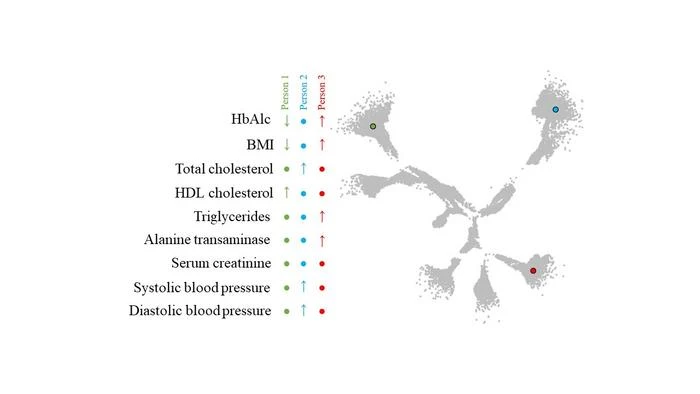
A landmark study by the German Diabetes Center (DDZ), published in The Lancet Diabetes & Endocrinology, sheds new light on the heterogeneity of type 2 diabetes. The researchers employed an innovative algorithm to stratify people with type 2 diabetes using routine data and thus visualize the metabolic diversity of diabetes.
Type 2 diabetes is a disease with highly diverse progression pathways. Using an innovative algorithm, a team led by the German Diabetes Center (DDZ) used routinely measured variables to open up new perspectives on the diversity of type 2 diabetes in terms of insulin sensitivity, insulin secretion, distribution of fatty tissue, and pro-inflammatory profiles.
Algorithm for Precision Diabetes Diagnosis
The work presents a unique, tree-like representation of diabetes heterogeneity that was originally developed by researchers in Great Britain under the leadership of Ewan Pearson and has now been refined with data from the German Diabetes Study (GDS) and the LURIC cohort. This innovative structure makes it possible to show different subtypes of type 2 diabetes in order to more clearly demonstrate how complex this disease is. Lead author Dr. Martin Schön stresses the importance of the study: “Our results demonstrate that we must consider type 2 diabetes in a significantly more differentiated manner and also, therefore, that there should not only be a single treatment for everyone.”
Besides age and sex, the algorithm is based on simple routine data that is either available to therapists or can be collected easily, such as BMI, total cholesterol, or HbA1c. In this way, people who produce less insulin or tend to exhibit insufficiently controlled hypertension or lipid metabolism disorders within the first five years of a diabetes diagnosis can be identified early on. Additionally, risks such as premature mortality and specific diabetes complications can also be visualized.
On the Way to Precision Diabetology
In recent years, countless results have been obtained at the DDZ for the purpose of subtyping diabetes mellitus. Continual refinement of these subtypes is now the goal for the precision diabetology of the future, says Prof. Dr. Michael Roden, director of the Clinic for Endocrinology and Diabetology at the University Hospital Düsseldorf and director of the DDZ. “Differentiating between subgroups of diabetes using simple clinical data will rapidly accelerate the development of new approaches to prevention and treatment in order to ultimately identify and treat high-risk groups in a targeted manner,” underlines the expert.
Practical Application
A simple illustration of the different forms and risks of type 2 diabetes, which can also be discussed with patients, delivers added value in daily practice. “Consequently, these research results could also be incorporated into everyday practice,” says Prof. Robert Wagner, who led the study at DDZ and is deputy director of the Clinic for Endocrinology and Diabetology at the University Hospital Düsseldorf. “The results of the study have the potential to change the way we understand and treat type 2 diabetes. An easy-to-use online tool already exists, making it possible to recognize and understand the biological heterogeneity of type 2 diabetes,” states Wagner. It has the potential to serve as a template for the development of more precise therapeutic approaches.
The algorithm clearly visualizes the diversity of type 2 diabetes and the variability of diabetes progression. It can be accessed and used via the following link: https://atn-uod2018.shinyapps.io/Prediction_diabetes_outcome_18082021/
END
Type 2 diabetes is a disease with highly diverse progression pathways. Using an innovative algorithm, a team led by the German Diabetes Center (DDZ) used routinely measured variables to open up new perspectives on the diversity of type 2 diabetes in terms of insulin sensitivity, insulin secretion, distribution of fatty tissue, and pro-inflammatory profiles.
Algorithm for Precision Diabetes Diagnosis
The work presents a unique, tree-like representation of diabetes heterogeneity that was originally developed by researchers in Great Britain under the leadership of Ewan Pearson and has now been refined with data from the German Diabetes Study (GDS) and the LURIC cohort. This innovative structure makes it possible to show different subtypes of type 2 diabetes in order to more clearly demonstrate how complex this disease is. Lead author Dr. Martin Schön stresses the importance of the study: “Our results demonstrate that we must consider type 2 diabetes in a significantly more differentiated manner and also, therefore, that there should not only be a single treatment for everyone.”
Besides age and sex, the algorithm is based on simple routine data that is either available to therapists or can be collected easily, such as BMI, total cholesterol, or HbA1c. In this way, people who produce less insulin or tend to exhibit insufficiently controlled hypertension or lipid metabolism disorders within the first five years of a diabetes diagnosis can be identified early on. Additionally, risks such as premature mortality and specific diabetes complications can also be visualized.
On the Way to Precision Diabetology
In recent years, countless results have been obtained at the DDZ for the purpose of subtyping diabetes mellitus. Continual refinement of these subtypes is now the goal for the precision diabetology of the future, says Prof. Dr. Michael Roden, director of the Clinic for Endocrinology and Diabetology at the University Hospital Düsseldorf and director of the DDZ. “Differentiating between subgroups of diabetes using simple clinical data will rapidly accelerate the development of new approaches to prevention and treatment in order to ultimately identify and treat high-risk groups in a targeted manner,” underlines the expert.
Practical Application
A simple illustration of the different forms and risks of type 2 diabetes, which can also be discussed with patients, delivers added value in daily practice. “Consequently, these research results could also be incorporated into everyday practice,” says Prof. Robert Wagner, who led the study at DDZ and is deputy director of the Clinic for Endocrinology and Diabetology at the University Hospital Düsseldorf. “The results of the study have the potential to change the way we understand and treat type 2 diabetes. An easy-to-use online tool already exists, making it possible to recognize and understand the biological heterogeneity of type 2 diabetes,” states Wagner. It has the potential to serve as a template for the development of more precise therapeutic approaches.
The algorithm clearly visualizes the diversity of type 2 diabetes and the variability of diabetes progression. It can be accessed and used via the following link: https://atn-uod2018.shinyapps.io/Prediction_diabetes_outcome_18082021/
END
Attachments