A protein that enables smell—and stops cell death
The protein Orco is essential for smell neuron function and development in ants, fostering the insects’ social behavior
Published 2024-06-07 · Original archive entry · Explore research explainers
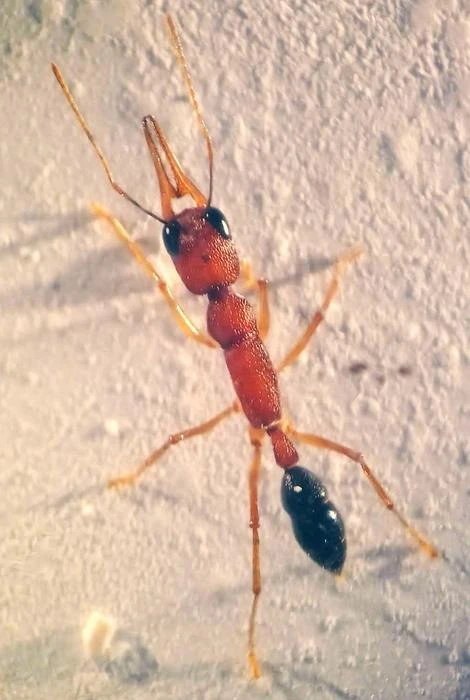
While smell plays a considerable role in the social interactions of humans—for instance, signaling fear or generating closeness—for ants, it is vitally important. Researchers from New York University and the University of Florida found that a key protein named Orco, essential for the function of olfactory cells, is also critical for the cells’ survival in ants.
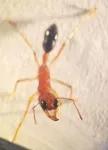
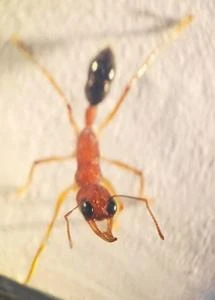
Their study showed that mutating the orco gene in Harpegnathos saltator jumping ants dramatically decreased the number of olfactory neurons, suggesting that Orco is necessary for the development and life of these cells. The findings, published in Science Advances, offer insights into the cellular and molecular basis of how animals socialize.
“Understanding how the nervous system develops is among the most pressing challenges in modern neuroscience,” said Bogdan Sieriebriennikov, a postdoctoral fellow in NYU’s Department of Biology and the study’s first author.
Sensing smell and mutant ants
Ants have evolved approximately 400 smell receptors—a number closer to humans than most other insects—thanks to their use of pheromone communication.
“Ants, like humans, are highly social and display cooperative social behavior, and thus provide an ideal system to study sensory-mediated social behavior,” explained Hua Yan, assistant professor of biology at the University of Florida and the study’s senior author. “Expanded odorant receptor genes allow ants to ‘talk’ to each other in a large society with hundreds, thousands, or up to a million individuals.”
Even for humans, who rely on other senses for communication, smell is essential.
“Loss of function of odorant receptor neurons leads to deficits in olfactory sensing and is often associated with social isolation, neurological disorders such as schizophrenia, and social disorders such as autism,” added Yan.
To better understand how ants’ sense of smell influences their social interactions, NYU researchers previously created the first genetically engineered ants by using CRISPR to edit the orco gene. These “mutant” ants, lacking the Orco protein, experienced changes to their smell organs and had difficulty interacting.
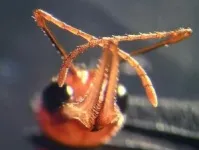
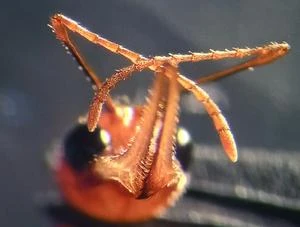
“We found that the antennae—which are the ‘nose’ of the ant—had very few cells. They were almost empty, suggesting that the cells that sense smell were absent from the mutant ants,” said Yan.
Neuron survival depends on Orco
In their new study in Science Advances, the researchers used single-nucleus gene expression profiling of ant antennae and fluorescence microscopy to analyze olfactory cell development. It emerged that mutant insects lacking Orco lose most of their olfactory neurons before adulthood.
“The cells appear to be made normally, and they start developing—growing, changing shape, and switching on certain genes they will need later, such as odorant receptors,” noted Sieriebriennikov. “Once the developing cells turn on the odorant receptors, very soon they start dying in massive amounts.”
This neuronal death may be because of stress. As the odorant receptors in the mutant ants cannot form a complex with Orco to travel to the cell membrane, the newly made receptors clog the organelles, leading to stress and death.
Such neuronal death may also show patterns particular to social insects. “So far, these unique processes have not been found in solitary insects and may provide important evidence of evolution of neural development to adapt to the expansion of odorant receptor genes,” said Kayli Sieber, a doctoral candidate at the University of Florida and the co-first author of the study.
Interestingly, some odorant receptors survived even without Orco. The cells in which they were present also expressed other types of receptors, suggesting that the activity they facilitate is essential for neuronal development.
“Some neurons must periodically ‘fire’ to develop properly. Without Orco, smell cells did not ‘fire’ and complete their development, leading to their death," said Sieriebriennikov.
The researchers also found that some odorant receptors are present in non-smell cells, such as mechanosensory neurons that detect motion and glia, which wrap around neurons and help them function. This may be due to imperfect regulation of genes, which causes odorant receptors to be accidentally activated by nearby genomic regions that are normally regulating other genes in other cells. Alternatively, the receptors may have a new function in these cells, like the odorant receptors found in the glia of C. elegans worms or human sperm.
“Turning on odorant receptor genes in the cells that are not smell-sensing could be totally useless for the organism—but then again, evolution tends to make use of such mistakes to give existing genes new function, so perhaps there is some exciting new role of odorant receptors in non-smell cells that we will discover in the future,” noted Sieriebriennikov.
“Our findings enhance our understanding of social insects’ sensory systems, including olfactory neural development that establishes a framework for social communication,” said Yan.
Other study authors include Olena Kolumba, Jakub Mlejnek, and Shadi Jafari. This research was supported by the National Institutes of Health (R01-DC020203, T32-DC015994), the National Science Foundation Industry-University Cooperative Research Center for Arthropod Management Technologies (#IIP1821914), and the Human Frontier Science Program (LT000010/2020-L).
END
Their study showed that mutating the orco gene in Harpegnathos saltator jumping ants dramatically decreased the number of olfactory neurons, suggesting that Orco is necessary for the development and life of these cells. The findings, published in Science Advances, offer insights into the cellular and molecular basis of how animals socialize.
“Understanding how the nervous system develops is among the most pressing challenges in modern neuroscience,” said Bogdan Sieriebriennikov, a postdoctoral fellow in NYU’s Department of Biology and the study’s first author.
Sensing smell and mutant ants
Ants have evolved approximately 400 smell receptors—a number closer to humans than most other insects—thanks to their use of pheromone communication.
“Ants, like humans, are highly social and display cooperative social behavior, and thus provide an ideal system to study sensory-mediated social behavior,” explained Hua Yan, assistant professor of biology at the University of Florida and the study’s senior author. “Expanded odorant receptor genes allow ants to ‘talk’ to each other in a large society with hundreds, thousands, or up to a million individuals.”
Even for humans, who rely on other senses for communication, smell is essential.
“Loss of function of odorant receptor neurons leads to deficits in olfactory sensing and is often associated with social isolation, neurological disorders such as schizophrenia, and social disorders such as autism,” added Yan.
To better understand how ants’ sense of smell influences their social interactions, NYU researchers previously created the first genetically engineered ants by using CRISPR to edit the orco gene. These “mutant” ants, lacking the Orco protein, experienced changes to their smell organs and had difficulty interacting.
“We found that the antennae—which are the ‘nose’ of the ant—had very few cells. They were almost empty, suggesting that the cells that sense smell were absent from the mutant ants,” said Yan.
Neuron survival depends on Orco
In their new study in Science Advances, the researchers used single-nucleus gene expression profiling of ant antennae and fluorescence microscopy to analyze olfactory cell development. It emerged that mutant insects lacking Orco lose most of their olfactory neurons before adulthood.
“The cells appear to be made normally, and they start developing—growing, changing shape, and switching on certain genes they will need later, such as odorant receptors,” noted Sieriebriennikov. “Once the developing cells turn on the odorant receptors, very soon they start dying in massive amounts.”
This neuronal death may be because of stress. As the odorant receptors in the mutant ants cannot form a complex with Orco to travel to the cell membrane, the newly made receptors clog the organelles, leading to stress and death.
Such neuronal death may also show patterns particular to social insects. “So far, these unique processes have not been found in solitary insects and may provide important evidence of evolution of neural development to adapt to the expansion of odorant receptor genes,” said Kayli Sieber, a doctoral candidate at the University of Florida and the co-first author of the study.
Interestingly, some odorant receptors survived even without Orco. The cells in which they were present also expressed other types of receptors, suggesting that the activity they facilitate is essential for neuronal development.
“Some neurons must periodically ‘fire’ to develop properly. Without Orco, smell cells did not ‘fire’ and complete their development, leading to their death," said Sieriebriennikov.
The researchers also found that some odorant receptors are present in non-smell cells, such as mechanosensory neurons that detect motion and glia, which wrap around neurons and help them function. This may be due to imperfect regulation of genes, which causes odorant receptors to be accidentally activated by nearby genomic regions that are normally regulating other genes in other cells. Alternatively, the receptors may have a new function in these cells, like the odorant receptors found in the glia of C. elegans worms or human sperm.
“Turning on odorant receptor genes in the cells that are not smell-sensing could be totally useless for the organism—but then again, evolution tends to make use of such mistakes to give existing genes new function, so perhaps there is some exciting new role of odorant receptors in non-smell cells that we will discover in the future,” noted Sieriebriennikov.
“Our findings enhance our understanding of social insects’ sensory systems, including olfactory neural development that establishes a framework for social communication,” said Yan.
Other study authors include Olena Kolumba, Jakub Mlejnek, and Shadi Jafari. This research was supported by the National Institutes of Health (R01-DC020203, T32-DC015994), the National Science Foundation Industry-University Cooperative Research Center for Arthropod Management Technologies (#IIP1821914), and the Human Frontier Science Program (LT000010/2020-L).
END
Attachments