Microporous crystals for greater food safety – ERC proof of concept grant for researcher at Graz University of Technology
A research team led by Paolo Falcaro has developed a microporous crystal compound that signals whether protein-rich foods are spoilt. The ERC grant is now being used to explore practical applications.
Published 2025-01-23 · Original archive entry · Explore research explainers
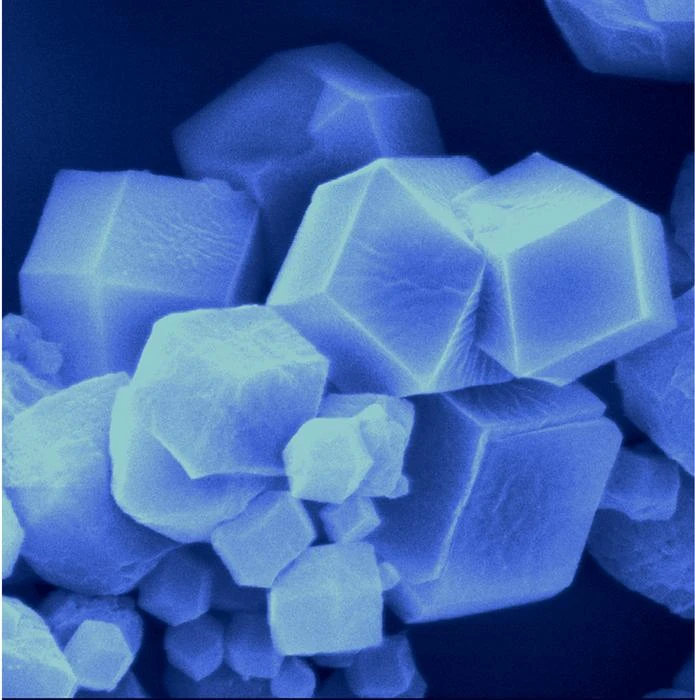
It is a result of his ERC Consolidator Grant-funded project POPCRYSTAL, with which Paolo Falcaro from the Institute of Physical and Theoretical Chemistry at TU Graz has now acquired an ERC Proof of Concept Grant (PoC). The new project called FRESCO, which is being funded to the tune of 150,000 euros over a period of 18 months, aims to increase food safety and reduce food waste. This is made possible by a microporous crystalline composite developed as part of the POPCRYSTAL project, which detects toxic chemical compounds that are produced when protein-rich foods such as fish, meat or cheese spoil.
Composite ink recognises toxic compounds A class of microporous crystals, also known as metal-organic frameworks (MOFs), are considered to have great potential in the field of materials science, as they have a very large surface area despite their small size. Depending on the arrangement of their pores, they can have a wide variety of properties. Paolo Falcaro succeeded in controlling the pore orientation in the POPCRYSTAL project. Building on this work, and through collaborations established within the framework of the TU Graz Lead Project 'Porous Materials at Work for Sustainability,' lithographic methods for the development of MOF-based applications were explored, resulting in preliminary findings published in Advanced Materials. These promising results will now be researched in FRESCO to further develop a sensitive ink that helps to detect food spoilage.
The basis for this is a MOF developed during POPCRYSTAL that can be applied to the inside of food packaging in the form of a non-toxic composite ink. The composite ink changes colour depending on the concentration of toxic compounds in the packaged food. This makes it possible to determine whether the food is still edible or not. During the new ERC project, Paolo Falcaro and his team, together with other researchers from TU Graz, want to improve the composition of the MOF ink, test its effectiveness and find suitable partners from the packaging industry to bring the development into application. This is also the intention behind the Proof of Concept Grant: to build on an ERC grant that has already been acquired and to evaluate the research results for marketable innovation potential.
Paolo Falcaro says: “Improving food safety and reducing food waste are global challenges. FRESCO is therefore also in line with the United Nations Sustainable Development Goals (SDGs), which aim, among other things, to increase food safety and achieve a more sustainable use of food through a more responsible consumption of products. If packaging can continuously monitor the freshness of food with our MOF, this should prevent the premature disposal of food that is still edible as well as the consumption of spoilt food.”
Materials science as a field of scientific strength at TU Graz As a proven field of scientific strength at TU Graz, research in the field of materials science is both intensive and successful. Several ERC grants have already been acquired here and a total of seven Christian Doppler Laboratories are dedicated to topics such as nanoprobes, geopolymer construction materials from mineral waste or mass transport through paper. In addition, a Lead Project is underway that deals with porous materials.
“TU Graz congratulates Paolo Falcaro and his team on this ERC Proof of Concept Grant,” says Andrea Höglinger, TU Graz Vice Rector for Research. “Our researchers in the field of materials science, particularly in the area of porous materials, are constantly achieving results that attract international attention. The ERC grant for the FRESCO project is further proof of this outstanding research work.”
END
Composite ink recognises toxic compounds A class of microporous crystals, also known as metal-organic frameworks (MOFs), are considered to have great potential in the field of materials science, as they have a very large surface area despite their small size. Depending on the arrangement of their pores, they can have a wide variety of properties. Paolo Falcaro succeeded in controlling the pore orientation in the POPCRYSTAL project. Building on this work, and through collaborations established within the framework of the TU Graz Lead Project 'Porous Materials at Work for Sustainability,' lithographic methods for the development of MOF-based applications were explored, resulting in preliminary findings published in Advanced Materials. These promising results will now be researched in FRESCO to further develop a sensitive ink that helps to detect food spoilage.
The basis for this is a MOF developed during POPCRYSTAL that can be applied to the inside of food packaging in the form of a non-toxic composite ink. The composite ink changes colour depending on the concentration of toxic compounds in the packaged food. This makes it possible to determine whether the food is still edible or not. During the new ERC project, Paolo Falcaro and his team, together with other researchers from TU Graz, want to improve the composition of the MOF ink, test its effectiveness and find suitable partners from the packaging industry to bring the development into application. This is also the intention behind the Proof of Concept Grant: to build on an ERC grant that has already been acquired and to evaluate the research results for marketable innovation potential.
Paolo Falcaro says: “Improving food safety and reducing food waste are global challenges. FRESCO is therefore also in line with the United Nations Sustainable Development Goals (SDGs), which aim, among other things, to increase food safety and achieve a more sustainable use of food through a more responsible consumption of products. If packaging can continuously monitor the freshness of food with our MOF, this should prevent the premature disposal of food that is still edible as well as the consumption of spoilt food.”
Materials science as a field of scientific strength at TU Graz As a proven field of scientific strength at TU Graz, research in the field of materials science is both intensive and successful. Several ERC grants have already been acquired here and a total of seven Christian Doppler Laboratories are dedicated to topics such as nanoprobes, geopolymer construction materials from mineral waste or mass transport through paper. In addition, a Lead Project is underway that deals with porous materials.
“TU Graz congratulates Paolo Falcaro and his team on this ERC Proof of Concept Grant,” says Andrea Höglinger, TU Graz Vice Rector for Research. “Our researchers in the field of materials science, particularly in the area of porous materials, are constantly achieving results that attract international attention. The ERC grant for the FRESCO project is further proof of this outstanding research work.”
END
Attachments