Our ancestors lived on shaky ground
Scientists find link between tectonically active landscapes and ancient sites
Published 2011-03-04 · Original archive entry · Explore research explainers
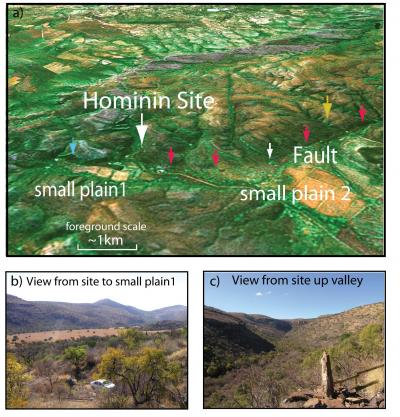
Our earliest ancestors preferred to settle in locations that have something in common with cities such as San Francisco, Naples and Istanbul -- they are often on active tectonic faults in areas that have an earthquake risk or volcanoes, or both.
An international team of scientists has established a link between the shape of the landscape and the habitats preferred by our earliest ancestors. The research, by scientists at the University of the Witwatersrand, South Africa, the University of York and the Institut de Physique du Globe Paris (IPGP), is published in the March 2011 issue of the Journal of Human Evolution.
The four-year study examines the geomorphology (literally the shape of the landscape) around ancient sites in southern Africa.
Lead author, South African Dr Sally Reynolds, a palaeoanthropologist at Witwatersrand who conducted the research during a postdoctoral fellowship at IPGP, says: "We were stunned when during a fieldwork trip in South Africa in 2007, Professor Geoffrey King and I discovered evidence that hominin sites such as Taung, Sterkfontein and Makapansgat, show landscape features in combinations that are not random, but result from tectonic motions, such as earthquakes."
Several lines of scientific evidence suggest that Australopithecus africanus (like the 'Mrs Ples' fossil from Sterkfontein) was adapted to mixed, or mosaic habitats -- landscapes with trees and open grassland, with some wetland marshy areas. The study suggests that it was the type of mosaic environment created by tectonic earth movements near rivers or lakes.
These features including cliffs, sedimented valleys, river gorges and drier plateau areas in close proximity of about 10 kilometres, are created when sections of the earth's crust move in response to pressure, then blocks of land are lifted up, while others are forced downwards. When this happens next to a river, the result is the creation of wetland, marshy areas close to drier plateaus and areas of erosion.
Professor Geoff Bailey, from the University of York, who is the lead author on an accompanying paper, also published in the same issue of the Journal of Human Evolution, confirms: "This link between earthquakes and human habitation is one we've long suspected was there. Regions vulnerable to earthquake and volcanic activity often create landscapes with long-term benefits for human settlement. But the tragic events in Christchurch are a graphic illustration of the attendant risk of these locations."
Professor King, a tectonic geomorphologist at the IPGP, adds: "The original idea was developed in Greece over a decade ago, with the surprising discovery that the sites there were clearly associated with ongoing tectonic activity.
"Even though South Africa appears to be tectonically stable, there are landscape features that indicate that modest levels of activity are preserved in the hard, southern African rocks. This means that the landscape model we developed in Greece is equally applicable to East Africa, and now also to the well-known fossil sites of the South Africa's Cradle of Humankind World Heritage Site."
Dr Reynolds, who is also an honorary research fellow at the School of Natural Sciences and Psychology at Liverpool John Moores University, explains "Our hominin ancestors would have been unaware of the tectonic influence on their habitats, but instead would have been attracted by the range of food and shelter offered."
The combination of drinking water, steep cliffs that provided shelter from predators, together with a range of feeding sources constitute the key ingredients for an ideal habitat for our ancestors.
INFORMATION:
An international team of scientists has established a link between the shape of the landscape and the habitats preferred by our earliest ancestors. The research, by scientists at the University of the Witwatersrand, South Africa, the University of York and the Institut de Physique du Globe Paris (IPGP), is published in the March 2011 issue of the Journal of Human Evolution.
The four-year study examines the geomorphology (literally the shape of the landscape) around ancient sites in southern Africa.
Lead author, South African Dr Sally Reynolds, a palaeoanthropologist at Witwatersrand who conducted the research during a postdoctoral fellowship at IPGP, says: "We were stunned when during a fieldwork trip in South Africa in 2007, Professor Geoffrey King and I discovered evidence that hominin sites such as Taung, Sterkfontein and Makapansgat, show landscape features in combinations that are not random, but result from tectonic motions, such as earthquakes."
Several lines of scientific evidence suggest that Australopithecus africanus (like the 'Mrs Ples' fossil from Sterkfontein) was adapted to mixed, or mosaic habitats -- landscapes with trees and open grassland, with some wetland marshy areas. The study suggests that it was the type of mosaic environment created by tectonic earth movements near rivers or lakes.
These features including cliffs, sedimented valleys, river gorges and drier plateau areas in close proximity of about 10 kilometres, are created when sections of the earth's crust move in response to pressure, then blocks of land are lifted up, while others are forced downwards. When this happens next to a river, the result is the creation of wetland, marshy areas close to drier plateaus and areas of erosion.
Professor Geoff Bailey, from the University of York, who is the lead author on an accompanying paper, also published in the same issue of the Journal of Human Evolution, confirms: "This link between earthquakes and human habitation is one we've long suspected was there. Regions vulnerable to earthquake and volcanic activity often create landscapes with long-term benefits for human settlement. But the tragic events in Christchurch are a graphic illustration of the attendant risk of these locations."
Professor King, a tectonic geomorphologist at the IPGP, adds: "The original idea was developed in Greece over a decade ago, with the surprising discovery that the sites there were clearly associated with ongoing tectonic activity.
"Even though South Africa appears to be tectonically stable, there are landscape features that indicate that modest levels of activity are preserved in the hard, southern African rocks. This means that the landscape model we developed in Greece is equally applicable to East Africa, and now also to the well-known fossil sites of the South Africa's Cradle of Humankind World Heritage Site."
Dr Reynolds, who is also an honorary research fellow at the School of Natural Sciences and Psychology at Liverpool John Moores University, explains "Our hominin ancestors would have been unaware of the tectonic influence on their habitats, but instead would have been attracted by the range of food and shelter offered."
The combination of drinking water, steep cliffs that provided shelter from predators, together with a range of feeding sources constitute the key ingredients for an ideal habitat for our ancestors.
INFORMATION: