Global warming won't harm wind energy production, climate models predict
Published 2011-05-03 · Original archive entry · Explore research explainers
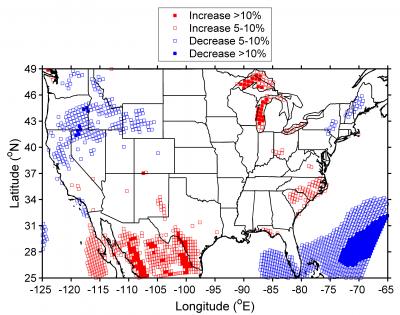
BLOOMINGTON, Ind. -- The production of wind energy in the U.S. over the next 30-50 years will be largely unaffected by upward changes in global temperature, say a pair of Indiana University Bloomington scientists who analyzed output from several regional climate models to assess future wind patterns in America's lower 48 states.
Their report -- the first analysis of long-term stability of wind over the U.S. -- appears in this week's Proceedings of the National Academy of Sciences Early Edition.
"The greatest consistencies in wind density we found were over the Great Plains, which are already being used to harness wind, and over the Great Lakes, which the U.S. and Canada are looking at right now," said Provost's Professor of Atmospheric Science Sara Pryor, the project's principal investigator. "Areas where the model predicts decreases in wind density are quite limited, and many of the areas where wind density is predicted to decrease are off limits for wind farms anyway."
Coauthor Rebecca Barthelmie, also a professor of atmospheric science, said the present study begins to address a major dearth of information about the long-term stability of wind as an energy resource. Questions have lingered about whether a warmer atmosphere might lead to decreases in wind density or changes in wind patterns.
"We decided it was time someone did a thorough analysis of long term-patterns in wind density," Barthelmie said. "There are a lot of myths out there about the stability of wind patterns, and industry and government also want more information before making decisions to expand it."
Pryor and Barthelmie examined three different regional climate models in terms of wind density changes in a future U.S. experiencing modest but noticeable climate change (warming of about 2 degrees Celsius relative to the end of the last century).
The scientists found the Canadian Regional Climate Model (CRCM) did the best job modeling the current wind climate, but included results from Regional Climate Model 3 (created in Italy but now developed in the U.S.) and the Hadley Centre Model (developed in the U.K.) for the sake of academic robustness and to see whether the different models agreed or disagreed when seeded with the same parameters.
All three state-of-the-art regional climate models were chained to output from one of four atmospheric-ocean general circulation models to derive a complete picture of wind density changes throughout the study area -- the lower 48 United States and a portion of northern Mexico.
Comparing model predictions for 2041-2062 to past observations of wind density (1979-2000), most areas were predicted to see little or no change. The areas expected to see continuing high wind density -- and therefore greater opportunities for wind energy production -- are atop the Great Lakes, eastern New Mexico, southwestern Ohio, southern Texas, and large swaths of several Mexican states, including Nuevo Leon, Tamaulipas, Chihuahua, and Durango.
"There was quite a bit of variability in predicted wind densities, but interestingly, that variability was very similar to the variability we observe in current wind patterns," Pryor said.
The Great Lakes -- Lakes Michigan, Superior, and Erie in particular -- consistently showed high wind density no matter what model was used.
Such predictions should prove crucial to American policymakers and energy producers, many of whom have pledged to make wind energy 20 percent of America's total energy production by 2030. Currently only about 2 percent of American energy comes from wind.
"There have been questions about the stability of wind energy over the long term, " Barthelmie said. "So we are focusing on providing the best science available to help decision makers." Pryor added that 'this is the first assessment of its type, so the results have to be considered preliminary. Climate models are evolving and improving all the time, so we intend to continue this assessment as new models become available."
Wind farms are nearly carbon neutral, and studies show that a turbine pays for itself after only three months of energy production. A typical turbine lasts about 30 years, Pryor says, not because parts break, but because advances in technology make it desirable to replace turbines with newer versions.
"Wind speed increases with height, so turbines are also getting taller," Pryor said. "One of our future projects will be to assess the benefit of deploying bigger turbines that extend farther from the ground."
This is also the week of the annual Offshore Technology Conference in Houston, the largest such energy conference in the world, which has increasingly focused on offshore wind energy production in recent years.
Last month, Pryor was appointed to the National Climate Assessment and Development Committee, convened by the U.S. Department of Commerce's National Oceanic and Atmospheric Administration to help the U.S. government prepare for and deal with climate change. She also contributed to a special report used by the Intergovernmental Panel on Climate Change (IPCC). Barthelmie is a widely respected expert on wind energy, particularly in northern Europe, whose wind farms she has studied for years. She was the winner of the European Academy of Wind Energy's 2009 Academy Science Award. Both Pryor and Barthelmie are faculty in the IU Bloomington Department of Geography, a division of the College of Arts and Sciences, and the Center for Research in Environmental Science.
INFORMATION:
Pryor and Barthelmie's work was supported by grants from the National Science Foundation (BCS 1019603), the International Atomic Energy Authority, and the IU Center for Research in Environmental Sciences. The model output they analyzed were provided by the North American Regional Climate Change Assessment Program (NARCCAP). NARCCAP is funded by the National Science Foundation, the U.S. Department of Energy, the National Oceanic and Atmospheric Administration, and the U.S. Environmental Protection Agency Office of Research and Development.
To speak with Pryor or Barthelmie, please contact David Bricker, University Communications, at 812-391-2434, 812-856-9035, or brickerd@indiana.edu.
Their report -- the first analysis of long-term stability of wind over the U.S. -- appears in this week's Proceedings of the National Academy of Sciences Early Edition.
"The greatest consistencies in wind density we found were over the Great Plains, which are already being used to harness wind, and over the Great Lakes, which the U.S. and Canada are looking at right now," said Provost's Professor of Atmospheric Science Sara Pryor, the project's principal investigator. "Areas where the model predicts decreases in wind density are quite limited, and many of the areas where wind density is predicted to decrease are off limits for wind farms anyway."
Coauthor Rebecca Barthelmie, also a professor of atmospheric science, said the present study begins to address a major dearth of information about the long-term stability of wind as an energy resource. Questions have lingered about whether a warmer atmosphere might lead to decreases in wind density or changes in wind patterns.
"We decided it was time someone did a thorough analysis of long term-patterns in wind density," Barthelmie said. "There are a lot of myths out there about the stability of wind patterns, and industry and government also want more information before making decisions to expand it."
Pryor and Barthelmie examined three different regional climate models in terms of wind density changes in a future U.S. experiencing modest but noticeable climate change (warming of about 2 degrees Celsius relative to the end of the last century).
The scientists found the Canadian Regional Climate Model (CRCM) did the best job modeling the current wind climate, but included results from Regional Climate Model 3 (created in Italy but now developed in the U.S.) and the Hadley Centre Model (developed in the U.K.) for the sake of academic robustness and to see whether the different models agreed or disagreed when seeded with the same parameters.
All three state-of-the-art regional climate models were chained to output from one of four atmospheric-ocean general circulation models to derive a complete picture of wind density changes throughout the study area -- the lower 48 United States and a portion of northern Mexico.
Comparing model predictions for 2041-2062 to past observations of wind density (1979-2000), most areas were predicted to see little or no change. The areas expected to see continuing high wind density -- and therefore greater opportunities for wind energy production -- are atop the Great Lakes, eastern New Mexico, southwestern Ohio, southern Texas, and large swaths of several Mexican states, including Nuevo Leon, Tamaulipas, Chihuahua, and Durango.
"There was quite a bit of variability in predicted wind densities, but interestingly, that variability was very similar to the variability we observe in current wind patterns," Pryor said.
The Great Lakes -- Lakes Michigan, Superior, and Erie in particular -- consistently showed high wind density no matter what model was used.
Such predictions should prove crucial to American policymakers and energy producers, many of whom have pledged to make wind energy 20 percent of America's total energy production by 2030. Currently only about 2 percent of American energy comes from wind.
"There have been questions about the stability of wind energy over the long term, " Barthelmie said. "So we are focusing on providing the best science available to help decision makers." Pryor added that 'this is the first assessment of its type, so the results have to be considered preliminary. Climate models are evolving and improving all the time, so we intend to continue this assessment as new models become available."
Wind farms are nearly carbon neutral, and studies show that a turbine pays for itself after only three months of energy production. A typical turbine lasts about 30 years, Pryor says, not because parts break, but because advances in technology make it desirable to replace turbines with newer versions.
"Wind speed increases with height, so turbines are also getting taller," Pryor said. "One of our future projects will be to assess the benefit of deploying bigger turbines that extend farther from the ground."
This is also the week of the annual Offshore Technology Conference in Houston, the largest such energy conference in the world, which has increasingly focused on offshore wind energy production in recent years.
Last month, Pryor was appointed to the National Climate Assessment and Development Committee, convened by the U.S. Department of Commerce's National Oceanic and Atmospheric Administration to help the U.S. government prepare for and deal with climate change. She also contributed to a special report used by the Intergovernmental Panel on Climate Change (IPCC). Barthelmie is a widely respected expert on wind energy, particularly in northern Europe, whose wind farms she has studied for years. She was the winner of the European Academy of Wind Energy's 2009 Academy Science Award. Both Pryor and Barthelmie are faculty in the IU Bloomington Department of Geography, a division of the College of Arts and Sciences, and the Center for Research in Environmental Science.
INFORMATION:
Pryor and Barthelmie's work was supported by grants from the National Science Foundation (BCS 1019603), the International Atomic Energy Authority, and the IU Center for Research in Environmental Sciences. The model output they analyzed were provided by the North American Regional Climate Change Assessment Program (NARCCAP). NARCCAP is funded by the National Science Foundation, the U.S. Department of Energy, the National Oceanic and Atmospheric Administration, and the U.S. Environmental Protection Agency Office of Research and Development.
To speak with Pryor or Barthelmie, please contact David Bricker, University Communications, at 812-391-2434, 812-856-9035, or brickerd@indiana.edu.