New strategy to attack tumor-feeding blood vessels
Published 2011-06-07 · Original archive entry · Explore research explainers
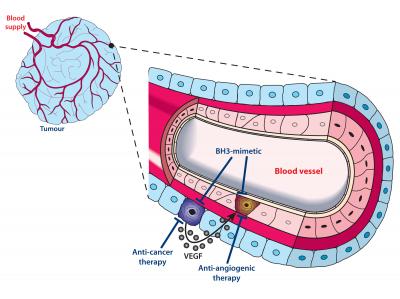
Scientists at the Walter and Eliza Hall Institute have discovered a key molecule needed to kill the blood vessels that supply tumours.
The research team from the institute's Molecular Genetics of Cancer and Cancer and Haematology divisions found that for anti-cancer therapies that target tumour blood vessels to work the death- inducing molecule Bim is required. The finding could lead to improved anti-cancer treatments that are based on a two- or three-pronged attack on both the tumour and its blood supply. The research will be published online in the Journal of Experimental Medicine today.
The growth of solid tumours, such as lung cancer, breast cancer and melanoma, depends on nutrients and oxygen being provided by the tumour blood supply. Cancer cells encourage the growth of blood vessels to feed a tumour by producing the hormone-like protein, vascular endothelial growth factor (VEGF). The research by Drs Edwina Naik, Leigh Coultas and Lorraine O'Reilly, and Professors Jerry Adams and Andreas Strasser showed that VEGF produced by tumours blocks production of Bim in the cells that line the tumour blood vessels.
New 'anti-angiogenic' medications that attack the blood vessels within tumours are showing promise in starving many types of cancers by reducing their blood supply.
In this study, in experimental melanoma, lung cancer and breast cancer models, Bim levels increased in the cells lining the blood vessels when VEGF was depleted by anti-angiogenic drugs, ultimately killing the blood vessel cells. VEGF depletion reduced the number of blood vessels in tumours, making the tumours shrink. However, in mice in which the blood vessels do not express Bim, VEGF depletion did not affect the number of tumour-associated blood vessels, and tumours grown in Bim-deficient mice did not respond to anti-angiogenic treatments.
Dr Strasser said this finding suggests that strategies for treating tumours by attacking the tumour blood supply could be optimised by incorporating drugs called BH3-mimetics that cause cell death by acting like Bim at a molecular level. "Similarly, therapies that increase the amount of Bim in tumour blood vessels could enhance the effects of anti-angiogenic agents," Dr Strasser said.
"BH3 mimetics may have two beneficial effects in cancer therapy. Our previous research had showed they can directly trigger death in tumour cells, particularly when the tumour is also attacked by chemotherapeutic drugs. We now think BH3-mimetics could also impact tumour cells indirectly by killing endothelial cells within tumours.
"This suggests that a promising new approach to the therapy of solid tumours may be to use a three-medication combination of a drug that specifically targets the tumour cell, an anti- angiogenic agent to impair the tumour blood vessels, plus a BH3 mimetic that will help the anti- tumour drug to directly kill the tumour cells and also will help the anti-angiogenic agent to kill the intra-tumoral endothelial cells, which in turn will starve the tumour, causing even more tumour cell death."
INFORMATION:
The research was supported by the Cancer Council Victoria, the National Health and Medical Research Council, the Australian Research Council, the US National Institutes of Health, the Leukemia and Lymphoma Society and Genentech.
The research team from the institute's Molecular Genetics of Cancer and Cancer and Haematology divisions found that for anti-cancer therapies that target tumour blood vessels to work the death- inducing molecule Bim is required. The finding could lead to improved anti-cancer treatments that are based on a two- or three-pronged attack on both the tumour and its blood supply. The research will be published online in the Journal of Experimental Medicine today.
The growth of solid tumours, such as lung cancer, breast cancer and melanoma, depends on nutrients and oxygen being provided by the tumour blood supply. Cancer cells encourage the growth of blood vessels to feed a tumour by producing the hormone-like protein, vascular endothelial growth factor (VEGF). The research by Drs Edwina Naik, Leigh Coultas and Lorraine O'Reilly, and Professors Jerry Adams and Andreas Strasser showed that VEGF produced by tumours blocks production of Bim in the cells that line the tumour blood vessels.
New 'anti-angiogenic' medications that attack the blood vessels within tumours are showing promise in starving many types of cancers by reducing their blood supply.
In this study, in experimental melanoma, lung cancer and breast cancer models, Bim levels increased in the cells lining the blood vessels when VEGF was depleted by anti-angiogenic drugs, ultimately killing the blood vessel cells. VEGF depletion reduced the number of blood vessels in tumours, making the tumours shrink. However, in mice in which the blood vessels do not express Bim, VEGF depletion did not affect the number of tumour-associated blood vessels, and tumours grown in Bim-deficient mice did not respond to anti-angiogenic treatments.
Dr Strasser said this finding suggests that strategies for treating tumours by attacking the tumour blood supply could be optimised by incorporating drugs called BH3-mimetics that cause cell death by acting like Bim at a molecular level. "Similarly, therapies that increase the amount of Bim in tumour blood vessels could enhance the effects of anti-angiogenic agents," Dr Strasser said.
"BH3 mimetics may have two beneficial effects in cancer therapy. Our previous research had showed they can directly trigger death in tumour cells, particularly when the tumour is also attacked by chemotherapeutic drugs. We now think BH3-mimetics could also impact tumour cells indirectly by killing endothelial cells within tumours.
"This suggests that a promising new approach to the therapy of solid tumours may be to use a three-medication combination of a drug that specifically targets the tumour cell, an anti- angiogenic agent to impair the tumour blood vessels, plus a BH3 mimetic that will help the anti- tumour drug to directly kill the tumour cells and also will help the anti-angiogenic agent to kill the intra-tumoral endothelial cells, which in turn will starve the tumour, causing even more tumour cell death."
INFORMATION:
The research was supported by the Cancer Council Victoria, the National Health and Medical Research Council, the Australian Research Council, the US National Institutes of Health, the Leukemia and Lymphoma Society and Genentech.