Non-coding RNA has role in inherited neurological disorder -- and maybe other brain diseases too
Published 2011-06-22 · Original archive entry · Explore research explainers
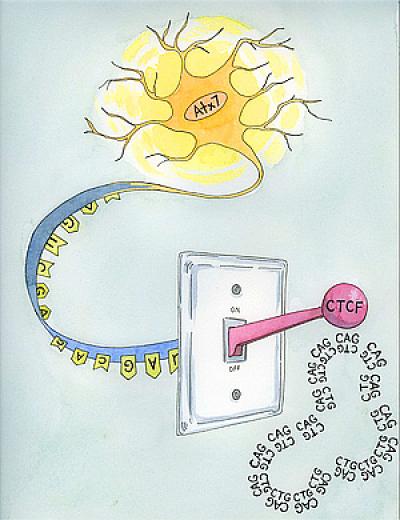
A team of scientists, led by researchers at the University of California, San Diego School of Medicine, have uncovered a novel mechanism regulating gene expression and transcription linked to Spinocerebellar ataxia 7, an inherited neurological disorder. The discovery promises to have broad ramifications, suggesting that abundant non-coding transcripts of ribonucleic acid (RNA) may be key players in neurological development and function, and could be powerful targets for future clinical therapies.
The research, headed by Albert La Spada, MD, PhD, chief of the division of genetics in the UCSD department of pediatrics, and professor of cellular and molecular medicine, neurosciences and biological sciences, is published in the June 22 issue of the journal Neuron.
"Our paper highlights a number of important emerging themes in our understanding of gene regulation in the brain," said La Spada, who is also associate director of the UCSD Institute for Genomic Medicine.
"With the advent of new technologies, science has learned that the vast majority of our transcripts are non-coding," said La Spada. "The challenge going forward is to determine what they do do, and if they have specific functions. It now seems increasingly likely that a multitude of these non-coding RNAs help finely tune transcription regulation in the brain, and perturbation of their work is linked to disease. If we can figure out exactly how, we should be able to gain new insights into how the brain is so precisely regulated – knowledge that may help us better understand how the brain works."
Spinocerebellar ataxia 7 is one of several types of spinocerebellar ataxia (SCA), genetic degenerative disorders characterized by atrophy in the cerebellum of the brain, progressive loss of physical coordination – and in the case of type 7 – retinal degeneration that can result in blindness. There is currently no known cure.
Many SCAs are classified as polyglutamine diseases, caused when a protein associated with the disease contains too many repeats of the amino acid glutamine. Polyglutamine diseases are also known as "CAG Triplet Repeat Disorders" because CAG is the sequence of nucleic acids that codes for glutamine.
La Spada and colleagues have long studied SCA. In 2001, they were the first to demonstrate that SCA7 retinal degeneration was the result of transcription dysregulation of ataxin-7, the protein associated with SCA7. Following up, they decided to learn how the gene that expresses ataxin-7 is itself regulated.
The researchers found not one, but two, regulators. The first is called CTCF, a highly conserved protein that regulates a variety of transcriptional processes, most notable establishing insulator domains and controlling genomic imprinting. But they also discovered an adjacent, alternative promoter dubbed intron 2 promoter (P2A) and a transcribed antisense, non-coding RNA, which they labeled SpinoCerebellarAtaxia-AntisenseNoncodingTranscript1 or SCAANT1.
Antisense RNA is single-stranded ribonucleic acid whose primary function appears to be as an inhibitor or suppressor of a gene, though sometimes it can promote gene expression instead. Most antisense RNAs are non-coding, meaning that their sequences do not provide information for making proteins. Even though non-coding RNAs do not provide instructions for the production of vital proteins, they comprise the bulk of the human genome. A major challenge for biomedical research in the 21st century is to figure what they do, and how they do it.
In their Neuron paper, La Spada and colleagues highlight one function, at least for SCAANT1. When they investigated how CTCF regulated ataxin-7 gene expression in transgenic mice, they discovered that CTCF promotes the production of SCAANT1 which in turn represses the newly discovered ataxin-7 sense promoter P2A. In mice lacking SCAANT1, sense promoter P2A is de-repressed, allowing a mutant ataxin-7 gene to be expressed, resulting in mice with a version of SCA7. The scientists found a similar lack of antisense SCAANT1 in the fibroblasts and white blood cells taken from human patients with SCA7, implicating deregulation of this pathway in the disease process.
As many inherited neurological disorders are now known to exhibit such overlapping "bidirectional" transcription, the findings in SCA7 could shed light on similar abnormalities with non-coding RNA function in a number of brain diseases.
INFORMATION:
Funding for this research came, in part, from the NIGMS of the National Institutes of Health.
Co-authors of the research are Bryce L. Sopher, Victor V. Pineda, Randell T. Libby and Cortlandt P. Thienes, Department of Laboratory Medicine, University of Washington, Seattle; Paula D. Ladd, Department of Pediatrics, UCSD; Susan M. Sunkin, Allen Institute for Brain Science, Seattle, WA; James B. Hurley, Department of Biochemistry, University of Washington, Seattle; Terry Gaasterland, Scripps Institute of Oceanography and Institute for Genomic Medicine, UCSD; Galina N. Filippova, Fred Hutchinson Cancer Research Center, Seattle, WA.
The research, headed by Albert La Spada, MD, PhD, chief of the division of genetics in the UCSD department of pediatrics, and professor of cellular and molecular medicine, neurosciences and biological sciences, is published in the June 22 issue of the journal Neuron.
"Our paper highlights a number of important emerging themes in our understanding of gene regulation in the brain," said La Spada, who is also associate director of the UCSD Institute for Genomic Medicine.
"With the advent of new technologies, science has learned that the vast majority of our transcripts are non-coding," said La Spada. "The challenge going forward is to determine what they do do, and if they have specific functions. It now seems increasingly likely that a multitude of these non-coding RNAs help finely tune transcription regulation in the brain, and perturbation of their work is linked to disease. If we can figure out exactly how, we should be able to gain new insights into how the brain is so precisely regulated – knowledge that may help us better understand how the brain works."
Spinocerebellar ataxia 7 is one of several types of spinocerebellar ataxia (SCA), genetic degenerative disorders characterized by atrophy in the cerebellum of the brain, progressive loss of physical coordination – and in the case of type 7 – retinal degeneration that can result in blindness. There is currently no known cure.
Many SCAs are classified as polyglutamine diseases, caused when a protein associated with the disease contains too many repeats of the amino acid glutamine. Polyglutamine diseases are also known as "CAG Triplet Repeat Disorders" because CAG is the sequence of nucleic acids that codes for glutamine.
La Spada and colleagues have long studied SCA. In 2001, they were the first to demonstrate that SCA7 retinal degeneration was the result of transcription dysregulation of ataxin-7, the protein associated with SCA7. Following up, they decided to learn how the gene that expresses ataxin-7 is itself regulated.
The researchers found not one, but two, regulators. The first is called CTCF, a highly conserved protein that regulates a variety of transcriptional processes, most notable establishing insulator domains and controlling genomic imprinting. But they also discovered an adjacent, alternative promoter dubbed intron 2 promoter (P2A) and a transcribed antisense, non-coding RNA, which they labeled SpinoCerebellarAtaxia-AntisenseNoncodingTranscript1 or SCAANT1.
Antisense RNA is single-stranded ribonucleic acid whose primary function appears to be as an inhibitor or suppressor of a gene, though sometimes it can promote gene expression instead. Most antisense RNAs are non-coding, meaning that their sequences do not provide information for making proteins. Even though non-coding RNAs do not provide instructions for the production of vital proteins, they comprise the bulk of the human genome. A major challenge for biomedical research in the 21st century is to figure what they do, and how they do it.
In their Neuron paper, La Spada and colleagues highlight one function, at least for SCAANT1. When they investigated how CTCF regulated ataxin-7 gene expression in transgenic mice, they discovered that CTCF promotes the production of SCAANT1 which in turn represses the newly discovered ataxin-7 sense promoter P2A. In mice lacking SCAANT1, sense promoter P2A is de-repressed, allowing a mutant ataxin-7 gene to be expressed, resulting in mice with a version of SCA7. The scientists found a similar lack of antisense SCAANT1 in the fibroblasts and white blood cells taken from human patients with SCA7, implicating deregulation of this pathway in the disease process.
As many inherited neurological disorders are now known to exhibit such overlapping "bidirectional" transcription, the findings in SCA7 could shed light on similar abnormalities with non-coding RNA function in a number of brain diseases.
INFORMATION:
Funding for this research came, in part, from the NIGMS of the National Institutes of Health.
Co-authors of the research are Bryce L. Sopher, Victor V. Pineda, Randell T. Libby and Cortlandt P. Thienes, Department of Laboratory Medicine, University of Washington, Seattle; Paula D. Ladd, Department of Pediatrics, UCSD; Susan M. Sunkin, Allen Institute for Brain Science, Seattle, WA; James B. Hurley, Department of Biochemistry, University of Washington, Seattle; Terry Gaasterland, Scripps Institute of Oceanography and Institute for Genomic Medicine, UCSD; Galina N. Filippova, Fred Hutchinson Cancer Research Center, Seattle, WA.