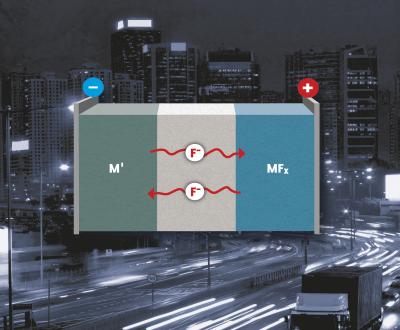
(Press-News.org) Lithium-ion batteries are applied widely, but their storage capacity is limited. In the future, battery systems of enhanced energy density will be needed for mobile applications in particular. Such batteries can store more energy at reduced weight. For this reason, KIT researchers are also conducting research into alternative systems. A completely new concept for secondary batteries based on metal fluorides was developed by Dr. Maximilian Fichtner, Head of the Energy Storage Systems Group, and Dr. Munnangi Anji Reddy at the KIT Institute of Nanotechnology (INT).
Metal fluorides may be applied as conversion materials in lithium-ion batteries. They also allow for lithium-free batteries with a fluoride-containing electrolyte, a metal anode, and metal fluoride cathode, which reach a much better storage capacity and possess improved safety properties. Instead of the lithium cation, the fluoride anion takes over charge transfer. At the cathode and anode, a metal fluoride is formed or reduced. "As several electrons per metal atom can be transferred, this concept allows to reach extraordinarily high energy densities – up to ten times as high as those of conventional lithium-ion batteries," explains Dr. Maximilian Fichtner.
The KIT researchers are now working on the further development of material design and battery architecture in order to improve the initial capacity and cyclic stability of the fluoride-ion battery. Another challenge lies in the further development of the electrolyte: The solid electrolyte applied so far is suited for applications at elevated temperatures only. It is therefore aimed at finding a liquid electrolyte that is suited for use at room temperature.
INFORMATION:
M. Anji Reddy and M. Fichtner: Batteries based on fluoride shuttle. Journal of Materials Chemistry. 2011, Advance Article. DOI: 10.1039/C1JM13535J.
Karlsruhe Institute of Technology (KIT) is a public corporation according to the legislation of the state of Baden-Württemberg. It fulfills the mission of a university and the mission of a national research center of the Helmholtz Association. KIT focuses on a knowledge triangle that links the tasks of research, teaching, and innovation.
Fluoride shuttle increases storage capacity
KIT researchers develop new concept for rechargeable batteries
2011-10-22
ELSE PRESS RELEASES FROM THIS DATE:
Misdiagnosis of Stroke Persistent Problem Among Young Patients
2011-10-22
For those suffering a stroke, effective early treatment is critical in order to avoid long term complications or even death. But, stroke is commonly thought of as a condition only affecting older patients. According to a study presented at the American Stroke Association's International Stroke Conference, this misperception often leads to misdiagnosis when stroke victims seek medical attention in an emergency room setting.
Nearly One in Seven Young Stroke Sufferers Misdiagnosed
It is true that the typical stroke victim is at least 55 years old. However, research shows ...
Research involving thyroid hormone lays foundation for more targeted drug development
2011-10-22
Research led by St. Jude Children's Research Hospital scientists advances a strategy for taming the side effects and enhancing the therapeutic benefits of steroids and other medications that work by disrupting the activity of certain hormones.
The approach relies on a small molecule developed at St. Jude. In this study, scientists showed that a compound known as SJ-AK selectively blocked the activity of genes in a cell signaling pathway regulated by thyroid hormone.
Investigators showed that SJ-AK also affected cells growing in the laboratory, reducing cell proliferation ...
How do protein binding sites stay dry in water?
2011-10-22
In a report to be published soon in EPJE¹, researchers from the National University of the South in Bahía Blanca, Argentina studied the condition for model cavity and tunnel structures resembling the binding sites of proteins to stay dry without losing their ability to react, a prerequisite for proteins to establish stable interactions with other proteins in water.
E.P. Schulz and colleagues used models of nanometric-scale hydrophobic cavities and tunnels to understand the influence of geometry on the ability of those structures to stay dry in solution.
The authors ...
Human Error Leads to Medical Malpractice Suit in UPMC Kidney Transplant
2011-10-22
The University of Pittsburgh Medical Center (UPMC) is known as a leading American health care provider. Yet, despite UPMC's high ranking in hospital rating publications, serious medical errors can and do occur in its facilities.
In early 2011, Michael Yocabet received a kidney from longtime girlfriend Christina Mecannic in an operation performed at UPMC Presbyterian. Although the surgery was completed without incident, it was later discovered that the donated kidney was infected with hepatitis C, which was passed to Yocabet. As a result, UPMC's living kidney donor transplant ...
Blood-pressure-lowering drug after stroke aids recovery, study finds
2011-10-22
Athens, Ga. – A commonly prescribed blood pressure-lowering medication appears to kick start recovery in the unaffected brain hemisphere after a stroke by boosting blood vessel growth, a new University of Georgia study has found.
The discovery, based on a study using rats and published recently in the online journal PLoS ONE, occurred only because the team, led by Susan Fagan, professor of clinical and administrative pharmacy at the UGA College of Pharmacy, struck a new path in stroke research by examining the healthy side of brain after the stroke occurred.
"I'm ...
Joint preservation in osteoarthritis
2011-10-22
Reconstructive surgical approaches can help delay endoprosthetic joint replacement in patients with osteoarthritis. Henning Madry and coauthors introduce such procedures in the current issue of Deutsches Ärzteblatt International (Dtsch Arztebl Int 2011; 108[40]: 669-77).
Articular cartilage defects often develop subsequent to injury or osteoarthritis. The authors in their article provide an overview of currently available medical and surgical therapeutic options. Medical therapy aims to preserve articular function for as long as possible and to delay surgical intervention. ...
Researchers generate first complete 3-D structures of bacterial chromosome
2011-10-22
WORCESTER, Mass. — A team of researchers at the University of Massachusetts Medical School, Harvard Medical School, Stanford University and the Prince Felipe Research Centre in Spain have deciphered the complete three-dimensional structure of the bacterium Caulobacter crescentus's chromosome. Analysis of the resulting structure —published this week in Molecular Cell — has revealed new insights into the function of genetic sequences responsible for the shape and structure of this genome.
Scientists know that the three-dimensional shape of a cell's chromosome plays a role ...
What you want vs. how you get it
2011-10-22
New research reveals how we make decisions. Birds choosing between berry bushes and investors trading stocks are faced with the same fundamental challenge - making optimal choices in an environment featuring varying costs and benefits. A neuroeconomics study from the Montreal Neurological Institute and Hospital – The Neuro, McGill University, shows that the brain employs two separate regions and two distinct processes in valuing 'stimuli' i.e. 'goods' (for example, berry bushes), as opposed to valuing the 'actions,' needed to obtain the desired option (for example flight ...
I-88 and I-80 Motorcycle Crashes Results in Catastrophic Brain Injury for Two Illinois Riders
2011-10-22
A motorcyclist was killed on Interstate 88 in Warrenville, Illinois, on his way to Chicago, when he was thrown from his bike and hit by a passing truck. At the time, Nicholas Linton was riding with a group of other cyclists on his way to Chicago when he lost control, swerved, and was thrown from his bike. The accident is still under investigation; eye witness statements give conflicting reasons for the cyclist's loss of control.
On I-80, another motorcycle rider was thrown from his bike after hitting a bump in the road produced by recent road construction. The rider ...
Plants feel the force
2011-10-22
"Picture yourself hiking through the woods or walking across a lawn," says Elizabeth Haswell, PhD, assistant professor of biology in Arts & Sciences at Washington University in St. Louis. "Now ask yourself: Do the bushes know that someone is brushing past them? Does the grass know that it is being crushed underfoot? Of course, plants don't think thoughts, but they do respond to being touched in a number of ways."
"It's clear," Haswell says, "that plants can respond to physical stimuli, such as gravity or touch. Roots grow down, a 'sensitive plant' folds its leaves, and ...
LAST 30 PRESS RELEASES:
Fecal microbiome and bile acid profiles differ in preterm infants with parenteral nutrition-associated cholestasis
The Institute of Science and Technology Austria (ISTA) receives €5 million donation for AI research
Study finds link between colorblindness and death from bladder cancer
Tailored treatment approach shows promise for reducing suicide and self-harm risk in teens and young adults
Call for papers: AI in biochar research for sustainable land ecosystems
Methane eating microbes turn a powerful greenhouse gas into green plastics, feed, and fuel
Hidden nitrogen in China’s rice paddies could cut fertilizer use
Texas A&M researchers expose hidden risks of firefighter gear in an effort to improve safety and performance
Wood burning in homes drives dangerous air pollution in winter
The Journal of Nuclear Medicine Ahead-of-Print Tip Sheet: January 23, 2026
ISSCR statement in response to new NIH policy on research using human fetal tissue (Notice NOT-OD-26-028)
Biologists and engineers follow goopy clues to plant-wilting bacteria
What do rats remember? IU research pushes the boundaries on what animal models can tell us about human memory
Frontiers Science House: did you miss it? Fresh stories from Davos – end of week wrap
Watching forests grow from space
New grounded theory reveals why hybrid delivery systems work the way they do
CDI scientist joins NIH group to improve post-stem cell transplant patient evaluation
Uncovering cancer's hidden oncRNA signatures: From discovery to liquid biopsy
Multiple maternal chronic conditions and risk of severe neonatal morbidity and mortality
Interactive virtual assistant for health promotion among older adults with type 2 diabetes
Ion accumulation in liquid–liquid phase separation regulates biomolecule localization
Hemispheric asymmetry in the genetic overlap between schizophrenia and white matter microstructure
Research Article | Evaluation of ten satellite-based and reanalysis precipitation datasets on a daily basis for Czechia (2001–2021)
Nano-immunotherapy synergizing ferroptosis and STING activation in metastatic bladder cancer
Insilico Medicine receives IND approval from FDA for ISM8969, an AI-empowered potential best-in-class NLRP3 inhibitor
Combined aerobic-resistance exercise: Dual efficacy and efficiency for hepatic steatosis
Expert consensus outlines a standardized framework to evaluate clinical large language models
Bioengineered tissue as a revolutionary treatment for secondary lymphedema
Forty years of tracking trees reveals how global change is impacting Amazon and Andean Forest diversity
Breathing disruptions during sleep widespread in newborns with severe spina bifida
[Press-News.org] Fluoride shuttle increases storage capacityKIT researchers develop new concept for rechargeable batteries