IceCube Neutrino Observatory provides new insights into origin of cosmic rays
The most luminous explosions in the universe are explored
Published 2012-04-21 · Original archive entry · Explore research explainers
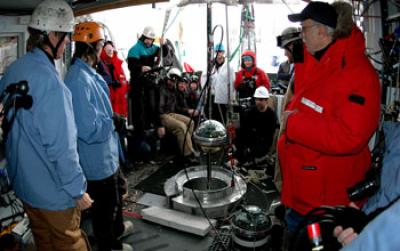
Analysis of data from the IceCube Neutrino Observatory, a massive detector deployed in deep ice at the U.S. Amundsen-Scott South Pole Station in Antarctica at the geographic South Pole, recently provided new insight into one of the most enduring mysteries in physics, the production of cosmic rays.
Cosmic rays were discovered 100 years ago, but only now are scientists homing in on how the highest energy cosmic rays are produced.
Cosmic rays are electrically charged particles, such as protons, that strike Earth from all directions with energies up to one hundred million times higher than those created in man-made accelerators.
The intense conditions needed to generate such energetic particles have focused physicists' interest on two potential sources: the massive black holes at the centers of active galaxies and exploding fireballs observed by astronomers called gamma-ray bursts or GRBs.
"Although we have not discovered where cosmic rays come from, we have taken a major step towards ruling out one of the leading predictions," said Francis Halzen, a physicist at the University of Wisconsin-Madison and the IceCube principal investigator.
In a paper published in the April 19 issue of the journal Nature, the IceCube collaboration describes a search for neutrinos emitted from 300 gamma ray bursts observed between May 2008 and April 2010 in coincidence with the SWIFT and Fermi satellites.
Surprisingly, the scientists found no neutrinos--a result that contradicts 15 years of predictions and challenges the theory that gamma-ray bursts produce the highest energy cosmic rays.
"The result of this neutrino search is significant because for the first time we have an instrument with sufficient sensitivity to open a new window on cosmic ray production and the interior processes of GRBs," said Greg Sullivan, a physicist at the University of Maryland and IceCube spokesman.
"The unexpected absence of neutrinos from GRBs has forced a re-evaluation of the theory for production of cosmic rays and neutrinos in a GRB fireball and possibly the theory that high-energy cosmic rays are generated in fireballs," he said.
IceCube observes neutrinos by detecting the faint blue light produced in neutrino interactions in ice. Neutrinos are of a ghostly nature; they can easily travel through people, walls, or the planet Earth. To compensate for the antisocial nature of neutrinos and detect their rare interactions, IceCube is built on an enormous scale. One cubic kilometer of glacial ice, enough to fit the great pyramid of Giza 400 times, is instrumented with 5,160 optical sensors embedded up to 2.5 kilometers deep in the ice.
GRBs, the universe's most powerful explosions, are usually first observed by satellites using X-rays and/or gamma rays. GRBs are seen about once per day, and are so bright that they can be seen from half way across the visible Universe. The explosions usually last only a few seconds, and during this brief time they can outshine everything else in the universe.
The IceCube Neutrino Observatory was built under a National Science Foundation (NSF) Major Research Equipment and Facilities Construction grant, with assistance from partner funding agencies around the world.
NSF continues to support the project with a Maintenance and Operations grant co-funded by the Division of Antarctic Sciences and the Division of Physics. IceCube construction was finished in December 2010. A collaboration of 250 physicists and engineers from the Unites States, Germany, Sweden, Belgium, Switzerland, Japan, Canada, New Zealand, Australia and Barbados operate the observatory.
"Building the IceCube Neutrino Observatory at the geographic South Pole was a major effort made possible through many collaborating institutions and the U.S. Antarctic Program," said Scott Borg, division director for Antarctic Sciences in NSF's Office of Polar Programs. "The IceCube Collaboration has been busy analyzing data and the finding published in Nature is an early and significant, result. We are pleased with this achievement but we also anticipate many more important discoveries to follow."
NSF, an independent U.S. government agency, manages the U.S. Antarctic Program, through which it coordinates all U.S. scientific research on the southernmost continent and aboard ships in the Southern Ocean as well as related logistics support.
Improved theoretical understanding and continued data collection from the complete and fully calibrated IceCube detector will help scientists better uncover the mystery of cosmic ray production.
INFORMATION:
For more information, visit the IceCube Neutrino Observatory Web site.
Cosmic rays were discovered 100 years ago, but only now are scientists homing in on how the highest energy cosmic rays are produced.
Cosmic rays are electrically charged particles, such as protons, that strike Earth from all directions with energies up to one hundred million times higher than those created in man-made accelerators.
The intense conditions needed to generate such energetic particles have focused physicists' interest on two potential sources: the massive black holes at the centers of active galaxies and exploding fireballs observed by astronomers called gamma-ray bursts or GRBs.
"Although we have not discovered where cosmic rays come from, we have taken a major step towards ruling out one of the leading predictions," said Francis Halzen, a physicist at the University of Wisconsin-Madison and the IceCube principal investigator.
In a paper published in the April 19 issue of the journal Nature, the IceCube collaboration describes a search for neutrinos emitted from 300 gamma ray bursts observed between May 2008 and April 2010 in coincidence with the SWIFT and Fermi satellites.
Surprisingly, the scientists found no neutrinos--a result that contradicts 15 years of predictions and challenges the theory that gamma-ray bursts produce the highest energy cosmic rays.
"The result of this neutrino search is significant because for the first time we have an instrument with sufficient sensitivity to open a new window on cosmic ray production and the interior processes of GRBs," said Greg Sullivan, a physicist at the University of Maryland and IceCube spokesman.
"The unexpected absence of neutrinos from GRBs has forced a re-evaluation of the theory for production of cosmic rays and neutrinos in a GRB fireball and possibly the theory that high-energy cosmic rays are generated in fireballs," he said.
IceCube observes neutrinos by detecting the faint blue light produced in neutrino interactions in ice. Neutrinos are of a ghostly nature; they can easily travel through people, walls, or the planet Earth. To compensate for the antisocial nature of neutrinos and detect their rare interactions, IceCube is built on an enormous scale. One cubic kilometer of glacial ice, enough to fit the great pyramid of Giza 400 times, is instrumented with 5,160 optical sensors embedded up to 2.5 kilometers deep in the ice.
GRBs, the universe's most powerful explosions, are usually first observed by satellites using X-rays and/or gamma rays. GRBs are seen about once per day, and are so bright that they can be seen from half way across the visible Universe. The explosions usually last only a few seconds, and during this brief time they can outshine everything else in the universe.
The IceCube Neutrino Observatory was built under a National Science Foundation (NSF) Major Research Equipment and Facilities Construction grant, with assistance from partner funding agencies around the world.
NSF continues to support the project with a Maintenance and Operations grant co-funded by the Division of Antarctic Sciences and the Division of Physics. IceCube construction was finished in December 2010. A collaboration of 250 physicists and engineers from the Unites States, Germany, Sweden, Belgium, Switzerland, Japan, Canada, New Zealand, Australia and Barbados operate the observatory.
"Building the IceCube Neutrino Observatory at the geographic South Pole was a major effort made possible through many collaborating institutions and the U.S. Antarctic Program," said Scott Borg, division director for Antarctic Sciences in NSF's Office of Polar Programs. "The IceCube Collaboration has been busy analyzing data and the finding published in Nature is an early and significant, result. We are pleased with this achievement but we also anticipate many more important discoveries to follow."
NSF, an independent U.S. government agency, manages the U.S. Antarctic Program, through which it coordinates all U.S. scientific research on the southernmost continent and aboard ships in the Southern Ocean as well as related logistics support.
Improved theoretical understanding and continued data collection from the complete and fully calibrated IceCube detector will help scientists better uncover the mystery of cosmic ray production.
INFORMATION:
For more information, visit the IceCube Neutrino Observatory Web site.