Gladstone scientists identify brain circuitry associated with addictive, depressive behaviors
Discovery has implications for neurodegenerative and psychiatric disorders
Published 2012-04-30 · Original archive entry · Explore research explainers
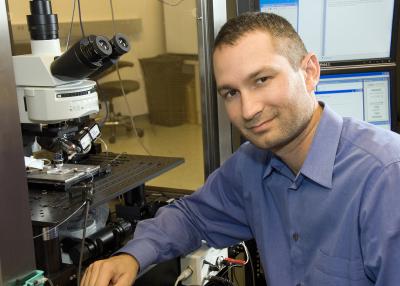
SAN FRANCISCO, CA—April 29, 2012—Scientists at the Gladstone Institutes have determined how specific circuitry in the brain controls not only body movement but also motivation and learning, providing new insight into neurodegenerative disorders such as Parkinson's disease—and psychiatric disorders such as addiction and depression.
Previously, researchers in the laboratory of Gladstone Investigator Anatol Kreitzer, PhD, discovered how an imbalance in the activity of a specific category of brain cells is linked to Parkinson's. Now, in a paper published online today in Nature Neuroscience, Dr. Kreitzer and his team used animal models to demonstrate that this imbalance may also contribute to psychiatric disorders. These findings also help explain the wide range of Parkinson's symptoms—and mark an important step in finding new treatments for those who suffer from addiction or depression.
"The physical symptoms that affect people with Parkinson's—including tremors and rigidity of movement—are caused by an imbalance between two types of medium spiny neurons in the brain," said Dr. Kreitzer, whose lab studies how Parkinson's disease affects brain functions. "In this paper we showed that psychiatric disorders—specifically addiction and depression—might be caused by this same neural imbalance."
Normally, two types of medium spiny neurons, or MSNs, coordinate body movements. One type, called direct pathway MSNs (dMSNs), acts like a gas pedal. The other type, known as indirect pathway MSNs (iMSNs), acts as a brake. And while researchers have long known about the link between a chemical in the brain called dopamine and Parkinson's, Gladstone researchers recently clarified that dopamine maintains the balance between these two MSN types.
But abnormal dopamine levels are implicated not only in Parkinson's, but also in addiction and depression. Dr. Kreitzer and his team hypothesized that the same circuitry that controlled movement might also control the process of learning to repeat pleasurable experiences and avoid unpleasant ones—and that an imbalance in this process could lead to addictive or depressive behaviors.
Dr. Kreitzer and his team genetically modified two sets of mice so that they could control which specific type of MSN was activated. They placed mice one at a time in a box with two triggers—one that delivered a laser pulse to stimulate the neurons and one that did nothing. They then monitored which trigger each mouse preferred.
"The mice that had only dMSNs activated gravitated toward the laser trigger, pushing it again and again to get the stimulation—reminiscent of addictive behavior," said Alexxai Kravitz, PhD, Gladstone postdoctoral fellow and a lead author of the paper. "But the mice that had only iMSNs activated did the opposite. Unlike their dMSN counterparts, the iMSN mice avoided the laser stimulation, which suggests that they found it unpleasant." These findings reveal a precise relationship between the two MSN types and how behaviors are learned. They also show how an MSN imbalance can throw normal learning processes out of whack, potentially leading to addictive or depressive behavior.
"People with Parkinson's disease often show signs of depression before the onset of significant movement problems, so it's likely that the neural imbalance in Parkinson's is also responsible for some behavioral changes associated with the disease," said Dr. Kreitzer, who is also an assistant professor of physiology at the University of California, San Francisco, with which Gladstone is affiliated. "Future research could discover how MSNs are activated in those suffering from addiction or depression—and whether tweaking them could reduce their symptoms and improve their quality of life.
INFORMATION:
Graduate student Lynne Tye was also a lead author on this paper. Funding came from a variety of sources, including the W.M. Keck Foundation, the Pew Biomedical Scholars Program, the McKnight Foundation and the National Institutes of Health.
About the Gladstone Institutes
Gladstone is an independent and nonprofit biomedical-research organization dedicated to accelerating the pace of scientific discovery and innovation to prevent, treat and cure cardiovascular, viral and neurological diseases. Gladstone is affiliated with the University of California, San Francisco.
Previously, researchers in the laboratory of Gladstone Investigator Anatol Kreitzer, PhD, discovered how an imbalance in the activity of a specific category of brain cells is linked to Parkinson's. Now, in a paper published online today in Nature Neuroscience, Dr. Kreitzer and his team used animal models to demonstrate that this imbalance may also contribute to psychiatric disorders. These findings also help explain the wide range of Parkinson's symptoms—and mark an important step in finding new treatments for those who suffer from addiction or depression.
"The physical symptoms that affect people with Parkinson's—including tremors and rigidity of movement—are caused by an imbalance between two types of medium spiny neurons in the brain," said Dr. Kreitzer, whose lab studies how Parkinson's disease affects brain functions. "In this paper we showed that psychiatric disorders—specifically addiction and depression—might be caused by this same neural imbalance."
Normally, two types of medium spiny neurons, or MSNs, coordinate body movements. One type, called direct pathway MSNs (dMSNs), acts like a gas pedal. The other type, known as indirect pathway MSNs (iMSNs), acts as a brake. And while researchers have long known about the link between a chemical in the brain called dopamine and Parkinson's, Gladstone researchers recently clarified that dopamine maintains the balance between these two MSN types.
But abnormal dopamine levels are implicated not only in Parkinson's, but also in addiction and depression. Dr. Kreitzer and his team hypothesized that the same circuitry that controlled movement might also control the process of learning to repeat pleasurable experiences and avoid unpleasant ones—and that an imbalance in this process could lead to addictive or depressive behaviors.
Dr. Kreitzer and his team genetically modified two sets of mice so that they could control which specific type of MSN was activated. They placed mice one at a time in a box with two triggers—one that delivered a laser pulse to stimulate the neurons and one that did nothing. They then monitored which trigger each mouse preferred.
"The mice that had only dMSNs activated gravitated toward the laser trigger, pushing it again and again to get the stimulation—reminiscent of addictive behavior," said Alexxai Kravitz, PhD, Gladstone postdoctoral fellow and a lead author of the paper. "But the mice that had only iMSNs activated did the opposite. Unlike their dMSN counterparts, the iMSN mice avoided the laser stimulation, which suggests that they found it unpleasant." These findings reveal a precise relationship between the two MSN types and how behaviors are learned. They also show how an MSN imbalance can throw normal learning processes out of whack, potentially leading to addictive or depressive behavior.
"People with Parkinson's disease often show signs of depression before the onset of significant movement problems, so it's likely that the neural imbalance in Parkinson's is also responsible for some behavioral changes associated with the disease," said Dr. Kreitzer, who is also an assistant professor of physiology at the University of California, San Francisco, with which Gladstone is affiliated. "Future research could discover how MSNs are activated in those suffering from addiction or depression—and whether tweaking them could reduce their symptoms and improve their quality of life.
INFORMATION:
Graduate student Lynne Tye was also a lead author on this paper. Funding came from a variety of sources, including the W.M. Keck Foundation, the Pew Biomedical Scholars Program, the McKnight Foundation and the National Institutes of Health.
About the Gladstone Institutes
Gladstone is an independent and nonprofit biomedical-research organization dedicated to accelerating the pace of scientific discovery and innovation to prevent, treat and cure cardiovascular, viral and neurological diseases. Gladstone is affiliated with the University of California, San Francisco.