PRESS-NEWS.org - Press Release Distribution
PRESS RELEASES DISTRIBUTION

Researchers from UC3M monitor a chicken's brain

Researchers from UC3M monitor a chicken's brain
2012-05-15
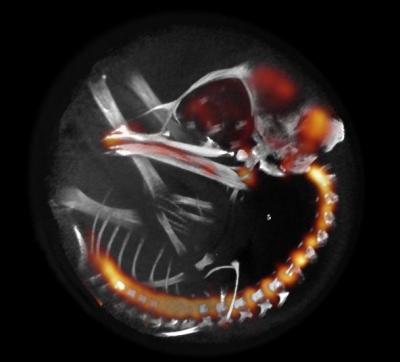
(Press-News.org) This is one of the principle conclusions of a study that has been published in the scientific journal Current Biology. Participants in the study included Evan Balaban (McGill University, Montreal), Manuel Desco (Gregorio Marañón General University Hospital of Madrid and UC3M) and Juan José Vaquero (UC3M). The researchers managed to arouse a chicken embryo by exposing it to a sound that would have meaning after its birth (for example, the sound of a chicken warning others of danger). However, their study has demonstrated that the animal does not have the same reaction when it is exposed to a sound that is similar, but that has no special meaning for the chick.

These findings have important implications with regard to understanding both the development of chickens' brains and that of human fetuses, according to the study's authors. According to the researchers, this is so because pediatricians still question the effects that external stimuli, such as music, might have on brains that are still being formed. According to the scientists, this demonstration, which shows that the brain alternates between states of wakefulness and sleep (which is the normal cycle of an adult brain) long before it was previously thought and that it is able to recognize an external stimulus and wake up, indicates that circuits that are capable of monitoring the surroundings in the same way as in an adult brain are already developing in the embryo's brain. All of these characteristics begin to appear in the last quarter of development during the embryo's incubation period.

In order to carry out this study, a technique in which "Spain is a pioneer", according to the scientists, was adapted. This technique combines sub millimeter-resolution brain positron emission tomography (PET) and structural X-ray computed tomography (CT), creating a non-invasive technique that provides three-dimensional images of brain function in animal models, with sub-millimetric resolution. "For the first time, we have designed a procedure which allows us to observe and measure the changes in the embryo's brain activity as it vacillates between sleep and awake phases, without interfering in its normal development," comments Juan José Vaquero, of UC3M's Bioengineering Department.

The researchers were able to study the process in "great detail", according to Manuel Desco, who nevertheless points out that a much more needs to be done with other mammals before arriving at the human model. Desco has also noted that we still do not know exactly when the human brain begins to carry out complex tasks. "The fact that there is certain electrical brain activity in the fetus does not indicate superior activity", according to this scientist, who hopes that this study can contribute to clarifying this issue. For Evan Balaban, these findings may help us understand complex learning processes in fetuses and newborns.


INFORMATION:

Video abstract (in English): http://www.youtube.com/watch?feature=player_embedded&v=VTKPrZ6vphU

Further information: http://www.cell.com/current-biology/abstract/S0960-9822(12)00317-X


[Attachments] See images for this press release:
Researchers from UC3M monitor a chicken's brain

ELSE PRESS RELEASES FROM THIS DATE:

Legislation to ban burqa is liberal overkill, researchers claim

2012-05-15
Banning and criminalising the Muslim face veil tests the very foundations of modern liberal society, warn researchers from Queen Mary, University of London and the University of Sussex. The paper 'Reasons to Ban? The Anti-Burqa Movement in Western Europe' examines the move to legislate against, and to criminalise face-veiling which has swept across the EU recently. The European movement against face-veiling is now widespread, with calls to implement a ban, or a ban being in place, in France, Belgium, Italy, Spain, the Netherlands, Scandinavia, and Germany. This move ...

Superbug spreads from big city hospitals to regional health centers, study suggests

2012-05-15
Hospitals in large cities act as breeding grounds for the superbug MRSA prior to it spreading to smaller hospitals, a study suggests. Researchers found evidence that shows for the first time how the superbug spreads between different hospitals throughout the country. The University of Edinburgh study involved looking at the genetic make-up of more than 80 variants of a major clone of MRSA found in hospitals. Scientists were able to determine the entire genetic code of MRSA bacteria taken from infected patients. They then identified mutations in the bug which led ...

See how students' 'Twipolitico' uses tweets to predict political races

2012-05-15
About 45 real-world senior engineering projects from the University of Cincinnati's College of Engineering and will go on display from noon-3 p.m., on Wednesday, May 16, in UC's Tangeman University Center. The projects represent work by seniors in electrical engineering, electrical engineering technology, computer engineering, computer engineering technology and computer science. Below is a sampling of the projects you will see TWIPOLITICO Seniors Jorge Moscat Pardos, Chris Nixon and Opeyemi Oyediran created a site and application, titled "Twipolitico," that analyzes ...

Pay-to-play sports keeping lower-income kids out of the game

2012-05-15
ANN ARBOR, Mich. – In an era of tight funding, school districts across the country are cutting their athletic budgets. Many schools are implementing athletic participation fees to cover the cost of school sports. But those fees have forced kids in lower-income families to the sidelines, according to a new poll that found nearly one in five lower-income parents report their children are participating less in school sports. The University of Michigan C.S. Mott Children's Hospital National Poll on Children's Health recently asked parents of middle- and high-school-age children ...

CNIO scientists successfully test the first gene therapy against aging-associated decline

CNIO scientists successfully test the first gene therapy against aging-associated decline
2012-05-15
A number of studies have shown that it is possible to lengthen the average life of individuals of many species, including mammals, by acting on specific genes. To date, however, this has meant altering the animals' genes permanently from the embryonic stage – an approach impracticable in humans. Researchers at the Spanish National Cancer Research Centre (CNIO), led by its director María Blasco, have proved that mouse lifespan can be extended by the application in adult life of a single treatment acting directly on the animal's genes. And they have done so using gene therapy, ...

Research opens doors to UV disinfection using LED technology

2012-05-15
Research from North Carolina State University will allow the development of energy-efficient LED devices that use ultraviolet (UV) light to kill pathogens such as bacteria and viruses. The technology has a wide array of applications ranging from drinking-water treatment to sterilizing surgical tools. "UV treatment utilizing LEDs would be more cost-effective, energy efficient and longer lasting," says Dr. Ramón Collazo, an assistant professor of materials science and engineering at NC State and lead author of a paper describing the research. "Our work would also allow ...

Real smart: Protective clothing with built-in A/C

2012-05-15
Functional sportswear is taken for granted nowadays. It is quite unexceptional for a sports jacket, for instance, to be both waterproof and breathable. In the case of working clothes, the functionality is mostly restricted to personal protection against fire, sharp objects, chemicals and so on, with wearer comfort (mostly) not being significance top priority. Bullet-proof vests made of Kevlar, as their name suggests, hold off bullets but they are also impenetrable for water vapor. Thus police personnel who must wear such gear under their uniforms sweat profusely when the ...

Cellular secrets of plant fatty acid production understood

Cellular secrets of plant fatty acid production understood
2012-05-15
A curious twist in a family of plant proteins called chalcone-isomerase recently was discovered by Salk Institute for Biological Studies scientist Joseph Noel and colleagues at Iowa State University led by Eve Wurtele. Pursuing basic scientific discovery, they found three similar proteins that could soon translate into positive results for bio-renewable fuels, commodity chemicals like plastics, food security and nutrition and biomedicine. The findings, reported May 13 in advance online publication of the journal Nature, may lead to higher-yield crops and quantities of ...

To avoid pain during an injection, look away

2012-05-15
Philadelphia, PA, May 14, 2012 – Health professionals commonly say, "Don't look and it won't hurt" before administering an injection, but is there any scientific basis for the advice? A group of German investigators has found that, in fact, your past experience with needle pricks, along with information you receive before an injection, shape your pain experience. Their research is published in the May issue of Pain®. "Throughout our lives, we repeatedly experience that needles cause pain when pricking our skin, but situational expectations, like information given by ...

Individuals with dementia more likely to die at home than in nursing homes

Individuals with dementia more likely to die at home than in nursing homes
2012-05-15
INDIANAPOLIS — A new study from the Regenstrief Institute and Indiana University has found that, at time of death, individuals with dementia are more likely to be living at home than in a nursing home. This contradicts the commonly held view that most individuals with dementia in the United States eventually move to nursing homes and die there. "Transitions in Care for Older Adults With and Without Dementia" appears online in advance of publication in the May 2012 issue of the Journal of the American Geriatrics Society. Most individuals with dementia, even advanced ...

LAST 30 PRESS RELEASES:

Ancient American pronghorns were built for speed

Two-stage hydrothermal process turns wastewater sludge into cleaner biofuel

Soil pH shapes nitrogen competition between wheat and microbes, new study finds

Scientists develop algae-derived biochar nanoreactor to tackle persistent PFAS pollution

New research delves into strengthening radiology education during a time of workforce shortages and financial constraints

Mediterranean diet associated with lower risk of all stroke types

Personalized palliative care shows signs of improving quality of life for children with advanced cancer

Pediatric Investigation review highlights the future of newborn screening with next-generation sequencing

Molecular nature of ‘sleeping’ pain neurons becomes clearer

A clearer view for IVF: New "invisible" culture dishes improve embryo selection

Common bacteria discovered in the eye linked to cognitive decline

Neuroticism may be linked with more frequent sexual fantasies

The ideal scent detection dog is confident, persistent and resilient, without insecurities or neuroticism, according to a study featuring Dutch police dog handlers

Elusive beaked whales off the Louisiana coast may sometimes be diving right to the seafloor, finds new 3D acoustic technology which accurately pinpoints their locations using their echolocation clicks

The vulnerable Amazonian manatee is most often found where human activity is low, with a new eDNA-based method most commonly detecting the freshwater mammal in the remote western Amazon

Dog behavioral traits are linked with salivary hormone cortisol and neurotransmitter serotonin

Breakthrough in human norovirus research: Researchers overcome major obstacle to grow and study the virus

Call for papers: 10th anniversary special issue of Big Earth Data

Embargoed: DNA marker in malaria mosquitoes may be pivotal in tackling insecticide resistance

Large increases in PM2.5 exposure from wildfires have exaggerated progress in reducing inequities in traditional sources of PM2.5 in California

Janus meta-imager enables asymmetric image transmission and transformation in opposite directions

Unlocking “hidden” modes: A new physics-driven approach to label-free cancer cell phenotyping

More isn’t always better: Texas A&M research links high-dose antioxidants to offspring birth defects

Study: Synthetic protein potentially improves outcomes for certain subgroups following intracerebral hemorrhage

Sub-shot-noise optical readout achieved in a Rydberg atomic medium

Unlocking dual-spin achromatic meta-optics with hybrid-phase dispersion engineering

On-chip dual microcombs drive nanomaterial-enhanced fiber sensors for high-selectivity multi-gas mapping

New transgenic zebrafish models decades of muscle atrophy in weeks

A double-edged sword: Chronic cellular stress promotes liver cancer—but also makes tumors vulnerable to immunotherapy

Ancient rocks reveal evidence of the first continents and crust recycling processes on Earth

[Press-News.org] Researchers from UC3M monitor a chicken's brain