Study identifies genes associated with genomic expansions that cause disease
Examining trinucleotide repeats
Published 2012-09-10 · Original archive entry · Explore research explainers
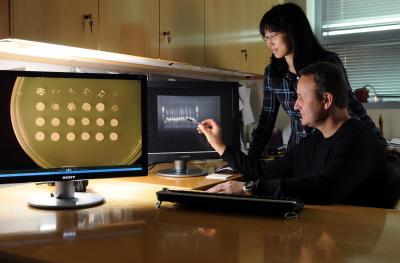
A study of more than 6,000 genes in a common species of yeast has identified the pathways that govern the instability of GAA/TTC repeats. In humans, the expansions of these repeats is known to inactivate a gene – FXN – which leads to Friedreich's ataxia, a neurodegenerative disease that is currently incurable. In yeast, long repeats also destabilize the genome, manifested by the breakage of chromosomes.
Working with collaborators at Tufts University, researchers at the Georgia Institute of Technology identified genetic deficiencies associated with the instability of the repeats in four different classes of genes that control replication, transcription initiation, checkpoint response and telomere maintenance. They were surprised to find that the GAA/TTC repeats could promote gene expression in yeast, suggesting that the repeats may play both positive and negative roles in cells.
While the study examined the repeat metabolisms in the yeast Saccharomyces cerevisiae, the researchers believe their discoveries may have implications for human disease because many components of genetic machinery have been conserved in evolution.
The study was reported online Sept. 6 in the journal Molecular Cell. The research was supported by the National Institutes of Health (NIH) and the National Science Foundation (NSF).
The expansions occur in GAA/TTC sequences located on the FXN gene that plays a vital role in cell metabolism. Patients with Friedreich's ataxia can have as many as 1,700 copies of the nucleotide sequence, compared to fewer than 65 copies in individuals without the genetic expansion. Although not yet observed in humans, in yeast the expanded repeats can cause chromosomal fragility, which – despite cellular repair mechanisms – can produce errors resulting in dramatic genomic rearrangements.
"How these expansions happen is a very mysterious process, and we do not know why some people get the disease and some people do not," said Kirill Lobachev, an associate professor in Georgia Tech's School of Biology. "We are trying to develop a simplistic way to determine what individuals may be predisposed to the disease and to find the genotypes where these expansions occur with great frequency."
At the core of the study was detailed screening of the yeast's entire genome, some 6,000 genes in all. Conducted by graduate research assistant Yu Zhang, the exhaustive assay identified 33 genes associated with the repeats fragility and expansions.
The connection between genomic expansion and genes that initiate transcription came as a surprise.
"We found that these repeats can recruit transcription initiation factors and induce transcription," said Lobachev. "The repeats seem to work as non-traditional promoters for an abnormal type of transcription. It turns out that this ability to drive transcription is a significant factor in their instability. That makes this a more complicated story for sure, however, it also opens new avenues to examine the repeats."
The ability of the repeats to affect the activity of genes may indicate a broader effect on the genome, and if the effect is also seen in humans, could account for some of the subtle differences between individuals.
"By some estimates, there may be a thousand locations in our chromosomes where these repeats can expand," said Lobachev. "Probably each person differs in the number of repeats in specific locations. This is important because of their ability to change gene expression."
Among the next steps in the research is to determine how the expansions occur in cells that aren't dividing, such as neurons. The genetic mechanisms involved in cell replication offer clear opportunities for repeat expansions, but the mechanism for repeat amplification in non-dividing cells remains a mystery. The researchers believe the finding that GAA/TTC repeats can promote transcription provides clues for understanding what is going on in terminally differentiated cells.
Why repeats with the detrimental ability to expand have remained a part of the genomes also remains a question. Genetic processes that hinder an organism's competitiveness are normally eliminated during the process of evolution.
"Perhaps these repeats play a positive role in the cell when they are small, but because of their ability to expand, they sometimes get out of control and become larger," Lobachev said.
The findings reported in the yeast, which is commonly used in wine-making and brewing, may help chart a new course in human studies. Scientists often begin genetic research with simpler organisms such as yeast, and use the findings to provide direction for examining similar mechanisms in humans.
"A lot of the processes that are going on in our cells and in yeast cells are the same," Lobachev noted. "These processes are highly conserved throughout evolution. The history of biology tells us that most probably what we find in yeast is going to turn out to be true in humans."
Lobachev hopes the study will lead to new research, both in yeast genetics and humans.
"We have built a map for future analysis so that when people sequence the genome and find deficiencies in particular genes, that will be a clear prediction that individuals with those deficiencies will be predisposed to instability," Lobachev said. "There are now several directions for us and other labs to pursue to see what is really happening here.
INFORMATION:
In addition to those already mentioned, the study's authors also included Alexander Shishkin, Dana Marcinkowski-Desmond and Sergei Mirkin from Tufts University, and Yuri Nishida, Natalie Saini and Kirill Volkov from Georgia Tech.
This work was supported by award number R01GM0825950 from NIGMS/NIH and MCB-0818122 from the NSF. The content is solely the responsibility of the authors and does not necessarily represent the official views of the NIGMS/NIH or the NSF.
CITATION: Zhang et al., Genome-wide Screen Identifies Pathways that Govern GAA/TTC Fragility and Expansions in Dividing and Nondividing Yeast Cells, Molecular Cell (2012): (dx.doi.org/10.1016/j.molcel.2012.08.002)
Working with collaborators at Tufts University, researchers at the Georgia Institute of Technology identified genetic deficiencies associated with the instability of the repeats in four different classes of genes that control replication, transcription initiation, checkpoint response and telomere maintenance. They were surprised to find that the GAA/TTC repeats could promote gene expression in yeast, suggesting that the repeats may play both positive and negative roles in cells.
While the study examined the repeat metabolisms in the yeast Saccharomyces cerevisiae, the researchers believe their discoveries may have implications for human disease because many components of genetic machinery have been conserved in evolution.
The study was reported online Sept. 6 in the journal Molecular Cell. The research was supported by the National Institutes of Health (NIH) and the National Science Foundation (NSF).
The expansions occur in GAA/TTC sequences located on the FXN gene that plays a vital role in cell metabolism. Patients with Friedreich's ataxia can have as many as 1,700 copies of the nucleotide sequence, compared to fewer than 65 copies in individuals without the genetic expansion. Although not yet observed in humans, in yeast the expanded repeats can cause chromosomal fragility, which – despite cellular repair mechanisms – can produce errors resulting in dramatic genomic rearrangements.
"How these expansions happen is a very mysterious process, and we do not know why some people get the disease and some people do not," said Kirill Lobachev, an associate professor in Georgia Tech's School of Biology. "We are trying to develop a simplistic way to determine what individuals may be predisposed to the disease and to find the genotypes where these expansions occur with great frequency."
At the core of the study was detailed screening of the yeast's entire genome, some 6,000 genes in all. Conducted by graduate research assistant Yu Zhang, the exhaustive assay identified 33 genes associated with the repeats fragility and expansions.
The connection between genomic expansion and genes that initiate transcription came as a surprise.
"We found that these repeats can recruit transcription initiation factors and induce transcription," said Lobachev. "The repeats seem to work as non-traditional promoters for an abnormal type of transcription. It turns out that this ability to drive transcription is a significant factor in their instability. That makes this a more complicated story for sure, however, it also opens new avenues to examine the repeats."
The ability of the repeats to affect the activity of genes may indicate a broader effect on the genome, and if the effect is also seen in humans, could account for some of the subtle differences between individuals.
"By some estimates, there may be a thousand locations in our chromosomes where these repeats can expand," said Lobachev. "Probably each person differs in the number of repeats in specific locations. This is important because of their ability to change gene expression."
Among the next steps in the research is to determine how the expansions occur in cells that aren't dividing, such as neurons. The genetic mechanisms involved in cell replication offer clear opportunities for repeat expansions, but the mechanism for repeat amplification in non-dividing cells remains a mystery. The researchers believe the finding that GAA/TTC repeats can promote transcription provides clues for understanding what is going on in terminally differentiated cells.
Why repeats with the detrimental ability to expand have remained a part of the genomes also remains a question. Genetic processes that hinder an organism's competitiveness are normally eliminated during the process of evolution.
"Perhaps these repeats play a positive role in the cell when they are small, but because of their ability to expand, they sometimes get out of control and become larger," Lobachev said.
The findings reported in the yeast, which is commonly used in wine-making and brewing, may help chart a new course in human studies. Scientists often begin genetic research with simpler organisms such as yeast, and use the findings to provide direction for examining similar mechanisms in humans.
"A lot of the processes that are going on in our cells and in yeast cells are the same," Lobachev noted. "These processes are highly conserved throughout evolution. The history of biology tells us that most probably what we find in yeast is going to turn out to be true in humans."
Lobachev hopes the study will lead to new research, both in yeast genetics and humans.
"We have built a map for future analysis so that when people sequence the genome and find deficiencies in particular genes, that will be a clear prediction that individuals with those deficiencies will be predisposed to instability," Lobachev said. "There are now several directions for us and other labs to pursue to see what is really happening here.
INFORMATION:
In addition to those already mentioned, the study's authors also included Alexander Shishkin, Dana Marcinkowski-Desmond and Sergei Mirkin from Tufts University, and Yuri Nishida, Natalie Saini and Kirill Volkov from Georgia Tech.
This work was supported by award number R01GM0825950 from NIGMS/NIH and MCB-0818122 from the NSF. The content is solely the responsibility of the authors and does not necessarily represent the official views of the NIGMS/NIH or the NSF.
CITATION: Zhang et al., Genome-wide Screen Identifies Pathways that Govern GAA/TTC Fragility and Expansions in Dividing and Nondividing Yeast Cells, Molecular Cell (2012): (dx.doi.org/10.1016/j.molcel.2012.08.002)