Using planarian flatworms to understand organ regeneration
Published 2012-10-25 · Original archive entry · Explore research explainers
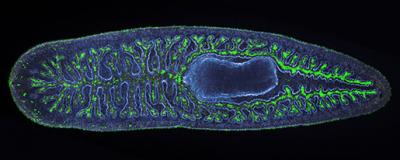
CHAMPAIGN, Ill. — Researchers report in the journal Developmental Cell that they have identified genes that control growth and regeneration of the intestine in the freshwater planarian Schmidtea mediterranea.
"How animals repair their internal organs after injury is not well understood," said University of Illinois cell and developmental biology professor Phillip Newmark, who led the study. "Planarian flatworms are useful models for studying this question."
After injury, planaria are able to re-grow missing body parts, including any organs that are damaged or lost, such as brain, eyes, and intestine. Injury initiates a complex set of cellular events, Newmark said. In planarians, specialized non-reproductive stem cells called neoblasts divide and give rise to all of the different cell types required to rebuild fully functional body parts. Old tissue remaining after amputation remodels and integrates with the new cells.
"The molecular signaling pathways that coordinate these cellular events to achieve organ regeneration have not been well characterized," Newmark said.
David Forsthoefel, a postdoctoral researcher in Newmark's laboratory and the lead author on the study, wanted to address the problem using the planarian intestine as a "model organ," in part because so few animals are capable of repairing severe damage to their digestive systems.
"The ability to recover from loss of digestive tissue is rare in the animal kingdom," Forsthoefel said. "What we learn from how a simple worm deals with gut damage might one day help us to come up with better medical therapies, for example in the treatment of short bowel syndrome, in which segments of intestine must be removed from patients with digestive diseases, leading to impaired nutrient absorption."
Forsthoefel developed a method for purifying a single intestinal cell type from the planarian gut. He and his colleagues in the Newmark lab identified over a thousand genes that were uniquely expressed at higher levels in intestinal cells than in the surrounding tissues. Guessing that some of these genes would have important roles during intestinal growth and regeneration, they probed the function of a subset of these genes using a technique called RNA interference, in which the expression of individual genes is selectively inhibited. The researchers were able to pinpoint functions for specific genes, for example, genes involved in the establishment of the appropriate pattern of intestinal branches, and the production of functional intestinal cells capable of taking up nutrients.
The authors also identified a transcription factor called nkx-2.2 that, although expressed in the intestine, was required for neoblasts to proliferate in various contexts, including after injury. This result suggests a potential role for the intestine in regulating stem cell division, a result Forsthoefel is following up by identifying genes downstream of Nkx-2.2 that might have more direct roles in communication between the intestine and neoblasts.
"How cells in the vicinity of damaged tissue contribute to the choices stem cells make in response to injury is an area of regeneration biology where much more research is needed," Forsthoefel said. The field of regeneration research is rife with such uncharted territory. How do animals manage to produce the correct number specific cell types, at the correct locations? What are the signals that instruct stem cells to become specific cell types, and where do they come from? How is organ-specific morphology, for example the number of intestinal branches, determined? This study from the Newmark lab, the first systematic effort to elucidate intestinal morphogenesis in planarians, lays the groundwork for addressing many of these fundamental questions of organ regeneration.
INFORMATION:
Phillip Newmark is a Howard Hughes Medical Institute Investigator in the School of Molecular and Cellular Biology at the University of Illinois.
"An RNAi Screen Reveals Intestinal Regulators of Branching Morphogenesis, Differentiation, and Stem Cell Proliferation in Planarians" is available online at Developmental Cell.
"How animals repair their internal organs after injury is not well understood," said University of Illinois cell and developmental biology professor Phillip Newmark, who led the study. "Planarian flatworms are useful models for studying this question."
After injury, planaria are able to re-grow missing body parts, including any organs that are damaged or lost, such as brain, eyes, and intestine. Injury initiates a complex set of cellular events, Newmark said. In planarians, specialized non-reproductive stem cells called neoblasts divide and give rise to all of the different cell types required to rebuild fully functional body parts. Old tissue remaining after amputation remodels and integrates with the new cells.
"The molecular signaling pathways that coordinate these cellular events to achieve organ regeneration have not been well characterized," Newmark said.
David Forsthoefel, a postdoctoral researcher in Newmark's laboratory and the lead author on the study, wanted to address the problem using the planarian intestine as a "model organ," in part because so few animals are capable of repairing severe damage to their digestive systems.
"The ability to recover from loss of digestive tissue is rare in the animal kingdom," Forsthoefel said. "What we learn from how a simple worm deals with gut damage might one day help us to come up with better medical therapies, for example in the treatment of short bowel syndrome, in which segments of intestine must be removed from patients with digestive diseases, leading to impaired nutrient absorption."
Forsthoefel developed a method for purifying a single intestinal cell type from the planarian gut. He and his colleagues in the Newmark lab identified over a thousand genes that were uniquely expressed at higher levels in intestinal cells than in the surrounding tissues. Guessing that some of these genes would have important roles during intestinal growth and regeneration, they probed the function of a subset of these genes using a technique called RNA interference, in which the expression of individual genes is selectively inhibited. The researchers were able to pinpoint functions for specific genes, for example, genes involved in the establishment of the appropriate pattern of intestinal branches, and the production of functional intestinal cells capable of taking up nutrients.
The authors also identified a transcription factor called nkx-2.2 that, although expressed in the intestine, was required for neoblasts to proliferate in various contexts, including after injury. This result suggests a potential role for the intestine in regulating stem cell division, a result Forsthoefel is following up by identifying genes downstream of Nkx-2.2 that might have more direct roles in communication between the intestine and neoblasts.
"How cells in the vicinity of damaged tissue contribute to the choices stem cells make in response to injury is an area of regeneration biology where much more research is needed," Forsthoefel said. The field of regeneration research is rife with such uncharted territory. How do animals manage to produce the correct number specific cell types, at the correct locations? What are the signals that instruct stem cells to become specific cell types, and where do they come from? How is organ-specific morphology, for example the number of intestinal branches, determined? This study from the Newmark lab, the first systematic effort to elucidate intestinal morphogenesis in planarians, lays the groundwork for addressing many of these fundamental questions of organ regeneration.
INFORMATION:
Phillip Newmark is a Howard Hughes Medical Institute Investigator in the School of Molecular and Cellular Biology at the University of Illinois.
"An RNAi Screen Reveals Intestinal Regulators of Branching Morphogenesis, Differentiation, and Stem Cell Proliferation in Planarians" is available online at Developmental Cell.