NASA spacecraft observe Nov. 20 solar eruption
Published 2012-11-21 · Original archive entry · Explore research explainers
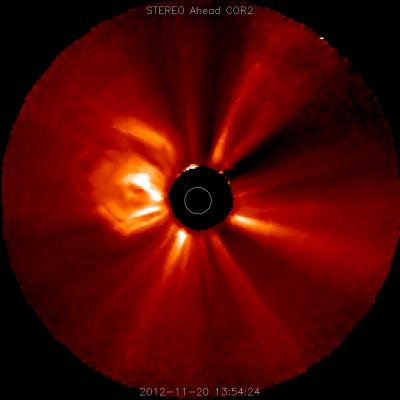
On Nov. 20, 2012, at 7:09 a.m. EST, the sun erupted with a coronal mass ejection or CME. Not to be confused with a solar flare, a CME is a solar phenomenon that can send solar particles into space and can reach Earth one to three days later. When Earth-directed, CMEs can affect electronic systems in satellites and on Earth.
Experimental NASA research models, based on observations from the Solar Terrestrial Relations Observatory (STEREO), show that the Nov. 20 CME left the sun at speeds of 450 miles per second, which is a slow to average speed for CMEs. CMEs can cause a space weather phenomenon called a geomagnetic storm, which occurs when CMEs successfully connect up with the outside of the Earth's magnetic envelope, the magnetosphere, for an extended period of time. In the past, CMEs of this speed have not usually caused substantial geomagnetic storms. They have caused auroras near the poles but are unlikely to cause disruptions to electrical systems on Earth or interfere with GPS or satellite-based communications systems.
INFORMATION:
NOAA's Space Weather Prediction Center is the United States government's official source for space weather forecasts.
Experimental NASA research models, based on observations from the Solar Terrestrial Relations Observatory (STEREO), show that the Nov. 20 CME left the sun at speeds of 450 miles per second, which is a slow to average speed for CMEs. CMEs can cause a space weather phenomenon called a geomagnetic storm, which occurs when CMEs successfully connect up with the outside of the Earth's magnetic envelope, the magnetosphere, for an extended period of time. In the past, CMEs of this speed have not usually caused substantial geomagnetic storms. They have caused auroras near the poles but are unlikely to cause disruptions to electrical systems on Earth or interfere with GPS or satellite-based communications systems.
INFORMATION:
NOAA's Space Weather Prediction Center is the United States government's official source for space weather forecasts.