A new fish species from Lake Victoria named in honor of the author of Darwin's Dreampond
Published 2013-01-02 · Original archive entry · Explore research explainers
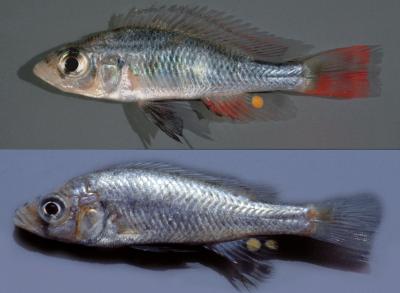
Two new species of cichlid fish from Lake Victoria are described by biologists from Naturalis Biodiversity Center (Research Department Marine Zoology) and the Institute of Biology Leiden (Section Integrative Zoology), the Netherlands. One of these species is named in honour of Tijs Goldschmidt, author of Darwin's Dreampond. This book, published in nine languages, describes the dramatic extinction of hundreds of cichlid species in Lake Victoria in the 1980s due to the introduced Nile perch and other human induced environmental changes.
In 1985, Leiden biologists made a survey in the Tanzanian part of the lake, with an old ferry as floating lab, to establish the status of the rapidly declining cichlids. During this expedition Tijs studied the egg spots on the anal fin of cichlids for their possible role in the rapid speciation of these fish. In the Emin Pasha Gulf, among a species nicknamed Haplochromis "argens", individuals were found with aberrant egg dummies and lacking red in the fins. Just the kind of example Tijs was looking for to test his theory of speciation by sexual selection. The aberrant individuals were provisionally named H. "dusky argens".
Both "species" play a part in Tijs' PhD thesis and in other studies. However, a taxonomic description was never made and whether H. "dusky argens" was a separate species or a colour morph remained unclear. In 1987, most cichlid species from the offshore waters of the lake had disappeared, and with them the urge of taxonomic descriptions.
Now, 25 years later, about a quarter of the cichlid species have recovered in the "Nile perch desert", some of them became even more abundant than in the past, but the former common H. "argens" is still extremely rare. The status of H. "dusky-argens" is unknown as it was only caught in the remote Emin Pasha Gulf, which is not sampled nowadays. Research on successfully resurgent species shows that they were able to adapt morphologically to the new environmental conditions. Their body shape, for instance, changed, so that burst swimming to escape predators improved. Preliminary results suggest that such a response is not found in H. "argens".
The above observations triggered the present taxonomic study as a baseline for further research. It shows that several taxonomic characters differ more between the co-occurring populations of H. "argens" and H. "dusky argens" in the Emin Pasha Gulf, than between populations from different locations. This suggests that they are indeed two species, which are morphologically driven apart at places where they co-occur. In case of H. "argens" the nickname was upgraded to the formal name, while H. "dusky-argens" is now named H. goldschmidti.
INFORMATION:
Original source
de Zeeuw MP, Westbroek I, van Oijen MJP, Witte F (2013) Two new species of zooplanktivorous haplochromine cichlids from Lake Victoria, Tanzania. ZooKeys 256: 1–34. doi: 10.3897/zookeys.256.3871
About ZooKeys
ZooKeys is a peer-reviewed, open-access journal launched to support free exchange of ideas and information in biodiversity science, issued by Pensoft Publishers. All papers published in ZooKeys can be freely copied, downloaded, printed and distributed at no charge for the reader. ZooKeys implemented several cutting-edge innovation in publishing and dissemination of science information and is considered a technological leader in its field.
Additional Information
Goldschmidt T, de Visser J (1990) On the possible role of egg mimics in speciation. Acta Biotheoretica 38: 125-134.
van Rijssel JC, Witte F (2012) Adaptive responses in resurgent Lake Victoria cichlid over the past 30 years. Evolutionary Ecology. doi: 10.1007/s10682-012-9596-9
Posted by Pensoft Publishers.
In 1985, Leiden biologists made a survey in the Tanzanian part of the lake, with an old ferry as floating lab, to establish the status of the rapidly declining cichlids. During this expedition Tijs studied the egg spots on the anal fin of cichlids for their possible role in the rapid speciation of these fish. In the Emin Pasha Gulf, among a species nicknamed Haplochromis "argens", individuals were found with aberrant egg dummies and lacking red in the fins. Just the kind of example Tijs was looking for to test his theory of speciation by sexual selection. The aberrant individuals were provisionally named H. "dusky argens".
Both "species" play a part in Tijs' PhD thesis and in other studies. However, a taxonomic description was never made and whether H. "dusky argens" was a separate species or a colour morph remained unclear. In 1987, most cichlid species from the offshore waters of the lake had disappeared, and with them the urge of taxonomic descriptions.
Now, 25 years later, about a quarter of the cichlid species have recovered in the "Nile perch desert", some of them became even more abundant than in the past, but the former common H. "argens" is still extremely rare. The status of H. "dusky-argens" is unknown as it was only caught in the remote Emin Pasha Gulf, which is not sampled nowadays. Research on successfully resurgent species shows that they were able to adapt morphologically to the new environmental conditions. Their body shape, for instance, changed, so that burst swimming to escape predators improved. Preliminary results suggest that such a response is not found in H. "argens".
The above observations triggered the present taxonomic study as a baseline for further research. It shows that several taxonomic characters differ more between the co-occurring populations of H. "argens" and H. "dusky argens" in the Emin Pasha Gulf, than between populations from different locations. This suggests that they are indeed two species, which are morphologically driven apart at places where they co-occur. In case of H. "argens" the nickname was upgraded to the formal name, while H. "dusky-argens" is now named H. goldschmidti.
INFORMATION:
Original source
de Zeeuw MP, Westbroek I, van Oijen MJP, Witte F (2013) Two new species of zooplanktivorous haplochromine cichlids from Lake Victoria, Tanzania. ZooKeys 256: 1–34. doi: 10.3897/zookeys.256.3871
About ZooKeys
ZooKeys is a peer-reviewed, open-access journal launched to support free exchange of ideas and information in biodiversity science, issued by Pensoft Publishers. All papers published in ZooKeys can be freely copied, downloaded, printed and distributed at no charge for the reader. ZooKeys implemented several cutting-edge innovation in publishing and dissemination of science information and is considered a technological leader in its field.
Additional Information
Goldschmidt T, de Visser J (1990) On the possible role of egg mimics in speciation. Acta Biotheoretica 38: 125-134.
van Rijssel JC, Witte F (2012) Adaptive responses in resurgent Lake Victoria cichlid over the past 30 years. Evolutionary Ecology. doi: 10.1007/s10682-012-9596-9
Posted by Pensoft Publishers.