Monkeys stressed from longer foraging times
Published 2013-01-22 · Original archive entry · Explore research explainers
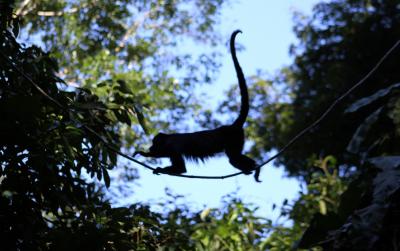
Endangered Mexican howler monkeys are consuming more leaves and less fruit as a result of habitat disturbance by humans, which is forcing them to invest much more time foraging for sustenance and leading to increased 'stress' levels, as detected through hormone analysis.
The research, published today in the International Journal of Primatology, took place in the tropical rainforests of the Mexican state of Veracruz, which are being deforested and fragmented by human activity - primarily the clearing of forest for cattle raising. It shows that increases in howler monkey 'travel time' – the amount of time needed to find requisite nourishment – are leading to increases in levels of stress hormones called glucocorticoids.
These hormones are not only indicators of stress, but are also known to relate to diminished reproductive success and lower survival rates. Researchers believe the study could serve as a model for behavioural change and resulting health implications more generally in primates living in habitats disturbed by human activities, such as deforestation.
"Howlers are arboreal primates, that is to say they spend their wholes lives in the trees", said Dr Jacob Dunn from Cambridge's Department of Biological Anthropology, who carried out the research.
"As forests are fragmented, the howlers become cut off, isolated on forest 'islands' that increasingly lack the fruit which provide an important component of their natural diet. This has led to the monkeys expending ever more time and effort foraging for food, often increasing leaf consumption when their search is, quite literally, fruitless."
Fruit occurs in natural cycles, and the monkeys will naturally revert to 'fallback' foods, including leaves, when fruit is scarce. But as habitats shrink, and fruit is harder to find, leaves from second-choice plants, such as lianas, have increased in the Mexican howlers' diet.
While leaves may sound like a plentiful resource in a rainforest, many leaves are difficult to digest and can be filled with toxins - a natural defence mechanism in most trees and plants - so the monkeys are actually forced to spend more time seeking out the right foliage to eat, such as new shoots which are generally less toxic.
"The traditional view was that the leaves exploited by howler monkeys were an abundant food source - but this is not the case," said Dunn.
"The monkeys rely much more heavily on fruit than previously believed, and when turning to foliage for food - as they are increasingly forced to do – they have to be highly selective in the leaves they consume, visiting lots of different trees. This leads to the increased 'travel time' and consequent high levels of stress we are seeing in these primates as their habitats disintegrate."
As trying to catch the howlers to examine them would in itself be highly stressful for the animal, the best way of evaluating stress levels in wild primates is by analysing their faeces for glucocorticoid stress hormones, which are general to all vertebrates.
Through statistical modelling, the researchers were able to determine that it is the 'travel time' - rather than the increased foliage intake - causing high levels of stress.
"Monkeys in disturbed habitats suffering high levels of stress is in itself unsurprising perhaps, but now we think we know why, the root cause from the primates perspective. Our results also highlight the importance of preserving and planting fruit trees - particularly those species such as figs that can produce fruit during periods of general fruit scarcity - for the conservation of howler monkeys¨ said Dr Jurgi Cristóbal-Azkarate, also from Cambridge, who led the research in collaboration with Dr Joaquim Vea from the University of Barcelona.
The authors say that further studies are required to fully understand the significance of increases in stress in howler monkeys living in disturbed habitats. "Determining the full relevance of our results for the conservation of primates living in forest fragments will require long-term studies of stress hormones and survival", said Dunn.
INFORMATION:
The research, published today in the International Journal of Primatology, took place in the tropical rainforests of the Mexican state of Veracruz, which are being deforested and fragmented by human activity - primarily the clearing of forest for cattle raising. It shows that increases in howler monkey 'travel time' – the amount of time needed to find requisite nourishment – are leading to increases in levels of stress hormones called glucocorticoids.
These hormones are not only indicators of stress, but are also known to relate to diminished reproductive success and lower survival rates. Researchers believe the study could serve as a model for behavioural change and resulting health implications more generally in primates living in habitats disturbed by human activities, such as deforestation.
"Howlers are arboreal primates, that is to say they spend their wholes lives in the trees", said Dr Jacob Dunn from Cambridge's Department of Biological Anthropology, who carried out the research.
"As forests are fragmented, the howlers become cut off, isolated on forest 'islands' that increasingly lack the fruit which provide an important component of their natural diet. This has led to the monkeys expending ever more time and effort foraging for food, often increasing leaf consumption when their search is, quite literally, fruitless."
Fruit occurs in natural cycles, and the monkeys will naturally revert to 'fallback' foods, including leaves, when fruit is scarce. But as habitats shrink, and fruit is harder to find, leaves from second-choice plants, such as lianas, have increased in the Mexican howlers' diet.
While leaves may sound like a plentiful resource in a rainforest, many leaves are difficult to digest and can be filled with toxins - a natural defence mechanism in most trees and plants - so the monkeys are actually forced to spend more time seeking out the right foliage to eat, such as new shoots which are generally less toxic.
"The traditional view was that the leaves exploited by howler monkeys were an abundant food source - but this is not the case," said Dunn.
"The monkeys rely much more heavily on fruit than previously believed, and when turning to foliage for food - as they are increasingly forced to do – they have to be highly selective in the leaves they consume, visiting lots of different trees. This leads to the increased 'travel time' and consequent high levels of stress we are seeing in these primates as their habitats disintegrate."
As trying to catch the howlers to examine them would in itself be highly stressful for the animal, the best way of evaluating stress levels in wild primates is by analysing their faeces for glucocorticoid stress hormones, which are general to all vertebrates.
Through statistical modelling, the researchers were able to determine that it is the 'travel time' - rather than the increased foliage intake - causing high levels of stress.
"Monkeys in disturbed habitats suffering high levels of stress is in itself unsurprising perhaps, but now we think we know why, the root cause from the primates perspective. Our results also highlight the importance of preserving and planting fruit trees - particularly those species such as figs that can produce fruit during periods of general fruit scarcity - for the conservation of howler monkeys¨ said Dr Jurgi Cristóbal-Azkarate, also from Cambridge, who led the research in collaboration with Dr Joaquim Vea from the University of Barcelona.
The authors say that further studies are required to fully understand the significance of increases in stress in howler monkeys living in disturbed habitats. "Determining the full relevance of our results for the conservation of primates living in forest fragments will require long-term studies of stress hormones and survival", said Dunn.
INFORMATION: