PRESS-NEWS.org - Press Release Distribution
PRESS RELEASES DISTRIBUTION

Bats may use bidirectional echolocation to detect prey, orient themselves
Bidirectional sound emission facilitates 'stealth echolocation' in barbastelle bats

Bats may use bidirectional echolocation to detect prey, orient themselves
2015-09-09
(Press-News.org) The barbastelle bat may emit two different types of weak echolocation signals alternately, one upward through the nose and one downward through the mouth, to find prey while undetected and to sufficiently keep track of the environment, respectively, according to a study published September 9, 2015 in the open-access journal PLOS ONE by Anna-Maria Seibert and colleagues from the University of Tübingen, Germany.

Barbastelle bats prey almost exclusively on eared moths, using "stealth echolocation" signals that are 10-100 times weaker than those of other aerial hawking bats. These low intensity signals prevent early detection of the bat and can be heard by moths only at short distances leaving no time for evasive behavior. While foraging, barbastelle bats alternate between two different echolocation signal types. The authors of this study investigated whether these signals differ in emission direction or source level. They used a 16-microphone array to determine source level and sonar beam direction of more than 300 calls of wild bats in Central France.

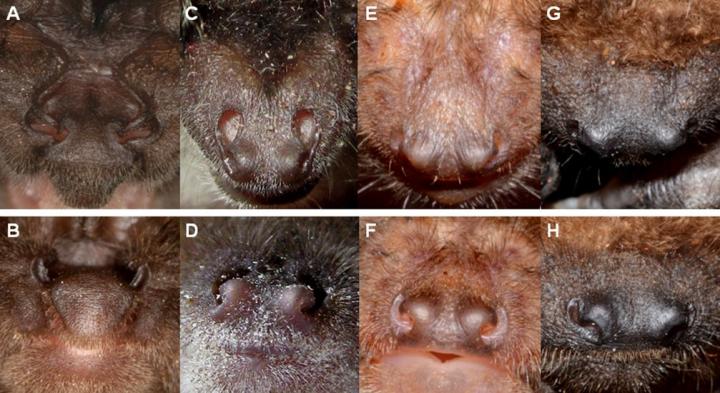
The authors found that both types of search signals had very low source levels as compared to other aerial hawking bats. These two signal types were emitted in different directions; type 1 signals were directed downward and type 2 signals upward. The mouth and nostrils in barbastelle bats are roughly perpendicular to each other, and the authors posit that type 1 signals are emitted through the mouth while type 2 signals are emitted through the nose.

The authors suspect that the "stealth" upward signals may be used for the search and localization of prey while remaining undetected; however, the low source level may come at the cost of reducing the detection range for the environment below the bat. Therefore, the more downward directed signals may have evolved to compensate for this disadvantage and may be mainly used for spatial orientation in relation to the environment below the bat. The authors suggest that this signaling system has been adapted to the selective foraging of eared moths.

INFORMATION:

In your coverage please use this URL to provide access to the freely available paper: http://dx.plos.org/10.1371/journal.pone.0135590

Citation: Seibert A-M, Koblitz JC, Denzinger A, Schnitzler H-U (2015) Bidirectional Echolocation in the Bat Barbastella barbastellus: Different Signals of Low Source Level Are Emitted Upward through the Nose and Downward through the Mouth. PLoS ONE 10(9): e0135590. doi:10.1371/journal.pone.0135590

Funding: This study was funded by the Werner Reichardt Centre for Integrative Neuroscience (CIN) at the Eberhard Karls University of Tübingen (S.51.40001.2). The CIN is an Excellence Cluster funded by the Deutsche Forschungsgemeinschaft (DFG) within the framework of the Excellence Initiative (EXC 307). This study was also funded by the Deutsche Forschungsgemeinschaft (SFB 550 and Schn 138/27-1). Furthermore we acknowledge support by the Deutsche Forschungsgemeinschaft and the Open Access Publishing Fund of the University of Tübingen. The funders had no role in study design, data collection and analysis, decision to publish, or preparation of the manuscript.

Competing Interests: The authors have declared that no competing interests exist.


[Attachments] See images for this press release:
Bats may use bidirectional echolocation to detect prey, orient themselves

ELSE PRESS RELEASES FROM THIS DATE:

UQ scientists close in on first dengue treatment

UQ scientists close in on first dengue treatment
2015-09-09
Clinical trials for a dengue fever treatment could start within a year, following a discovery by University of Queensland scientists. UQ's School of Chemistry and Molecular Biosciences Head Professor Paul Young said the researchers had identified similarities in how the body reacted to dengue virus and bacterial infections, in a finding that would allow them to re-purpose existing drugs. "We have discovered that the dengue virus NS1 protein acts as a toxin in the body, in a similar manner to the way bacterial cell wall products lead to septic shock in bacterial infections," ...

NFL fans and ESPN reporters overly optimistic about team prospects

2015-09-09
US fans of the National Football League (NFL) and sports reporters assigned to specific teams have unrealistic expectations about how well their team will perform, finds new research from UCL and Oxford University. The study, published in PLOS ONE, also reveals which teams are most liked and disliked, as well as which teams have the most optimistic fans. The main results are from an April 2015 survey of 1,116 US-based NFL fans, who were asked to predict how many games their favourite and least favourite teams would win in the 2015 season. As each team plays 16 games ...

Paying farmers to help the environment works, but 'perverse' subsidies must be balanced

Paying farmers to help the environment works, but perverse subsidies must be balanced
2015-09-09
New research suggests that offering financial incentives for farming industries to mitigate the impact agriculture has on the environment, by reducing fertiliser use and 'sparing' land for conservation, for example, actually has a positive effect on critical areas such as greenhouse gas reduction and increased biodiversity. It has been a point of contention whether such 'cash for conservation' initiatives succeed. For the latest study, researchers aggregated investment in environmental incentives at a national level for the first time, and, by comparing them to broad ...

A hint of increased brain tumor risk -- 5 years before diagnosis

2015-09-09
COLUMBUS, Ohio - A new study suggests that changes in immune function can occur as long as five years before the diagnosis of a brain tumor that typically produces symptoms only three months before it is detected. Using blood samples collected an average of 15 years before brain tumor diagnosis to analyze interactions between 12 allergy-related proteins, researchers looked at how those relationships differed between people later diagnosed with brain tumors and cancer-free controls. Among people who were subsequently diagnosed with this brain tumor, called a glioma, ...

New video series 'Beyond the Desktop' explores potential of 3-D printing

2015-09-09
The Wilson Center's Science and Technology Innovation Program (STIP) is releasing a five-episode video series looking at the potential for additive manufacturing to transform how we build things - and what we need to do to fully realize this potential. Beyond the Desktop explores how additive manufacturing could affect the fields of medicine, aerospace, space technology and more. Beginning Sept. 9, 2015, a new episode will be released each Wednesday through early October. Episodes will be posted on the Wilson Center homepage: https://www.wilsoncenter.org/3dprinting Many ...

Ocean life triggers ice formation in clouds

2015-09-09
Researchers have shown for the first time that phytoplankton (plant life) in remote ocean regions can contribute to rare airborne particles that trigger ice formation in clouds. Results published this week (Wednesday 9 September) in the journal Nature show that the organic waste from life in the oceans, which is ejected into the atmosphere along with sea spray from breaking waves, stimulates cloud droplets to freeze into ice particles. This affects how clouds behave and influence global climate, which is important for improved projections of future climate change. Clouds ...

How to spawn an 'exceptional ring'

2015-09-09
CAMBRIDGE, Mass.--The Dirac cone, named after British physicist Paul Dirac, started as a concept in particle and high-energy physics and has recently became important in research in condensed matter physics and material science. It has since been found to describe aspects of graphene, a two dimensional form of carbon, suggesting the possibility of applications across various fields. Now physicists at MIT have found another unusual phenomenon produced by the Dirac cone: It can spawn a phenomenon described as a "ring of exceptional points." This connects two fields of ...

Cells from human umbilical cord blood improve cognition in Alzheimer's disease model mice

2015-09-09
Putnam Valley, NY. (Sept. 9, 2015) - Alzheimer's disease (AD), which affects an estimated 26 million people worldwide, is the fourth leading cause of death among the elderly and the leading cause of dementia. Predictions are that the number of AD cases will quadruple by 2050. Although pharmacological methods for treating AD have been discovered, none significantly delay the progression of the disease. However, cell transplantation research using animals modeled with AD has indicated that human umbilical cord blood cells (HUCBCs) can ameliorate some cognitive deficits ...

The Industrial Revolution put an end to 1,800 years of ocean cooling

2015-09-09
The high frequency and magnitude of volcanic eruptions could have been the cause of the progressive cooling of ocean surfaces over a period of 1,800 years. This is made apparent in an international study published recently in the journal Nature Geoscience, involving researcher P. Graham Mortyn of the Institute for Environmental Science and Technology (ICTA-UAB) and the UAB Department of Geography. The study emphasises that this trend came to an end with the beginning of the Industrial Revolution and the resulting global warming caused by human activity. It further shows ...

Tree planting can harm ecosystems

2015-09-09
The world's grassy biomes are key contributors to biodiversity and ecosystem services, and are under immense pressure from conversion to agriculture and tree planting, report Joseph W. Veldman, of Iowa State University, and his colleagues in an article for the October issue of BioScience. The authors argue that forest- and tree-focused environmental policies and conservation initiatives have potentially dire ecological consequences for undervalued ecosystems, such as grasslands, savannas, and open-canopy woodlands. To illustrate this forest bias and its consequences, ...

LAST 30 PRESS RELEASES:

Forty years of tracking trees reveals how global change is impacting Amazon and Andean Forest diversity

Breathing disruptions during sleep widespread in newborns with severe spina bifida

Whales may divide resources to co-exist under pressures from climate change

Why wetland restoration needs citizens on the ground

Sharktober: Study links October shark bite spike to tiger shark reproduction

PPPL launches STELLAR-AI platform to accelerate fusion energy research

Breakthrough in development of reliable satellite-based positioning for dense urban areas

DNA-templated method opens new frontiers in synthesizing amorphous silver nanostructures

Stress-testing AI vision systems: Rethinking how adversarial images are generated

Why a crowded office can be the loneliest place on earth

Choosing the right biochar can lock toxic cadmium in soil, study finds

Desperate race to resurrect newly-named zombie tree

New study links combination of hormone therapy and tirzepatide to greater weight loss after menopause

How molecules move in extreme water environments depends on their shape

Early-life exposure to a common pollutant harms fish development across generations

How is your corn growing? Aerial surveillance provides answers

Center for BrainHealth launches Fourth Annual BrainHealth Week in 2026

Why some messages are more convincing than others

National Foundation for Cancer Research CEO Sujuan Ba Named One of OncoDaily’s 100 Most Influential Oncology CEOs of 2025

New analysis disputes historic earthquake, tsunami and death toll on Greek island

Drexel study finds early intervention helps most autistic children acquire spoken language

Study finds Alzheimer's disease can be evaluated with brain stimulation

Cells that are not our own may unlock secrets about our health

Caring Cross and Boston Children’s Hospital collaborate to expand access to gene therapy for sickle cell disease and beta thalassemia

Mount Sinai review maps the path forward for cancer vaccines, highlighting promise of personalized and combination approaches

Illinois study: How a potential antibiotics ban could affect apple growers

UC Irvine and Jefferson Health researchers find differences between two causes of heart valve narrowing

Ancien DNA pushes back record of treponemal disease-causing bacteria by 3,000 years

Human penis size influences female attraction and male assessment of rivals

Scientists devise way to track space junk as it falls to earth

[Press-News.org] Bats may use bidirectional echolocation to detect prey, orient themselves
Bidirectional sound emission facilitates 'stealth echolocation' in barbastelle bats