Turning back the clock on aging muscles?
New study supports the possibility of localized rejuvenation
Published 2014-02-20 · Original archive entry · Explore research explainers
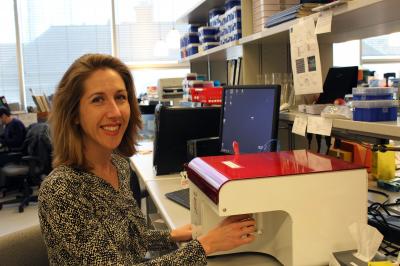
A study co-published in Nature Medicine this week by University of Toronto researcher Penney Gilbert has determined a stem cell based method for restoring strength to damaged skeletal muscles of the elderly.
Skeletal muscles are some of the most important muscles in the body, supporting functions such as sitting, standing, blinking and swallowing. In aging individuals, the function of these muscles significantly decreases.
"You lose fifteen percent of muscle mass every single year after the age of 75, a trend that is irreversible," cites Gilbert, Assistant Professor at the Institute of Biomaterials & Biomedical Engineering (IBBME) and the Donnelly Centre for Cellular & Biomolecular Research (CCBR). The study originates from Gilbert's postdoctoral research at Stanford University's Baxter Laboratory for Stem Cell Biology.
Through tracing the signaling pathways of the cells, the researchers – including lead author, Professor Helen Blau, and postdoctoral researcher Ben Cosgrove – determined that during aging, a subpopulation of stem cells begin to express a modification of a protein that inhibits their ability to grow and make new stem cells.
"But if we instead treated those cells outside the body with a drug that prevented that protein modification from occurring, in combination with culturing the cells on something soft that is reminiscent of soft skeletal tissue, like a hydrogel biomaterial, the combination allowed the aged cells to grow and make more copies of themselves," Gilbert describes.
The rejuvenated cell cultures were then transplanted into injured and aged tissues, with remarkable results: the transplanted cells returned strength to the damaged and aged tissues to levels matching a young, healthy state.
"We've now shown that muscle stem cells progressively lose their stem cell function during aging," Cosgrove said in a statement. "This treatment does not turn the clock back on
dysfunctional stem cells in the aged population. Rather, it stimulates stem cells from old muscle tissues that are still functional to begin dividing and self-renewing."
"An important thing to stress here is that this is not a panacea for aging in general," warns Dr. Blau. The stem cell treatment would only be used to repair localized defects in relatively small muscles found in the hip area, the throat, or the muscles in the eye.
One of the significant challenges to elderly individuals who receive hip transplants, for instance, is the challenge of repairing skeletal muscles around the hip joint injured during surgery. The study points to the potential for future post-surgery therapies that could leave elderly hip replacement patients spry in a fraction of the time.
"Even a small, localized transplantation could have a huge impact on quality of life," Blau argues, and adds, "One big advantage is that because the cells would come from the person's own muscles there would be no problem with an immune response."
"It's a really new, exciting field," says Gilbert, who argues that the muscle stem cell field, which only began to isolate muscle stem cells for study within the last five years, is especially "wide open" in Toronto where "there are really impassioned clinician researchers who are interested in restoring strength in aging and disease.
INFORMATION: END
Skeletal muscles are some of the most important muscles in the body, supporting functions such as sitting, standing, blinking and swallowing. In aging individuals, the function of these muscles significantly decreases.
"You lose fifteen percent of muscle mass every single year after the age of 75, a trend that is irreversible," cites Gilbert, Assistant Professor at the Institute of Biomaterials & Biomedical Engineering (IBBME) and the Donnelly Centre for Cellular & Biomolecular Research (CCBR). The study originates from Gilbert's postdoctoral research at Stanford University's Baxter Laboratory for Stem Cell Biology.
Through tracing the signaling pathways of the cells, the researchers – including lead author, Professor Helen Blau, and postdoctoral researcher Ben Cosgrove – determined that during aging, a subpopulation of stem cells begin to express a modification of a protein that inhibits their ability to grow and make new stem cells.
"But if we instead treated those cells outside the body with a drug that prevented that protein modification from occurring, in combination with culturing the cells on something soft that is reminiscent of soft skeletal tissue, like a hydrogel biomaterial, the combination allowed the aged cells to grow and make more copies of themselves," Gilbert describes.
The rejuvenated cell cultures were then transplanted into injured and aged tissues, with remarkable results: the transplanted cells returned strength to the damaged and aged tissues to levels matching a young, healthy state.
"We've now shown that muscle stem cells progressively lose their stem cell function during aging," Cosgrove said in a statement. "This treatment does not turn the clock back on
dysfunctional stem cells in the aged population. Rather, it stimulates stem cells from old muscle tissues that are still functional to begin dividing and self-renewing."
"An important thing to stress here is that this is not a panacea for aging in general," warns Dr. Blau. The stem cell treatment would only be used to repair localized defects in relatively small muscles found in the hip area, the throat, or the muscles in the eye.
One of the significant challenges to elderly individuals who receive hip transplants, for instance, is the challenge of repairing skeletal muscles around the hip joint injured during surgery. The study points to the potential for future post-surgery therapies that could leave elderly hip replacement patients spry in a fraction of the time.
"Even a small, localized transplantation could have a huge impact on quality of life," Blau argues, and adds, "One big advantage is that because the cells would come from the person's own muscles there would be no problem with an immune response."
"It's a really new, exciting field," says Gilbert, who argues that the muscle stem cell field, which only began to isolate muscle stem cells for study within the last five years, is especially "wide open" in Toronto where "there are really impassioned clinician researchers who are interested in restoring strength in aging and disease.
INFORMATION: END