Roomy cages built from DNA
Self-assembling cages are the largest standalone 3-D DNA structures yet, and could one day deliver drugs, or house tiny bioreactors or photonic devices
Published 2014-03-13 · Original archive entry · Explore research explainers

VIDEO:
To create supersharp images of their cage-shaped DNA polyhedral, the scientists used DNA-PAINT, a microscopy method that uses short strands of DNA (yellow) labeled with a fluorescent chemical (green) to...
Click here for more information.
BOSTON, March 13, 2014 – Move over, nanotechnologists, and make room for the biggest of the small. Scientists at the Harvard's Wyss Institute have built a set of self-assembling DNA cages one-tenth as wide as a bacterium. The structures are some of the largest and most complex structures ever constructed solely from DNA, they report today's online edition of Science.
Moreover, the scientists visualized them using a DNA-based super-resolution microscopy method -- and obtained the first sharp 3D optical images of intact synthetic DNA nanostructures in solution.
In the future, scientists could potentially coat the DNA cages to enclose their contents, packaging drugs for delivery to tissues. And, like a roomy closet, the cage could be modified with chemical hooks that could be used to hang other components such as proteins or gold nanoparticles. This could help scientists build a variety of technologies, including tiny power plants, miniscule factories that produce specialty chemicals, or high-sensitivity photonic sensors that diagnose disease by detecting molecules produced by abnormal tissue.
"I see exciting possibilities for this technology," said Peng Yin, Ph.D., a Core Faculty member at the Wyss Institute and Assistant Professor of Systems Biology at Harvard Medical School, and senior author of the paper.
Building with DNA
DNA is best known as a keeper of genetic information. But scientists in the emerging field of DNA nanotechnology are exploring ways to use it to build tiny structures for a variety of applications. These structures are programmable, in that scientists can specify the sequence of letters, or bases, in the DNA, and those sequences then determine the structure it creates.
So far most researchers in the field have used a method called DNA origami, in which short strands of DNA staple two or three separate segments of a much longer strand together, causing that strand to fold into a precise shape. DNA origami was pioneered in part by Wyss Institute Core Faculty member William Shih, Ph.D., who is also an Associate Professor in the Department of Biological Chemistry and Molecular Pharmacology at Harvard Medical School and the Department of Cancer Biology at the Dana-Farber Cancer Institute.
Yin's team has built different types of DNA structures, including a modular set of parts called single-stranded DNA tiles or DNA bricks. Like LEGO® bricks, these parts can be added or removed independently. Unlike LEGO® bricks, they spontaneously self-assemble.
But for some applications, scientists might need to build much larger DNA structures than anyone has built so far. So, to add to their toolkit, Yin's team sought much larger building blocks to match.
Engineering challenges
Yin and his colleagues first used DNA origami to create extra-large building blocks the shape of a photographer's tripod. The plan was to engineer those tripod legs to attach end-to-end to form polyhedra -- objects with many flat faces that are themselves triangles, rectangles, or other polygons.
But when Yin and the paper's three lead authors, Ryosuke Iinuma, a former Wyss Institute Visiting Fellow, Yonggang Ke, Ph.D., a former Wyss Postdoctoral Fellow who is now an Assistant Professor of Biomedical Engineering at Georgia Institute of Technology and Emory University, and Ralf Jungman, Ph.D, a Wyss Postdoctoral Fellow, built bigger tripods and tried to assemble them into polyhedra, the large tripods' legs would splay and wobble, which kept them from making polyhedra at all.
The researchers got around that problem by building in a horizontal strut to stabilize each pair of legs, just as a furniture maker would use a piece of wood to bridge legs of a wobbly chair.
To glue the tripod legs together end-to-end, they took advantage of the fact that matching DNA strands pair up and adhere to each other. They left a tag of DNA hanging off a tripod leg, and a matching tag on the leg of a different tripod that they wanted it to pair with.
The team programmed DNA to fold into sturdy tripods 60 times larger than previous DNA tripod-like building blocks and 400 times larger than DNA bricks. Those tripods then self-assembled into a specific type of three-dimensional polyhedron -- all in a single test tube.
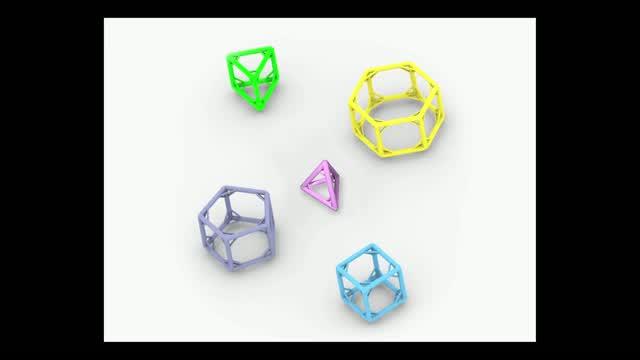
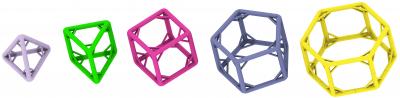
By adjusting the length of the strut, they built tripods that ranged from upright to splay-legged. More upright tripods formed polyhedra with fewer faces and sharper angles, such as a tetrahedron, which has four triangular faces. More splay-legged tripods formed polyhedra with more faces, such as a hexagonal prism, which is shaped like a wheel of cheese and has eight faces, including its top and bottom.
In all, they created five polyhedra: a tetrahedron, a triangular prism, a cube, a pentagonal prism, and a hexagonal prism.
Ultrasharp snapshots
After building the cages, the scientists visualized them using a DNA-based microscopy method Jungmann had helped developed called DNA-PAINT. In DNA-PAINT, short strands of modified DNA cause points on a structure to blink, and data from the blinking images reveal structures too small to be seen with a conventional light microscope. DNA-PAINT produced ultrasharp snapshots of the researchers' DNA cages – the first 3D snapshots ever of single DNA structures in their native, watery environment.
"Bioengineers interested in advancing the field of nanotechnology need to devise manufacturing methods that build sturdy components in a highly robust manner, and develop self-assembly methods that enable formation of nanoscale devices with defined structures and functions," said Wyss Institute Founding Director Don Ingber, M.D., Ph.D. "Peng's DNA cages and his methods for visualizing the process in solution represent major advances along this path."
INFORMATION:
This work was funded by the Office of Naval Research, the Army Research Office, the National Institutes of Health, the National Science Foundation, the JSR Corporation, and the Wyss Institute. In addition to Yin, Iinuma, Ke, and Jungmann, the research team included Thomas Schlichthaerle, a visiting student at the Wyss Institute, and Johannes B. Woehrstein, a research fellow at the Wyss Institute.
IMAGE AND VIDEO AVAILABLE
About the Wyss Institute for Biologically Inspired Engineering at Harvard University
The Wyss Institute for Biologically Inspired Engineering at Harvard University uses Nature's design principles to develop bioinspired materials and devices that will transform medicine and create a more sustainable world. Working as an alliance among all of Harvard's Schools, and in partnership with Beth Israel Deaconess Medical Center, Brigham and Women's Hospital, Boston Children's Hospital, Dana Farber Cancer Institute, Massachusetts General Hospital, the University of Massachusetts Medical School, Spaulding Rehabilitation Hospital, Boston University, Tufts University, and Charité - Universitätsmedizin Berlin, the Institute crosses disciplinary and institutional barriers to engage in high-risk research that leads to transformative technological breakthroughs. By emulating Nature's principles for self-organizing and self-regulating, Wyss researchers are developing innovative new engineering solutions for healthcare, energy, architecture, robotics, and manufacturing. These technologies are translated into commercial products and therapies through collaborations with clinical investigators, corporate alliances, and new start-ups.
Click here for more information.
BOSTON, March 13, 2014 – Move over, nanotechnologists, and make room for the biggest of the small. Scientists at the Harvard's Wyss Institute have built a set of self-assembling DNA cages one-tenth as wide as a bacterium. The structures are some of the largest and most complex structures ever constructed solely from DNA, they report today's online edition of Science.
Moreover, the scientists visualized them using a DNA-based super-resolution microscopy method -- and obtained the first sharp 3D optical images of intact synthetic DNA nanostructures in solution.
In the future, scientists could potentially coat the DNA cages to enclose their contents, packaging drugs for delivery to tissues. And, like a roomy closet, the cage could be modified with chemical hooks that could be used to hang other components such as proteins or gold nanoparticles. This could help scientists build a variety of technologies, including tiny power plants, miniscule factories that produce specialty chemicals, or high-sensitivity photonic sensors that diagnose disease by detecting molecules produced by abnormal tissue.
"I see exciting possibilities for this technology," said Peng Yin, Ph.D., a Core Faculty member at the Wyss Institute and Assistant Professor of Systems Biology at Harvard Medical School, and senior author of the paper.
Building with DNA
DNA is best known as a keeper of genetic information. But scientists in the emerging field of DNA nanotechnology are exploring ways to use it to build tiny structures for a variety of applications. These structures are programmable, in that scientists can specify the sequence of letters, or bases, in the DNA, and those sequences then determine the structure it creates.
So far most researchers in the field have used a method called DNA origami, in which short strands of DNA staple two or three separate segments of a much longer strand together, causing that strand to fold into a precise shape. DNA origami was pioneered in part by Wyss Institute Core Faculty member William Shih, Ph.D., who is also an Associate Professor in the Department of Biological Chemistry and Molecular Pharmacology at Harvard Medical School and the Department of Cancer Biology at the Dana-Farber Cancer Institute.
Yin's team has built different types of DNA structures, including a modular set of parts called single-stranded DNA tiles or DNA bricks. Like LEGO® bricks, these parts can be added or removed independently. Unlike LEGO® bricks, they spontaneously self-assemble.
But for some applications, scientists might need to build much larger DNA structures than anyone has built so far. So, to add to their toolkit, Yin's team sought much larger building blocks to match.
Engineering challenges
Yin and his colleagues first used DNA origami to create extra-large building blocks the shape of a photographer's tripod. The plan was to engineer those tripod legs to attach end-to-end to form polyhedra -- objects with many flat faces that are themselves triangles, rectangles, or other polygons.
But when Yin and the paper's three lead authors, Ryosuke Iinuma, a former Wyss Institute Visiting Fellow, Yonggang Ke, Ph.D., a former Wyss Postdoctoral Fellow who is now an Assistant Professor of Biomedical Engineering at Georgia Institute of Technology and Emory University, and Ralf Jungman, Ph.D, a Wyss Postdoctoral Fellow, built bigger tripods and tried to assemble them into polyhedra, the large tripods' legs would splay and wobble, which kept them from making polyhedra at all.
The researchers got around that problem by building in a horizontal strut to stabilize each pair of legs, just as a furniture maker would use a piece of wood to bridge legs of a wobbly chair.
To glue the tripod legs together end-to-end, they took advantage of the fact that matching DNA strands pair up and adhere to each other. They left a tag of DNA hanging off a tripod leg, and a matching tag on the leg of a different tripod that they wanted it to pair with.
The team programmed DNA to fold into sturdy tripods 60 times larger than previous DNA tripod-like building blocks and 400 times larger than DNA bricks. Those tripods then self-assembled into a specific type of three-dimensional polyhedron -- all in a single test tube.
By adjusting the length of the strut, they built tripods that ranged from upright to splay-legged. More upright tripods formed polyhedra with fewer faces and sharper angles, such as a tetrahedron, which has four triangular faces. More splay-legged tripods formed polyhedra with more faces, such as a hexagonal prism, which is shaped like a wheel of cheese and has eight faces, including its top and bottom.
In all, they created five polyhedra: a tetrahedron, a triangular prism, a cube, a pentagonal prism, and a hexagonal prism.
Ultrasharp snapshots
After building the cages, the scientists visualized them using a DNA-based microscopy method Jungmann had helped developed called DNA-PAINT. In DNA-PAINT, short strands of modified DNA cause points on a structure to blink, and data from the blinking images reveal structures too small to be seen with a conventional light microscope. DNA-PAINT produced ultrasharp snapshots of the researchers' DNA cages – the first 3D snapshots ever of single DNA structures in their native, watery environment.
"Bioengineers interested in advancing the field of nanotechnology need to devise manufacturing methods that build sturdy components in a highly robust manner, and develop self-assembly methods that enable formation of nanoscale devices with defined structures and functions," said Wyss Institute Founding Director Don Ingber, M.D., Ph.D. "Peng's DNA cages and his methods for visualizing the process in solution represent major advances along this path."
INFORMATION:
This work was funded by the Office of Naval Research, the Army Research Office, the National Institutes of Health, the National Science Foundation, the JSR Corporation, and the Wyss Institute. In addition to Yin, Iinuma, Ke, and Jungmann, the research team included Thomas Schlichthaerle, a visiting student at the Wyss Institute, and Johannes B. Woehrstein, a research fellow at the Wyss Institute.
IMAGE AND VIDEO AVAILABLE
About the Wyss Institute for Biologically Inspired Engineering at Harvard University
The Wyss Institute for Biologically Inspired Engineering at Harvard University uses Nature's design principles to develop bioinspired materials and devices that will transform medicine and create a more sustainable world. Working as an alliance among all of Harvard's Schools, and in partnership with Beth Israel Deaconess Medical Center, Brigham and Women's Hospital, Boston Children's Hospital, Dana Farber Cancer Institute, Massachusetts General Hospital, the University of Massachusetts Medical School, Spaulding Rehabilitation Hospital, Boston University, Tufts University, and Charité - Universitätsmedizin Berlin, the Institute crosses disciplinary and institutional barriers to engage in high-risk research that leads to transformative technological breakthroughs. By emulating Nature's principles for self-organizing and self-regulating, Wyss researchers are developing innovative new engineering solutions for healthcare, energy, architecture, robotics, and manufacturing. These technologies are translated into commercial products and therapies through collaborations with clinical investigators, corporate alliances, and new start-ups.
Attachments