PRESS-NEWS.org - Press Release Distribution
PRESS RELEASES DISTRIBUTION

Huge tooth fossil shows marine predator had plenty to chew on

Huge tooth fossil shows marine predator had plenty to chew on
2014-05-29
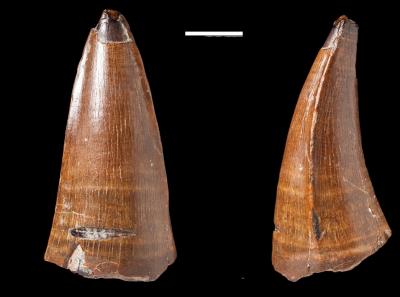
(Press-News.org) A fossilised tooth belonging to a fearsome marine predator has been recorded as the largest of its kind found in the UK, following its recent discovery.

A team of palaeontologists have verified the tooth, which was found near Chesil Beach in Dorset, as belonging to a prehistoric relative of modern crocodiles known as Dakosaurus maximus.

The tooth, which has a broken tip, is approximately 5.5 cm long.

Researchers and curators from University of Edinburgh and the Natural History Museum in London identified the item after it was bought at an online auction by a fossil collector.

Scientists say the circumstances in which the fossil was found were unusual – it was dredged from the sea floor rather than being found on the shore or dug up.

The tooth has been examined and identified by a team of UK palaeontologists and placed in the fossil collection of the Natural History Museum.

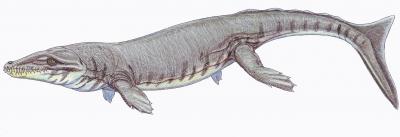
Dakosaurus maximus, which grew up to about 4.5 metres long, swam in the shallow seas that covered Europe some 152 million years ago. It belonged to a family of marine animals known as thalattosuchians, relatives of today's crocodiles.

The unusual shape of the animal's skull and teeth suggests it ate similar prey to modern-day killer whales. It would have used its broad, short jaws to swallow large fish whole and to bite chunks from larger prey.

The team's research is published in the scientific journal Historical Biology.

Dr Mark Young, of the University of Edinburgh's School of Biological Sciences, said: "Given its size, Dakosaurus had very large teeth. However, it wasn't the top marine predator of its time, and would have swum alongside other larger marine reptiles, making the shallow seas of the Late Jurassic period exceptionally dangerous."

INFORMATION: END

[Attachments] See images for this press release:
Huge tooth fossil shows marine predator had plenty to chew on Huge tooth fossil shows marine predator had plenty to chew on 2

ELSE PRESS RELEASES FROM THIS DATE:

Amber discovery indicates Lyme disease is older than human race

Amber discovery indicates Lyme disease is older than human race
2014-05-29
CORVALLIS, Ore. – Lyme disease is a stealthy, often misdiagnosed disease that was only recognized about 40 years ago, but new discoveries of ticks fossilized in amber show that the bacteria which cause it may have been lurking around for 15 million years – long before any humans walked on Earth. The findings were made by researchers from Oregon State University, who studied 15-20 million-year-old amber from the Dominican Republic that offer the oldest fossil evidence ever found of Borrelia, a type of spirochete-like bacteria that to this day causes Lyme disease. They ...

Remember parathyroid hormone as well as vitamin D to assess vitamin's role in diabetes

2014-05-29
TORONTO -- Combined assessment of parathyroid hormone along with vitamin D may be needed to assess the impact of vitamin D status on sugar metabolism, according to Toronto researchers. Their study is published on-line in Diabetes on May 29 2014. The new findings might explain why studies of vitamin D alone have been conflicting and why clinical trials of vitamin D supplementation to improve diabetes have been disappointing, says principal investigator Dr. Ravi Retnakaran. He is a clinician-scientist at the Lunenfeld-Tanenbaum Research Institute at Mount Sinai Hospital ...

Grape-enriched diet supports eye health

2014-05-29
FRESNO, CA – New research presented this week at the Association for Research in Vision and Ophthalmology conference in Orlando, Florida suggests that regular grape consumption may play a role in eye health by protecting the retina from deterioration. Specifically, a grape-enriched diet resulted in a protective effect on retinal structure and function. The retina is the part of the eye that contains the cells that respond to light, known as photoreceptors. There are two types of photoreceptors: rods and cones. Retinal degenerative diseases affect over 5 million people ...

First-of-its-kind study: Swimmers gain an advantage when they recover with chocolate milk

2014-05-29
Grabbing chocolate milk after a hard swim could give swimmers a performance edge, according to new research presented at one of the nation's top sports medicine conferences – the American College of Sports Medicine's annual conference.1 In a sport where seconds and even tenths of a second can make a big difference and intense practice routines are the norm, Indiana University researchers found that when collegiate, trained swimmers recovered with chocolate milk after an exhaustive swim, they swam faster in time trials later that same day. On average, they shaved off 2.1 ...

The Hoosier Cavefish, a new and endangered species from the caves of southern Indiana

The Hoosier Cavefish, a new and endangered species from the caves of southern Indiana
2014-05-29
A new eyeless cavefish is described from Indiana and named after the Indiana Hoosiers. It is the first new cavefish species described from the U.S. in 40 years. Notably, it has an anus right behind its head, and the females brood their young in their gill chamber. The new species was described in the open access journal ZooKeys. The new species, Amblyopsis hoosieri, is the closest relative of a species (A. spelaea) from the longest cave system in the world, Mammoth Cave in Kentucky. These two species are separated by the Ohio River, which also separates the states of ...

Think fast, robot

2014-05-29
One of the reasons we don't yet have self-driving cars and mini-helicopters delivering online purchases is that autonomous vehicles tend not to perform well under pressure. A system that can flawlessly parallel park at 5 mph may have trouble avoiding obstacles at 35 mph. Part of the problem is the time it takes to produce and interpret camera data. An autonomous vehicle using a standard camera to monitor its surroundings might take about a fifth of a second to update its location. That's good enough for normal operating conditions but not nearly fast enough to handle ...

Minority entrepreneurs face discrimination when seeking loans

2014-05-29
A disheartening new study from researchers at Utah State University, BYU and Rutgers University reveals that discrimination is still tainting the American Dream for minorities. The three-part research article, which appears online in the Journal of Consumer Research, finds that minorities seeking small business loans are treated differently than their white counterparts, despite having identical qualifications on paper. While discrimination in housing, employment and education is well documented, the study shows that minorities also face discrimination in the marketplace. ...

Four-billion-year-old rocks yield clues about Earth's earliest crust

Four-billion-year-old rocks yield clues about Earths earliest crust
2014-05-29
(Edmonton) It looks like just another rock, but what Jesse Reimink holds in his hands is a four-billion-year-old chunk of an ancient protocontinent that holds clues about how the Earth's first continents formed. The University of Alberta geochemistry student spent the better part of three years collecting and studying ancient rock samples from the Acasta Gneiss Complex in the Northwest Territories, part of his PhD research to understand the environment in which they formed. "The timing and mode of continental crust formation throughout Earth's history is a controversial ...

Diesel bus alternative

Diesel bus alternative
2014-05-29
Electric school buses that feed the power grid could save school districts millions of dollars — and reduce children's exposure to diesel fumes — based on recent research by the University of Delaware's College of Earth, Ocean, and Environment (CEOE). A new study examines the cost-effectiveness of electric school buses that discharge their batteries into the electrical grid when not in use and get paid for the service. The technology, called vehicle-to-grid (V2G), was pioneered at UD and is being tested with electric cars in a pilot project. Adapting the system for ...

Stress degrades sperm quality

2014-05-29
Psychological stress is harmful to sperm and semen quality, affecting its concentration, appearance, and ability to fertilize an egg, according to a study led by researchers Columbia University's Mailman School of Public Health and Rutgers School of Public Health. Results are published online in the journal Fertility and Sterility. According to the American Society for Reproductive Medicine, infertility affects men and women equally, and semen quality is a key indicator of male fertility. "Men who feel stressed are more likely to have lower concentrations of sperm ...

LAST 30 PRESS RELEASES:

Elucidating liquid-liquid phase separation under non-equilibrium conditions

Fecal microbiome and bile acid profiles differ in preterm infants with parenteral nutrition-associated cholestasis

The Institute of Science and Technology Austria (ISTA) receives €5 million donation for AI research

Study finds link between colorblindness and death from bladder cancer

Tailored treatment approach shows promise for reducing suicide and self-harm risk in teens and young adults

Call for papers: AI in biochar research for sustainable land ecosystems

Methane eating microbes turn a powerful greenhouse gas into green plastics, feed, and fuel

Hidden nitrogen in China’s rice paddies could cut fertilizer use

Texas A&M researchers expose hidden risks of firefighter gear in an effort to improve safety and performance

Wood burning in homes drives dangerous air pollution in winter

The Journal of Nuclear Medicine Ahead-of-Print Tip Sheet: January 23, 2026

ISSCR statement in response to new NIH policy on research using human fetal tissue (Notice NOT-OD-26-028)

Biologists and engineers follow goopy clues to plant-wilting bacteria

What do rats remember? IU research pushes the boundaries on what animal models can tell us about human memory

Frontiers Science House: did you miss it? Fresh stories from Davos – end of week wrap

Watching forests grow from space

New grounded theory reveals why hybrid delivery systems work the way they do

CDI scientist joins NIH group to improve post-stem cell transplant patient evaluation

Uncovering cancer's hidden oncRNA signatures: From discovery to liquid biopsy

Multiple maternal chronic conditions and risk of severe neonatal morbidity and mortality

Interactive virtual assistant for health promotion among older adults with type 2 diabetes

Ion accumulation in liquid–liquid phase separation regulates biomolecule localization

Hemispheric asymmetry in the genetic overlap between schizophrenia and white matter microstructure

Research Article | Evaluation of ten satellite-based and reanalysis precipitation datasets on a daily basis for Czechia (2001–2021)

Nano-immunotherapy synergizing ferroptosis and STING activation in metastatic bladder cancer

Insilico Medicine receives IND approval from FDA for ISM8969, an AI-empowered potential best-in-class NLRP3 inhibitor

Combined aerobic-resistance exercise: Dual efficacy and efficiency for hepatic steatosis

Expert consensus outlines a standardized framework to evaluate clinical large language models

Bioengineered tissue as a revolutionary treatment for secondary lymphedema

Forty years of tracking trees reveals how global change is impacting Amazon and Andean Forest diversity

[Press-News.org] Huge tooth fossil shows marine predator had plenty to chew on