Sequencing electric eel genome unlocks shocking secrets
Published 2014-06-26 · Original archive entry · Explore research explainers
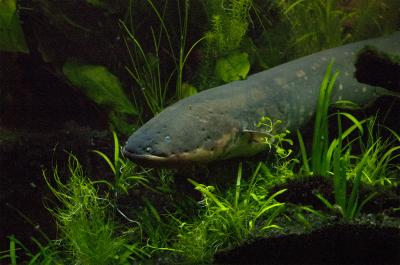
EAST LANSING, Mich. — For the first time, the genome of the electric eel has been sequenced. This discovery has revealed the secret of how fishes with electric organs have evolved six times in the history of life to produce electricity outside of their bodies.
The research, published in the current issue of Science, sheds light on the genetic blueprint used to evolve these complex, novel organs. It was co-led by Michigan State University, University of Wisconsin-Madison, University of Texas-Austin and the Systemix Institute.
"It's truly exciting to find that complex structures like the electric organ, which evolved completely independently in six groups of fish, seem to share the same genetic toolkit," said Jason Gallant, MSU zoologist and co-lead author of the paper. "Biologists are starting to learn, using genomics, that evolution makes similar structures from the same starting materials, even if the organisms aren't even that closely related."
Worldwide, there are hundreds of species of electric fish in six broad lineages. Their diversity is so great that Darwin himself cited electric fishes as critical examples of convergent evolution, where unrelated animals independently evolve similar traits to adapt to a particular environment or ecological niche.
All muscle and nerve cells have electrical potential. Simple contraction of a muscle will release a small amount of voltage. But between 100 and 200 million years ago, some fish began to amplify that potential by evolving electrocytes from muscle cells, organized in sequence and capable of generating much higher voltages than those used to make muscles work.
"Evolution has removed the ability of muscle cells to contract and changed the distribution of proteins in the cell membrane; now all electrocytes do is push ions across a membrane to create a massive flow of positive charge," said Lindsay Traeger, U-W graduate student and co-author of the study.
The "in-series alignment" of the electrocytes and unique polarity of each cell allows for the "summation of voltages, much like batteries stacked in series in a flashlight," said Michael Sussman, U-W biochemist.
The additional current required for the power comes from the fact that an eel body contains many millions of such "batteries" working together and firing their electrical discharge simultaneously.
The new work provides the world's first electric fish genome sequence assembly. It also identifies the genetic factors and developmental pathways the animals use to grow an organ that, in the case of the electric eel, can deliver a jolt several times more powerful than the current from a standard household electrical outlet. Other electric fishes use electricity for defense, predation, navigation and communication.
Future MSU research will focus on testing the role of these genes in the development of electric organs, using state-of-the-art transgenic techniques in Gallant's newly constructed laboratory.
INFORMATION: The research was funded by the National Science Foundation, the W.M. Keck Foundation and the National Institutes of Health.
Michigan State University has been working to advance the common good in uncommon ways for more than 150 years. One of the top research universities in the world, MSU focuses its vast resources on creating solutions to some of the world's most pressing challenges, while providing life-changing opportunities to a diverse and inclusive academic community through more than 200 programs of study in 17 degree-granting colleges.
For MSU news on the Web, go to MSUToday. Follow MSU News on Twitter at twitter.com/MSUnews.
The research, published in the current issue of Science, sheds light on the genetic blueprint used to evolve these complex, novel organs. It was co-led by Michigan State University, University of Wisconsin-Madison, University of Texas-Austin and the Systemix Institute.
"It's truly exciting to find that complex structures like the electric organ, which evolved completely independently in six groups of fish, seem to share the same genetic toolkit," said Jason Gallant, MSU zoologist and co-lead author of the paper. "Biologists are starting to learn, using genomics, that evolution makes similar structures from the same starting materials, even if the organisms aren't even that closely related."
Worldwide, there are hundreds of species of electric fish in six broad lineages. Their diversity is so great that Darwin himself cited electric fishes as critical examples of convergent evolution, where unrelated animals independently evolve similar traits to adapt to a particular environment or ecological niche.
All muscle and nerve cells have electrical potential. Simple contraction of a muscle will release a small amount of voltage. But between 100 and 200 million years ago, some fish began to amplify that potential by evolving electrocytes from muscle cells, organized in sequence and capable of generating much higher voltages than those used to make muscles work.
"Evolution has removed the ability of muscle cells to contract and changed the distribution of proteins in the cell membrane; now all electrocytes do is push ions across a membrane to create a massive flow of positive charge," said Lindsay Traeger, U-W graduate student and co-author of the study.
The "in-series alignment" of the electrocytes and unique polarity of each cell allows for the "summation of voltages, much like batteries stacked in series in a flashlight," said Michael Sussman, U-W biochemist.
The additional current required for the power comes from the fact that an eel body contains many millions of such "batteries" working together and firing their electrical discharge simultaneously.
The new work provides the world's first electric fish genome sequence assembly. It also identifies the genetic factors and developmental pathways the animals use to grow an organ that, in the case of the electric eel, can deliver a jolt several times more powerful than the current from a standard household electrical outlet. Other electric fishes use electricity for defense, predation, navigation and communication.
Future MSU research will focus on testing the role of these genes in the development of electric organs, using state-of-the-art transgenic techniques in Gallant's newly constructed laboratory.
INFORMATION: The research was funded by the National Science Foundation, the W.M. Keck Foundation and the National Institutes of Health.
Michigan State University has been working to advance the common good in uncommon ways for more than 150 years. One of the top research universities in the world, MSU focuses its vast resources on creating solutions to some of the world's most pressing challenges, while providing life-changing opportunities to a diverse and inclusive academic community through more than 200 programs of study in 17 degree-granting colleges.
For MSU news on the Web, go to MSUToday. Follow MSU News on Twitter at twitter.com/MSUnews.