Forelimb bone data predicts predator style
Published 2014-06-30 · Original archive entry · Explore research explainers
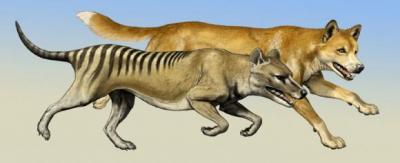
At the start of their research, paleobiologists Christine Janis and Borja Figueirido simply wanted to determine the hunting style of an extinct marsupial called Thylacine (also known as the "marsupial wolf" or the "Tasmanian tiger"). In the end, the Australian relic, which has a very dog-like head but with both cat- and dog-like features in the skeleton, proved to be uniquely unspecialized, but what emerged from the effort is a new classification system that can capably predict the hunting behaviors of mammals from measurements of just a few forelimb bones.
"We realized what we are also doing was providing a dataset or a framework whereby people could look at extinct animals because it provides a good categorization of extant forms," said Janis, professor of ecology and evolutionary biology at Brown University, and co-author of a paper describing the framework in the Journal of Morphology.
For example, the scapulas (shoulder blades) of leopards (ambush predators who grapple with rather than chase their prey) and those of cheetahs (pursuit predators who chase their prey over a longer distance) measure very differently. So do their radius (forearm) bones. The shapes of the bones, including areas where muscles attach, place the cheetahs with other animals that evolved for chasing (mainly dogs), and the leopards with others that evolved for grappling (mostly other big cats).
"The main differences in the forelimbs really reflect adaptations for strength versus adaptations for speed," Janis said.
In plots of the data in the paper, cheetahs and African hunting dogs appear to be brethren by their scapular proportions even though one is a cat and one is a dog. But the similar scapulas don't lie: both species are acknowledged by zoologists to be pursuit predators.
In all, Janis and Figueirido of the Universidad de Malaga in Spain made 44 measurements on five forelimb bones in 62 specimens of 37 species of ranging from the Arctic fox to the thylacine. In various analyses the data proved helpful in sorting out the behaviors of their bones' owners. Given measurements from all of the forelimb bones of an animal, for example, they could accurately separate ambush predators from pursuit predators 100 percent of the time and ambush predators from pouncing predators 95 percent of the time. Results were similar for analyses based on the humerus (upper arm bone). They were always able to make correct classifications between the three predator styles more than 70 percent of the time, even with just one kind of bone.
The elusive thylacine
The thylacine has not been known from mainland Australia in recorded human history, and by official accounts it disappeared from the Australian island of Tasmania by 1936 (although some locals still believe they may be around). In a similar vein, the beasts evaded Janis and Figueirido's attempts at a neat classification of their mode of carnivory. By some bones they were ambushers. By others they were pursuers. In the end, they weren't anything but thylacines.
Janis notes that they could do just fine as generalists, given their relative lack of competition. Historically Australia has hosted less predator diversity than the Serengeti, for example.
"If you are one the few predators in the ecosystem, there's not a lot of pressure to be specialized," she said.
In the thylacine's case the evidence from forelimb bone measurements supports their somewhat unusual status by the standards of the rest of predatory mammals as generalists. For other extinct predators, the framework will support other conclusions based on these same standards.
"One thing you tend to see is that people want to make extinct animals like living ones, so if something has a wolf-like head with a long snout as does the thylacine, although its skull is more delicate than that of a wolf, then people want to make it into a wolf-like runner," she said. "But very few extinct animals actually are as specialized as modern day pursuit predators. People reconstruct things in the image of the familiar, which may not reflect reality."
But Janis said she hopes the framework will provide fellow paleobiologists with an empirical basis for guiding those determinations.
INFORMATION: The Bushnell Foundation supported the study with a research and teaching grant. The Museum of Comparative Zoology at Harvard University, the American Museum of Natural History in New York, and Australia's Museum Victoria and Queensland Museum provided access to specimens for measurement.
"We realized what we are also doing was providing a dataset or a framework whereby people could look at extinct animals because it provides a good categorization of extant forms," said Janis, professor of ecology and evolutionary biology at Brown University, and co-author of a paper describing the framework in the Journal of Morphology.
For example, the scapulas (shoulder blades) of leopards (ambush predators who grapple with rather than chase their prey) and those of cheetahs (pursuit predators who chase their prey over a longer distance) measure very differently. So do their radius (forearm) bones. The shapes of the bones, including areas where muscles attach, place the cheetahs with other animals that evolved for chasing (mainly dogs), and the leopards with others that evolved for grappling (mostly other big cats).
"The main differences in the forelimbs really reflect adaptations for strength versus adaptations for speed," Janis said.
In plots of the data in the paper, cheetahs and African hunting dogs appear to be brethren by their scapular proportions even though one is a cat and one is a dog. But the similar scapulas don't lie: both species are acknowledged by zoologists to be pursuit predators.
In all, Janis and Figueirido of the Universidad de Malaga in Spain made 44 measurements on five forelimb bones in 62 specimens of 37 species of ranging from the Arctic fox to the thylacine. In various analyses the data proved helpful in sorting out the behaviors of their bones' owners. Given measurements from all of the forelimb bones of an animal, for example, they could accurately separate ambush predators from pursuit predators 100 percent of the time and ambush predators from pouncing predators 95 percent of the time. Results were similar for analyses based on the humerus (upper arm bone). They were always able to make correct classifications between the three predator styles more than 70 percent of the time, even with just one kind of bone.
The elusive thylacine
The thylacine has not been known from mainland Australia in recorded human history, and by official accounts it disappeared from the Australian island of Tasmania by 1936 (although some locals still believe they may be around). In a similar vein, the beasts evaded Janis and Figueirido's attempts at a neat classification of their mode of carnivory. By some bones they were ambushers. By others they were pursuers. In the end, they weren't anything but thylacines.
Janis notes that they could do just fine as generalists, given their relative lack of competition. Historically Australia has hosted less predator diversity than the Serengeti, for example.
"If you are one the few predators in the ecosystem, there's not a lot of pressure to be specialized," she said.
In the thylacine's case the evidence from forelimb bone measurements supports their somewhat unusual status by the standards of the rest of predatory mammals as generalists. For other extinct predators, the framework will support other conclusions based on these same standards.
"One thing you tend to see is that people want to make extinct animals like living ones, so if something has a wolf-like head with a long snout as does the thylacine, although its skull is more delicate than that of a wolf, then people want to make it into a wolf-like runner," she said. "But very few extinct animals actually are as specialized as modern day pursuit predators. People reconstruct things in the image of the familiar, which may not reflect reality."
But Janis said she hopes the framework will provide fellow paleobiologists with an empirical basis for guiding those determinations.
INFORMATION: The Bushnell Foundation supported the study with a research and teaching grant. The Museum of Comparative Zoology at Harvard University, the American Museum of Natural History in New York, and Australia's Museum Victoria and Queensland Museum provided access to specimens for measurement.