Researchers unzip nanotubes by shooting them at 15,000 mph
Published 2014-06-30 · Original archive entry · Explore research explainers
Carbon nanotubes "unzipped" into graphene nanoribbons by a chemical process invented at Rice University are finding use in all kinds of projects, but Rice scientists have now found a chemical-free way to unzip them.
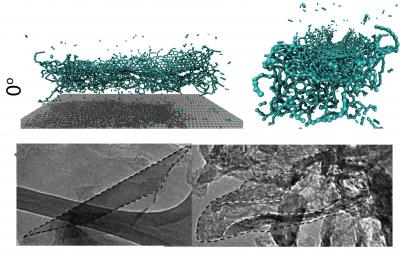
The Rice lab of materials scientist Pulickel Ajayan discovered that nanotubes that hit a target end first turn into mostly ragged clumps of atoms. But nanotubes that happen to broadside the target unzip into handy ribbons that can be used in composite materials for strength and applications that take advantage of their desirable electrical properties.
The Rice researchers led by graduate student Sehmus Ozden reported their finding in the American Chemical Society journal Nano Letters.
The result was a surprise, Ozden said. "Until now, we knew we could use mechanical forces to shorten and cut carbon nanotubes. This is the first time we have showed carbon nanotubes can be unzipped using mechanical forces."
The researchers fired pellets of randomly oriented, multiwalled carbon nanotubes from a light gas gun built by the Rice lab of materials scientist Enrique Barrera with funding from NASA. The pellets impacted an aluminum target in a vacuum chamber at about 15,000 miles per hour. When they inspected the resulting carbon rubble, they found nanotubes that smashed into the target end first or at a sharp angle simply deformed into a crumpled nanotube. But tubes that hit lengthwise actually split into ribbons with ragged edges.
"Hypervelocity impact tests are mostly used to simulate the impact of different projectiles on shields, spacecraft and satellites," Ozden said. "We were investigating possible applications for carbon nanotubes in space when we got this result."
The effect was confirmed through molecular simulations. They showed that when multiwalled tubes impact the target, the outer tube flattens, hitting the inside tubes and unzipping them in turn. Single-wall nanotubes do just the opposite; when the tube flattens, the bottom wall hits the inside of the top wall, which unzips from the middle out to the edges.
Ozden explained that the even distribution of stress along the belly-flopping nanotube, which is many times longer than it is wide, breaks carbon bonds in a line nearly simultaneously.
The researchers said 70 to 80 percent of the nanotubes in a pellet unzip to one degree or another.
Ozden said the process eliminates the need to clean chemical residues from nanoribbons produced through current techniques. "One-step, chemical-free, clean and high-quality graphene nanoribbons can be produced using our method. They're potential candidates for next-generation electronic materials," he said.
INFORMATION: Co-authors include Pedro Autreto, a postdoctoral researcher at the State University of Campinas, Brazil, who has a complimentary appointment at Rice; graduate student Chandra Sekhar Tiwary of Rice and the Indian Institute of Science, Bangalore; graduate student Suman Khatiwada of Rice; Leonardo Machado and Douglas Galvao of the State University of Campinas; and Robert Vajtai, a senior faculty fellow at Rice. Barrera is a professor of materials science and nanoengineering. Ajayan is Rice's Benjamin M. and Mary Greenwood Anderson Professor in Mechanical Engineering and Materials Science and of chemistry, and chair of the Department of Materials Science and NanoEngineering.
The Department of Defense, U.S. Air Force Office of Scientific Research through a Multidisciplinary University Research Institute grant, and the Brazilian agencies National Council for Scientific and Technological Development, Coordination for the Improvement of Higher Education Personnel and the São Paulo Research Foundation supported the research.
Read the abstract at http://pubs.acs.org/doi/abs/10.1021/nl501753n
Follow Rice News and Media Relations via Twitter @RiceUNews
Related Materials:
Ajayan Research Group: http://ajayan.rice.edu
Enrique Barrera: http://msne.rice.edu/Content.aspx?id=105
Department of Materials Science and NanoEngineering: http://msne.rice.edu
Images for download:
http://news.rice.edu/wp-content/uploads/2014/06/0630_SMASHING-1-web.jpg
Carbon nanotubes can be unzipped into nanoribbons by firing them at high velocity at a target, but only the ones that land lengthwise will unzip, according to researchers at Rice University. Tests evaluated nanotubes that impacted the target at various angles to see the results. (Credit: Ajayan Group/Rice University)
http://news.rice.edu/wp-content/uploads/2014/06/0630_SMASHING-3-web.jpg
From left, Rice University researchers Sehmus Ozden, Enrique Barrera and Robert Vajtai at the hypervelocity gun used to fire pellets of nanotubes at an aluminum target. The researchers found the collision would split those tubes that struck the target lengthwise into nanoribbons. Ozden and Vajtai hold aluminum plates with deep holes caused by small objects hitting them at 15,000 miles per hour. The gun was built with support from NASA to simulate the impact of micrometeorites on spacecraft. (Credit: Jeff Fitlow/Rice University)
Located on a 300-acre forested campus in Houston, Rice University is consistently ranked among the nation's top 20 universities by U.S. News & World Report. Rice has highly respected schools of Architecture, Business, Continuing Studies, Engineering, Humanities, Music, Natural Sciences and Social Sciences and is home to the Baker Institute for Public Policy. With 3,920 undergraduates and 2,567 graduate students, Rice's undergraduate student-to-faculty ratio is 6.3-to-1. Its residential college system builds close-knit communities and lifelong friendships, just one reason why Rice has been ranked No. 1 for best quality of life multiple times by the Princeton Review and No. 2 for "best value" among private universities by Kiplinger's Personal Finance.
The Rice lab of materials scientist Pulickel Ajayan discovered that nanotubes that hit a target end first turn into mostly ragged clumps of atoms. But nanotubes that happen to broadside the target unzip into handy ribbons that can be used in composite materials for strength and applications that take advantage of their desirable electrical properties.
The Rice researchers led by graduate student Sehmus Ozden reported their finding in the American Chemical Society journal Nano Letters.
The result was a surprise, Ozden said. "Until now, we knew we could use mechanical forces to shorten and cut carbon nanotubes. This is the first time we have showed carbon nanotubes can be unzipped using mechanical forces."
The researchers fired pellets of randomly oriented, multiwalled carbon nanotubes from a light gas gun built by the Rice lab of materials scientist Enrique Barrera with funding from NASA. The pellets impacted an aluminum target in a vacuum chamber at about 15,000 miles per hour. When they inspected the resulting carbon rubble, they found nanotubes that smashed into the target end first or at a sharp angle simply deformed into a crumpled nanotube. But tubes that hit lengthwise actually split into ribbons with ragged edges.
"Hypervelocity impact tests are mostly used to simulate the impact of different projectiles on shields, spacecraft and satellites," Ozden said. "We were investigating possible applications for carbon nanotubes in space when we got this result."
The effect was confirmed through molecular simulations. They showed that when multiwalled tubes impact the target, the outer tube flattens, hitting the inside tubes and unzipping them in turn. Single-wall nanotubes do just the opposite; when the tube flattens, the bottom wall hits the inside of the top wall, which unzips from the middle out to the edges.
Ozden explained that the even distribution of stress along the belly-flopping nanotube, which is many times longer than it is wide, breaks carbon bonds in a line nearly simultaneously.
The researchers said 70 to 80 percent of the nanotubes in a pellet unzip to one degree or another.
Ozden said the process eliminates the need to clean chemical residues from nanoribbons produced through current techniques. "One-step, chemical-free, clean and high-quality graphene nanoribbons can be produced using our method. They're potential candidates for next-generation electronic materials," he said.
INFORMATION: Co-authors include Pedro Autreto, a postdoctoral researcher at the State University of Campinas, Brazil, who has a complimentary appointment at Rice; graduate student Chandra Sekhar Tiwary of Rice and the Indian Institute of Science, Bangalore; graduate student Suman Khatiwada of Rice; Leonardo Machado and Douglas Galvao of the State University of Campinas; and Robert Vajtai, a senior faculty fellow at Rice. Barrera is a professor of materials science and nanoengineering. Ajayan is Rice's Benjamin M. and Mary Greenwood Anderson Professor in Mechanical Engineering and Materials Science and of chemistry, and chair of the Department of Materials Science and NanoEngineering.
The Department of Defense, U.S. Air Force Office of Scientific Research through a Multidisciplinary University Research Institute grant, and the Brazilian agencies National Council for Scientific and Technological Development, Coordination for the Improvement of Higher Education Personnel and the São Paulo Research Foundation supported the research.
Read the abstract at http://pubs.acs.org/doi/abs/10.1021/nl501753n
Follow Rice News and Media Relations via Twitter @RiceUNews
Related Materials:
Ajayan Research Group: http://ajayan.rice.edu
Enrique Barrera: http://msne.rice.edu/Content.aspx?id=105
Department of Materials Science and NanoEngineering: http://msne.rice.edu
Images for download:
http://news.rice.edu/wp-content/uploads/2014/06/0630_SMASHING-1-web.jpg
Carbon nanotubes can be unzipped into nanoribbons by firing them at high velocity at a target, but only the ones that land lengthwise will unzip, according to researchers at Rice University. Tests evaluated nanotubes that impacted the target at various angles to see the results. (Credit: Ajayan Group/Rice University)
http://news.rice.edu/wp-content/uploads/2014/06/0630_SMASHING-3-web.jpg
From left, Rice University researchers Sehmus Ozden, Enrique Barrera and Robert Vajtai at the hypervelocity gun used to fire pellets of nanotubes at an aluminum target. The researchers found the collision would split those tubes that struck the target lengthwise into nanoribbons. Ozden and Vajtai hold aluminum plates with deep holes caused by small objects hitting them at 15,000 miles per hour. The gun was built with support from NASA to simulate the impact of micrometeorites on spacecraft. (Credit: Jeff Fitlow/Rice University)
Located on a 300-acre forested campus in Houston, Rice University is consistently ranked among the nation's top 20 universities by U.S. News & World Report. Rice has highly respected schools of Architecture, Business, Continuing Studies, Engineering, Humanities, Music, Natural Sciences and Social Sciences and is home to the Baker Institute for Public Policy. With 3,920 undergraduates and 2,567 graduate students, Rice's undergraduate student-to-faculty ratio is 6.3-to-1. Its residential college system builds close-knit communities and lifelong friendships, just one reason why Rice has been ranked No. 1 for best quality of life multiple times by the Princeton Review and No. 2 for "best value" among private universities by Kiplinger's Personal Finance.