Researchers create quantum dots with single-atom precision
Published 2014-06-30 · Original archive entry · Explore research explainers
A team of physicists from the Paul-Drude-Institut für Festkörperelektronik (PDI) in Berlin, Germany, NTT Basic Research Laboratories in Atsugi, Japan, and the U.S. Naval Research Laboratory (NRL) has used a scanning tunneling microscope to create quantum dots with identical, deterministic sizes. The perfect reproducibility of these dots opens the door to quantum dot architectures completely free of uncontrolled variations, an important goal for technologies from nanophotonics to quantum information processing as well as for fundamental studies. The complete findings are published in the July 2014, issue of the journal Nature Nanotechnology.
Quantum dots are often regarded as artificial atoms because, like real atoms, they confine their electrons to quantized states with discrete energies. But the analogy breaks down quickly, because while real atoms are identical, quantum dots usually comprise hundreds or thousands of atoms – with unavoidable variations in their size and shape and, consequently, in their properties and behavior. External electrostatic gates can be used to reduce these variations. But the more ambitious goal of creating quantum dots with intrinsically perfect fidelity by completely eliminating statistical variations in their size, shape, and arrangement has long remained elusive.
Creating atomically precise quantum dots requires every atom to be placed in a precisely specified location without error. The team assembled the dots atom-by-atom, using a scanning tunneling microscope (STM), and relied on an atomically precise surface template to define a lattice of allowed atom positions. The template was the surface of an InAs crystal, which has a regular pattern of indium vacancies and a low concentration of native indium adatoms adsorbed above the vacancy sites. The adatoms are ionized +1 donors and can be moved with the STM tip by vertical atom manipulation. The team assembled quantum dots consisting of linear chains of N = 6 to 25 indium atoms; the example shown here is a chain of 22 atoms.
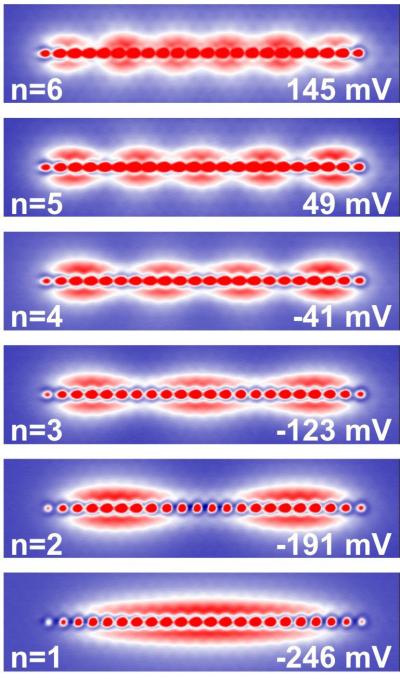
Stefan Fölsch, a physicist at the PDI who led the team, explained that "the ionized indium adatoms form a quantum dot by creating an electrostatic well that confines electrons normally associated with a surface state of the InAs crystal. The quantized states can then be probed and mapped by scanning tunneling spectroscopy measurements of the differential conductance." These spectra show a series of resonances labeled by the principal quantum number n. Spatial maps reveal the wave functions of these quantized states, which have n lobes and n − 1 nodes along the chain, exactly as expected for a quantum-mechanical electron in a box. For the 22-atom chain example, the states up to n = 6 are shown.
Because the indium atoms are strictly confined to the regular lattice of vacancy sites, every quantum dot with N atoms is essentially identical, with no intrinsic variation in size, shape, or position. This means that quantum dot "molecules" consisting of several coupled chains will reflect the same invariance. Steve Erwin, a physicist at NRL and the team's theorist, pointed out that "this greatly simplifies the task of creating, protecting, and controlling degenerate states in quantum dot molecules, which is an important prerequisite for many technologies." In quantum computing, for example, qubits with doubly degenerate ground states offer protection against environmental decoherence. By combining the invariance of quantum dot molecules with the intrinsic symmetry of the InAs vacancy lattice, the team created degenerate states that are surprisingly resistant to environmental perturbations by defects. In the example shown here, a molecule with perfect three-fold rotational symmetry was first created and its two-fold degenerate state demonstrated experimentally. By intentionally breaking the symmetry, the team found that the degeneracy was progressively removed, completing the demonstration.
The reproducibility and high fidelity offered by these quantum dots makes them excellent candidates for studying fundamental physics that is typically obscured by stochastic variations in size, shape, or position of the chains. Looking forward, the team also anticipates that the elimination of uncontrolled variations in quantum dot architectures will offer many benefits to a broad range of future quantum dot technologies in which fidelity is important.
INFORMATION: The Naval Research Laboratory (NRL) is the Navy's full-spectrum corporate laboratory, conducting a broadly based multidisciplinary program of scientific research and advanced technological development. The Laboratory, with a total complement of more than 2800 personnel, is located in southwest Washington, DC, with other major sites at the Stennis Space Center, MS, and Monterey, CA. NRL has served the Navy and the nation for over 90 years and continues to meet the complex technological challenges of today's world. For more information, visit the NRL homepage or join the conversation on Twitter, Facebook, and YouTube.
Quantum dots are often regarded as artificial atoms because, like real atoms, they confine their electrons to quantized states with discrete energies. But the analogy breaks down quickly, because while real atoms are identical, quantum dots usually comprise hundreds or thousands of atoms – with unavoidable variations in their size and shape and, consequently, in their properties and behavior. External electrostatic gates can be used to reduce these variations. But the more ambitious goal of creating quantum dots with intrinsically perfect fidelity by completely eliminating statistical variations in their size, shape, and arrangement has long remained elusive.
Creating atomically precise quantum dots requires every atom to be placed in a precisely specified location without error. The team assembled the dots atom-by-atom, using a scanning tunneling microscope (STM), and relied on an atomically precise surface template to define a lattice of allowed atom positions. The template was the surface of an InAs crystal, which has a regular pattern of indium vacancies and a low concentration of native indium adatoms adsorbed above the vacancy sites. The adatoms are ionized +1 donors and can be moved with the STM tip by vertical atom manipulation. The team assembled quantum dots consisting of linear chains of N = 6 to 25 indium atoms; the example shown here is a chain of 22 atoms.
Stefan Fölsch, a physicist at the PDI who led the team, explained that "the ionized indium adatoms form a quantum dot by creating an electrostatic well that confines electrons normally associated with a surface state of the InAs crystal. The quantized states can then be probed and mapped by scanning tunneling spectroscopy measurements of the differential conductance." These spectra show a series of resonances labeled by the principal quantum number n. Spatial maps reveal the wave functions of these quantized states, which have n lobes and n − 1 nodes along the chain, exactly as expected for a quantum-mechanical electron in a box. For the 22-atom chain example, the states up to n = 6 are shown.
Because the indium atoms are strictly confined to the regular lattice of vacancy sites, every quantum dot with N atoms is essentially identical, with no intrinsic variation in size, shape, or position. This means that quantum dot "molecules" consisting of several coupled chains will reflect the same invariance. Steve Erwin, a physicist at NRL and the team's theorist, pointed out that "this greatly simplifies the task of creating, protecting, and controlling degenerate states in quantum dot molecules, which is an important prerequisite for many technologies." In quantum computing, for example, qubits with doubly degenerate ground states offer protection against environmental decoherence. By combining the invariance of quantum dot molecules with the intrinsic symmetry of the InAs vacancy lattice, the team created degenerate states that are surprisingly resistant to environmental perturbations by defects. In the example shown here, a molecule with perfect three-fold rotational symmetry was first created and its two-fold degenerate state demonstrated experimentally. By intentionally breaking the symmetry, the team found that the degeneracy was progressively removed, completing the demonstration.
The reproducibility and high fidelity offered by these quantum dots makes them excellent candidates for studying fundamental physics that is typically obscured by stochastic variations in size, shape, or position of the chains. Looking forward, the team also anticipates that the elimination of uncontrolled variations in quantum dot architectures will offer many benefits to a broad range of future quantum dot technologies in which fidelity is important.
INFORMATION: The Naval Research Laboratory (NRL) is the Navy's full-spectrum corporate laboratory, conducting a broadly based multidisciplinary program of scientific research and advanced technological development. The Laboratory, with a total complement of more than 2800 personnel, is located in southwest Washington, DC, with other major sites at the Stennis Space Center, MS, and Monterey, CA. NRL has served the Navy and the nation for over 90 years and continues to meet the complex technological challenges of today's world. For more information, visit the NRL homepage or join the conversation on Twitter, Facebook, and YouTube.