Making dreams come true: Making graphene from plastic?
Creating a material that possesses similar characteristics of graphene using only a continuous process of polymer solution and heat treatment
Published 2014-07-02 · Original archive entry · Explore research explainers
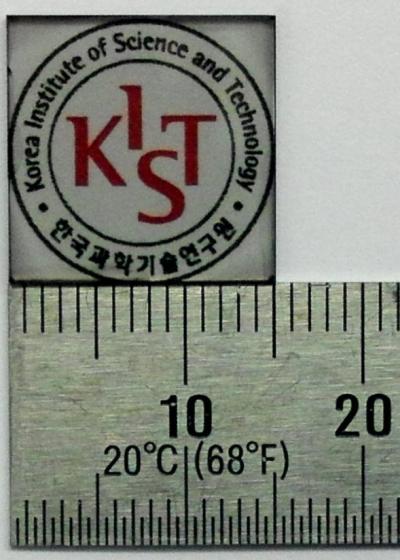
Graphene is gaining heated attention, dubbed a "wonder material" with great conductivity, flexibility and durability. However, graphene is hard to come by due to the fact that its manufacturing process is complicated and mass production not possible. Recently, a domestic research team developed a carbon material without artificial defects commonly found during the production process of graphene while maintaining its original characteristics. The newly developed material can be used as a substitute for graphene in solar cells and semiconductor chips. Further, the developed process is based on the continuous and mass-produced process of carbon fiber, making it much easier for full-scale commercialization. In recognition of the innovative approach, the research was introduced on the cover of Nanoscale, a high impacting peer-reviewed journal in the field of nano science.
The research team led by Dr. Han-Ik Joh at KIST along with Dr. Seok-In Na at Chonbuk National University and Dr. Byoung Gak Kim at KRICT synthesized carbon nanosheets similar to graphene using polymer, and directly used the transparent electrodes for organic solar cells. The research outcome was introduced in Nanoscale, a journal of Royal Society of Chemistry in the UK under the title of "One-step Synthesis of Carbon Nanosheets Converted from a Polycylic Compound and Their Direct Use as Transparent Electrodes of ITO-free Organic Solar Cells" and was selected as a cover story in the January 21st edition in recognition for this innovative and superb research findings.
To manufacture high quality graphene in large volume, the CVD (chemical vapor deposition)* method is widely used. However, this method requires intensive post-processing (transfer process) as it has to remove used metal after the manufacturing process and move the manufactured graphene to another board such as a solar cell substrate. In this process the quality quickly degrades as it is prone to wrinkles or cracks. CVD (Chemical Vapor Deposition): It is a method of manufacturing graphene on the board of metal film that serves as a catalyst. It manufactures the material by blowing out gas called the source gas onto the board. After it is done the metal has to be removed and graphene has to be transported to another board.
The research team developed "carbon nanosheet" in a two-step process, which consists of coating the substrate with a plymer solution and heating. Considering that the existing process consists of 8 steps to manufacture graphene, the new method makes it much simpler. In addition, the new method can be directly used as solar cell without any additional process.
The research team synthesized a polymer with a rigid ladder structure, namely PIM-1(Polymer of intrinsic microporosity-1) to form the 춘 through the simpole process, which is spin-coated on the quarts substrates using PIM-1 solution with light green color and then heat-treated at 1,200 °C, leading to transparent and conductive CNS.
The carbon nanosheet can be mass-produced in a simpler process while having high quality since the new process bypasses the steps that are prone to formation of defects such as elimination of the metal substrate or transfer of graphene to another board. The final product is as effective as graphene.
Dr. Han Ik Joh at KIST said, "It is expected to be applied for commercialization of transparent and conductive 2D carbon materials without difficulty since this process is based on the continuous and mass-produced process of carbon fiber."
INFORMATION: This is a follow-up research from the team that recently released its findings on the carbon nanosheet manufacturing based on polyacrylonitrile (published in the 2013 Carbon Vol. 55 and Applied Physics Letters Vol. 102). The new findings are even more meaningful as it offers deeper understanding on the growth mechanism of carbon nanosheet and much simpler manufacturing process.
The research was conducted with the funding from the KIST Proprietary Research Project and National Research Foundation of Korea.
The research team led by Dr. Han-Ik Joh at KIST along with Dr. Seok-In Na at Chonbuk National University and Dr. Byoung Gak Kim at KRICT synthesized carbon nanosheets similar to graphene using polymer, and directly used the transparent electrodes for organic solar cells. The research outcome was introduced in Nanoscale, a journal of Royal Society of Chemistry in the UK under the title of "One-step Synthesis of Carbon Nanosheets Converted from a Polycylic Compound and Their Direct Use as Transparent Electrodes of ITO-free Organic Solar Cells" and was selected as a cover story in the January 21st edition in recognition for this innovative and superb research findings.
To manufacture high quality graphene in large volume, the CVD (chemical vapor deposition)* method is widely used. However, this method requires intensive post-processing (transfer process) as it has to remove used metal after the manufacturing process and move the manufactured graphene to another board such as a solar cell substrate. In this process the quality quickly degrades as it is prone to wrinkles or cracks. CVD (Chemical Vapor Deposition): It is a method of manufacturing graphene on the board of metal film that serves as a catalyst. It manufactures the material by blowing out gas called the source gas onto the board. After it is done the metal has to be removed and graphene has to be transported to another board.
The research team developed "carbon nanosheet" in a two-step process, which consists of coating the substrate with a plymer solution and heating. Considering that the existing process consists of 8 steps to manufacture graphene, the new method makes it much simpler. In addition, the new method can be directly used as solar cell without any additional process.
The research team synthesized a polymer with a rigid ladder structure, namely PIM-1(Polymer of intrinsic microporosity-1) to form the 춘 through the simpole process, which is spin-coated on the quarts substrates using PIM-1 solution with light green color and then heat-treated at 1,200 °C, leading to transparent and conductive CNS.
The carbon nanosheet can be mass-produced in a simpler process while having high quality since the new process bypasses the steps that are prone to formation of defects such as elimination of the metal substrate or transfer of graphene to another board. The final product is as effective as graphene.
Dr. Han Ik Joh at KIST said, "It is expected to be applied for commercialization of transparent and conductive 2D carbon materials without difficulty since this process is based on the continuous and mass-produced process of carbon fiber."
INFORMATION: This is a follow-up research from the team that recently released its findings on the carbon nanosheet manufacturing based on polyacrylonitrile (published in the 2013 Carbon Vol. 55 and Applied Physics Letters Vol. 102). The new findings are even more meaningful as it offers deeper understanding on the growth mechanism of carbon nanosheet and much simpler manufacturing process.
The research was conducted with the funding from the KIST Proprietary Research Project and National Research Foundation of Korea.