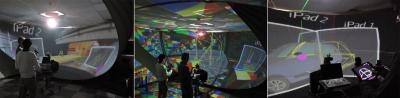
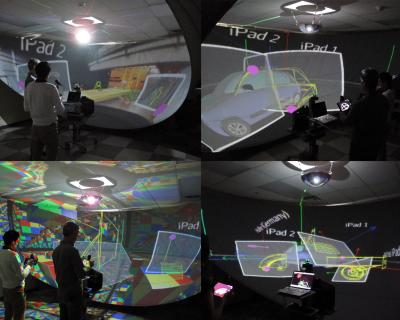
(Press-News.org) Collaborative three-dimensional sketching is now possible thanks to a system known as Hyve-3D that University of Montreal researchers are presenting today at the SIGGRAPH 2014 conference in Vancouver. "Hyve-3D is a new interface for 3D content creation via embodied and collaborative 3D sketching," explained lead researcher Professor Tomás Dorta, of the university's School of Design. "The system is a full scale immersive 3D environment. Users create drawings on hand-held tables. They can then use the tablets to manipulate the sketches to create a 3D design within the space". For example, as the designers are immersed in their work, this could mean designing the outside of a car, and then actually getting into it to work on the interior detailing. Hyve-3D stands for "Hybrid Virtual Environment 3D". Univalor, the university's technology commercialization unit, is supporting the market launch of the system.
The 3D images are the result of an optical illusion created by a widescreen high-resolution projector, a specially designed 5m-diameter spherically concave fabric screen and a 16-inch dome mirror projecting the image onto the screen. The system is driven by a MacBook Pro laptop, a tracking system with two 3D sensors, and two iPad mini tablets. Each iPad is attached to a tracker. "The software takes care of all the networking, scene management, 3D graphics and projection, and also couples the sensors input and iPad devices," Dorta explains. "The iPads run a Satellite application, which serves as the user interaction front-end of the system. Specialized techniques render the 3D scene onto a spherical projection in real-time". The Hyve-3D software also works on conventional 2D displays.
Up until now, 3D design required complicated or expensive equipment. "Our system is innovative, non-intrusive and simple," Dorta said. "Beyond its obvious artistic applications, Hyve-3D clearly has industrial applications in a wide range of fields, from industrial or architectural design to engineering, medical 3D applications, game design animation and movie making. My team is looking forward to taking the product to market and discovering what people do with it."
INFORMATION: END
Spectacular 3-D sketching system revolutionizes design interaction and collaboration
University of Montreal researchers present their Hyve-3D system at SIGGRAPH 2014 Conference
2014-08-11
ELSE PRESS RELEASES FROM THIS DATE:
Discovery of new form of dystrophin protein could lead to therapy for some DMD patients
2014-08-10
Scientists have discovered a new form of dystrophin, a protein critical to normal muscle function, and identified the genetic mechanism responsible for its production. Studies of the new protein isoform, published online Aug. 10 in Nature Medicine and led by a team in The Research Institute at Nationwide Children's Hospital, suggest it may offer a novel therapeutic approach for some patients with Duchenne muscular dystrophy, a debilitating neuromuscular condition that usually leaves patients unable to walk on their own by age 12.
Duchenne muscular dystrophy, or DMD, ...
Scientists unlock key to blood vessel formation
2014-08-10
Scientists from the University of Leeds have discovered a gene that plays a vital role in blood vessel formation, research which adds to our knowledge of how early life develops.
The discovery could also lead to greater understanding of how to treat cardiovascular diseases and cancer.
Professor David Beech, of the School of Medicine at the University of Leeds, who led the research, said: "Blood vessel networks are not already pre-constructed but emerge rather like a river system. Vessels do not develop until the blood is already flowing and they are created in response ...
Newly discovered heart molecule could lead to effective treatment for heart failure
2014-08-10
INDIANAPOLIS -- Researchers have discovered a previously unknown cardiac molecule that could provide a key to treating, and preventing, heart failure.
The newly discovered molecule provides the heart with a tool to block a protein that orchestrates genetic disruptions when the heart is subjected to stress, such as high blood pressure.
When the research team, led by Ching-Pin Chang, M.D., Ph.D., associate professor of medicine at the Indiana University School of Medicine, restored levels of the newly discovered molecule in mice experiencing heart failure, the progression ...
Bioengineers: Matrix stiffness is an essential tool in stem cell differentiation
2014-08-10
Bioengineers at the University of California, San Diego have proven that when it comes to guiding stem cells into a specific cell type, the stiffness of the extracellular matrix used to culture them really does matter. When placed in a dish of a very stiff material, or hydrogel, most stem cells become bone-like cells. By comparison, soft materials tend to steer stem cells into soft tissues such as neurons and fat cells. The research team, led by bioengineering professor Adam Engler, also found that a protein binding the stem cell to the hydrogel is not a factor in the differentiation ...
Pairing old technologies with new for next generation electronic devices
2014-08-10
UCL scientists have discovered a new method to efficiently generate and control currents based on the magnetic nature of electrons in semi-conducting materials, offering a radical way to develop a new generation of electronic devices.
One promising approach to developing new technologies is to exploit the electron's tiny magnetic moment, or 'spin'. Electrons have two properties – charge and spin – and although current technologies use charge, it is thought that spin-based technologies have the potential to outperform the 'charge'-based technology of semiconductors for ...
Physicists create water tractor beam
2014-08-10
VIDEO:
Physicists at the Australian National University have created a tractor beam in water. Using a simple wave generator they can create water currents which could be used to confine oil...
Click here for more information.
Physicists at The Australian National University (ANU) have created a tractor beam on water, providing a radical new technique that could confine oil spills, manipulate floating objects or explain rips at the beach.
The group, led by Professor Michael ...
2010 Chilean earthquake causes icequakes in Antarctica
2014-08-10
VIDEO:
High-frequency icequakes are shown at station HOWD in Antarctica during the distant waves of the 2010 magnitude 8.8 Chile earthquake. The triggered icequakes are indicated by the narrow vertical bands...
Click here for more information.
Seismic events aren't rare occurrences on Antarctica, where sections of the frozen desert can experience hundreds of micro-earthquakes an hour due to ice deformation. Some scientists call them icequakes. But in March of 2010, the ice sheets ...
Target identified for rare inherited neurological disease in men
2014-08-10
Researchers at University of California, San Diego School of Medicine have identified the mechanism by which a rare, inherited neurodegenerative disease causes often crippling muscle weakness in men, in addition to reduced fertility.
The study, published August 10 in the journal Nature Neuroscience, shows that a gene mutation long recognized as a key to the development of Kennedy's disease impairs the body's ability to degrade, remove and recycle clumps of "trash" proteins that may otherwise build up on neurons, progressively impairing their ability to control muscle ...
The grass really is greener on TV and computer screens, thanks to quantum dots
2014-08-10
SAN FRANCISCO, Aug. 10, 2014 — High-tech specks called quantum dots could bring brighter, more vibrant color to mass market TVs, tablets, phones and other displays. Today, a scientist will describe a new technology called 3M quantum dot enhancement film (QDEF) that efficiently makes liquid crystal display (LCD) screens more richly colored.
His talk will be one of nearly 12,000 presentations at the 248th National Meeting & Exposition of the American Chemical Society (ACS), the world's largest scientific society, taking place here through Thursday.
"Green grass just pops ...
Pregnant women and fetuses exposed to antibacterial compounds face potential health risks
2014-08-10
SAN FRANCISCO, Aug. 10, 2014 — As the Food and Drug Administration (FDA) mulls over whether to rein in the use of common antibacterial compounds that are causing growing concern among environmental health experts, scientists are reporting today that many pregnant women and their fetuses are being exposed to these substances. They will present their work at the 248th National Meeting & Exposition of the American Chemical Society (ACS), the world's largest scientific society.
The meeting, which takes place here through Thursday, features nearly 12,000 presentations on a ...
LAST 30 PRESS RELEASES:
Heart damage is common after an operation and often goes unnoticed, but patients who see a cardiologist may be less likely to die or suffer heart disease as a result
New tool exposes scale of fake research flooding cancer science
Researchers identify new blood markers that may detect early pancreatic cancer
Scientists uncover why some brain cells resist Alzheimer's disease
The Lancet: AI-supported mammography screening results in fewer aggressive and advanced breast cancers, finds full results from first randomized controlled trial
New AI tool improves treatment of cancer patients after heart attack
Kandahar University highlights global disparities in neurosurgical workforce and access to care
Research spotlight: Discovering risk factors for long-term relapse in alcohol use disorder
As fossil fuel use declines, experts urge planning and coordination to prevent chaotic collapse
Scientists identify the antibody's hinge as a structural "control hub"
Late-breaking study establishes new risk model for surgery after TAVR
To reduce CO2 emissions, policy on carbon pricing, taxation and investment in renewable energy is key
Kissing the sun: Unraveling mysteries of the solar wind
Breathing new life into nanotubes for a cooler planet
Machine learning reveals how to maximize biochar yield from algae
Inconsistent standards may be undermining global tracking of antibiotic resistance
Helping hands: UBCO research team develops brace to reduce tremors
MXene nanomaterials enter a new dimension
Hippocampus does more than store memories: it predicts rewards, study finds
New light-based nanotechnology could enable more precise, less harmful cancer treatment
The heritability of human lifespan is roughly 50%, once external mortality is addressed
Tracking Finland’s ice fishers reveals how social information guides foraging decisions
DNA-protein crosslinks promote inflammation-linked premature aging and embryonic lethality in mice
Accounting for fossil energy’s “minimum viable scale” is central to decarbonization
Immunotherapy reduces plaque in arteries of mice
Using AI to retrace the evolution of genetic control elements in the brain
New 3D printing method makes affordable, realistic replicas as structurally complex as a human hand
Direct imaging captures the crystalline vibrations of a supersolid made of atoms and light
What ice-fishing competitions reveal about human decision-making
Scientists solve the mystery of why termite kings and queens are monogamous
[Press-News.org] Spectacular 3-D sketching system revolutionizes design interaction and collaborationUniversity of Montreal researchers present their Hyve-3D system at SIGGRAPH 2014 Conference