A spectacular landscape of star formation
Published 2014-08-20 · Original archive entry · Explore research explainers
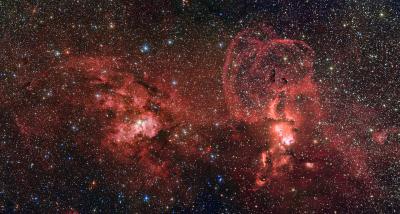
NGC 3603 is a very bright star cluster and is famed for having the highest concentration of massive stars that have been discovered in our galaxy so far. At the centre lies a Wolf–Rayet multiple star system, known as HD 97950. Wolf–Rayet stars are at an advanced stage of stellar evolution, and start off with around 20 times the mass of the Sun. But, despite this large mass, Wolf–Rayet stars shed a considerable amount of their matter due to intense stellar winds , which blast the star's surface material off into space at several million kilometres per hour, a crash diet of cosmic proportions.
NGC 3603 is in an area of very active star formation. Stars are born in dark and dusty regions of space, largely hidden from view. But as the very young stars gradually start to shine and clear away their surrounding cocoons of material they become visible and create glowing clouds in the surrounding material, known as HII regions. HII regions shine because of the interaction of ultraviolet radiation given off by the brilliant hot young stars with the hydrogen gas clouds. HII regions can measure several hundred light-years in diameter, and the one surrounding NGC 3603 has the distinction of being the most massive in our galaxy.
The cluster was first observed by John Herschel on 14 March 1834 during his three-year expedition to systematically survey the southern skies from near Cape Town. He described it as a remarkable object and thought that it might be a globular star cluster. Future studies showed that it is not an old globular, but a young open cluster, one of the richest known.
NGC 3576, on the right of the image, also lies in the Carina–Sagittarius spiral arm of the Milky Way. But it is located only about 9000 light-years from Earth — much closer than NGC 3603, but appearing next to it in the sky.
NGC 3576 is notable for two huge curved objects resembling the curled horns of a ram. These odd filaments are the result of stellar winds from the hot, young stars within the central regions of the nebula, which have blown the dust and gas outwards across a hundred light-years. Two dark silhouetted areas known as Bok globules are also visible in this vast complex of nebulae. These black clouds near the top of the nebula also offer potential sites for the future formation of new stars.
NGC 3576 was also discovered by John Herschel in 1834, making it a particularly productive and visually rewarding year for the English astronomer.
More information
ESO is the foremost intergovernmental astronomy organisation in Europe and the world's most productive ground-based astronomical observatory by far. It is supported by 15 countries: Austria, Belgium, Brazil, the Czech Republic, Denmark, France, Finland, Germany, Italy, the Netherlands, Portugal, Spain, Sweden, Switzerland and the United Kingdom. ESO carries out an ambitious programme focused on the design, construction and operation of powerful ground-based observing facilities enabling astronomers to make important scientific discoveries. ESO also plays a leading role in promoting and organising cooperation in astronomical research. ESO operates three unique world-class observing sites in Chile: La Silla, Paranal and Chajnantor. At Paranal, ESO operates the Very Large Telescope, the world's most advanced visible-light astronomical observatory and two survey telescopes. VISTA works in the infrared and is the world's largest survey telescope and the VLT Survey Telescope is the largest telescope designed to exclusively survey the skies in visible light. ESO is the European partner of a revolutionary astronomical telescope ALMA, the largest astronomical project in existence. ESO is currently planning the 39-metre European Extremely Large optical/near-infrared Telescope, the E-ELT, which will become "the world's biggest eye on the sky".
INFORMATION: Links
* Image of NGC 3603 from the VLT: http://www.eso.org/public/images/eso1005a/
* Another view of the NGC 3576 region: http://www.eso.org/public/images/eso1113a/
* Photos of the MPG/ESO 2.2-metre telescope: http://www.eso.org/public/images/archive/search/?adv=&subject_name=mpg
* Other photos taken with the MPG/ESO 2.2-metre telescope: http://www.eso.org/public/images/archive/search/?adv=&facility=15
* Photos of La Silla: http://www.eso.org/public/images/archive/category/lasilla/
Contacts
Richard Hook
ESO Public Information Officer
Garching bei München, Germany
Tel: +49 89 3200 6655
Email: rhook@eso.org
NGC 3603 is in an area of very active star formation. Stars are born in dark and dusty regions of space, largely hidden from view. But as the very young stars gradually start to shine and clear away their surrounding cocoons of material they become visible and create glowing clouds in the surrounding material, known as HII regions. HII regions shine because of the interaction of ultraviolet radiation given off by the brilliant hot young stars with the hydrogen gas clouds. HII regions can measure several hundred light-years in diameter, and the one surrounding NGC 3603 has the distinction of being the most massive in our galaxy.
The cluster was first observed by John Herschel on 14 March 1834 during his three-year expedition to systematically survey the southern skies from near Cape Town. He described it as a remarkable object and thought that it might be a globular star cluster. Future studies showed that it is not an old globular, but a young open cluster, one of the richest known.
NGC 3576, on the right of the image, also lies in the Carina–Sagittarius spiral arm of the Milky Way. But it is located only about 9000 light-years from Earth — much closer than NGC 3603, but appearing next to it in the sky.
NGC 3576 is notable for two huge curved objects resembling the curled horns of a ram. These odd filaments are the result of stellar winds from the hot, young stars within the central regions of the nebula, which have blown the dust and gas outwards across a hundred light-years. Two dark silhouetted areas known as Bok globules are also visible in this vast complex of nebulae. These black clouds near the top of the nebula also offer potential sites for the future formation of new stars.
NGC 3576 was also discovered by John Herschel in 1834, making it a particularly productive and visually rewarding year for the English astronomer.
More information
ESO is the foremost intergovernmental astronomy organisation in Europe and the world's most productive ground-based astronomical observatory by far. It is supported by 15 countries: Austria, Belgium, Brazil, the Czech Republic, Denmark, France, Finland, Germany, Italy, the Netherlands, Portugal, Spain, Sweden, Switzerland and the United Kingdom. ESO carries out an ambitious programme focused on the design, construction and operation of powerful ground-based observing facilities enabling astronomers to make important scientific discoveries. ESO also plays a leading role in promoting and organising cooperation in astronomical research. ESO operates three unique world-class observing sites in Chile: La Silla, Paranal and Chajnantor. At Paranal, ESO operates the Very Large Telescope, the world's most advanced visible-light astronomical observatory and two survey telescopes. VISTA works in the infrared and is the world's largest survey telescope and the VLT Survey Telescope is the largest telescope designed to exclusively survey the skies in visible light. ESO is the European partner of a revolutionary astronomical telescope ALMA, the largest astronomical project in existence. ESO is currently planning the 39-metre European Extremely Large optical/near-infrared Telescope, the E-ELT, which will become "the world's biggest eye on the sky".
INFORMATION: Links
* Image of NGC 3603 from the VLT: http://www.eso.org/public/images/eso1005a/
* Another view of the NGC 3576 region: http://www.eso.org/public/images/eso1113a/
* Photos of the MPG/ESO 2.2-metre telescope: http://www.eso.org/public/images/archive/search/?adv=&subject_name=mpg
* Other photos taken with the MPG/ESO 2.2-metre telescope: http://www.eso.org/public/images/archive/search/?adv=&facility=15
* Photos of La Silla: http://www.eso.org/public/images/archive/category/lasilla/
Contacts
Richard Hook
ESO Public Information Officer
Garching bei München, Germany
Tel: +49 89 3200 6655
Email: rhook@eso.org