Scientists uncover navigation system used by cancer, nerve cells
Published 2014-08-25 · Original archive entry · Explore research explainers
VIDEO:
Duke University's David Sherwood and his team are using live-cell imaging to probe living cells to see how they find their way to new tissues and organs in the body....
Click here for more information.
DURHAM, N.C. -- Duke University researchers have found a "roving detection system" on the surface of cells that may point to new ways of treating diseases like cancer, Parkinson's disease and amyotrophic lateral sclerosis (ALS).
The cells, which were studied in nematode worms, are able to break through normal tissue boundaries and burrow into other tissues and organs -- a crucial step in many normal developmental processes, ranging from embryonic development and wound-healing to the formation of new blood vessels.
But sometimes the process goes awry. Such is the case with metastatic cancer, in which cancer cells spread unchecked from where they originated and form tumors in other parts of the body.
"Cell invasion is one of the most clinically relevant yet least understood aspects of cancer progression," said David Sherwood, an associate professor of biology at Duke.
Sherwood is leading a team that is investigating the molecular mechanisms that control cell invasion in both normal development and cancer, using a one-millimeter worm known as C. elegans.
At one point in C. elegans development, a specialized cell called the anchor cell breaches the dense, sheet-like membrane that separate the worm's uterus from its vulva, opening up the worm's reproductive tract.
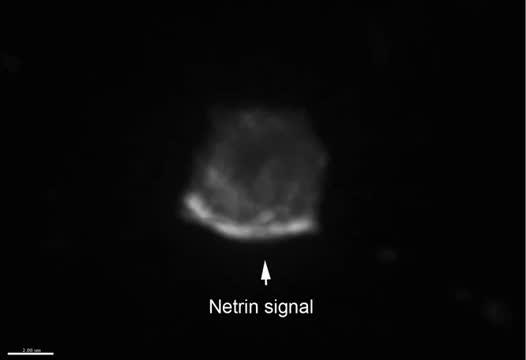
Anchor cells can't see, so they need some kind of signal to tell them where to break through. In a 2009 study, Sherwood and colleagues discovered that an extracellular cue called netrin orients the anchor cell so that it invades in the right direction.
In a new study appearing Aug. 25 in the Journal of Cell Biology, the team shows how receptors on the invasive cells essentially rove around the cell membrane "hunting" for the missing netrin signal that will guide the cell to the correct location.
The researchers used a video camera attached to a powerful microscope to take time-lapse movies of the slow movement of the C. elegans anchor cell during its invasion.
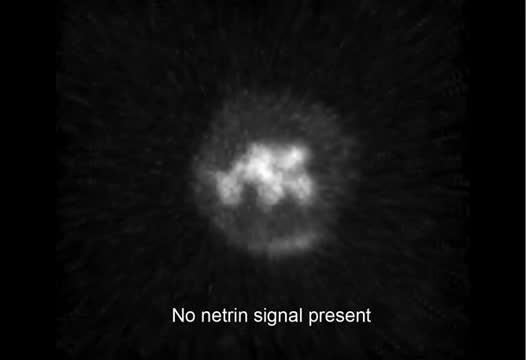
Their time-lapse analyses reveal that when netrin production is blocked, netrin receptors on the surface of the anchor cell periodically cluster, disperse and reassemble in a different region of the cell membrane. The receptors cluster alongside patches of actin filaments -- thin flexible fibers that help cells change shape and form invasive protrusions –- that pop up in each new spot.
"It's kind of like a missile detection system," Sherwood said.
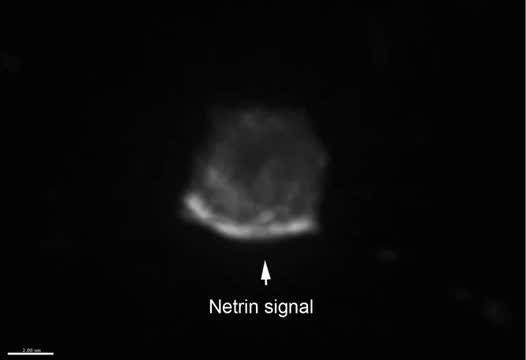
Rather than the whole cell having to move around, its receptors move around on the outside of the cell until they get a signal. Once the receptors locate the netrin signal, they stabilize in the region of the cell membrane that is closest to the source of the signal.
The findings redefine decades-old ideas about how the cell's navigation system works. "Cells don't just passively respond to the netrin signal -- they're actively searching for it," Sherwood said.
Given that netrin has been found to promote cell invasion in some of the most lethal cancers, the findings could lead to new treatment strategies. Disrupting the cell's netrin detection system, for example, could prevent cancer cells from finding their way to the bloodstream or the lymphatic system and stop them from metastasizing, or becoming invasive and spreading throughout the body.
VIDEO: Once the receptors locate the signal, they stay put in the region of the cell membrane that is closest to its source.
Click here for more information.
"One of the things we're gearing up to do next are drug screens with our collaborators to see if we can block this detection system during invasion," Sherwood said.
Scientists have also known for years that netrin plays a key role in wiring the brain and nervous system by guiding developing nerve cells as they grow and form connections.
This means the results could also point to new ways of treating neurological disorders like Parkinson's and ALS and recovering from spinal cord injuries.
Tinkering with the cell's netrin detection machinery, for example, may make it possible to encourage damaged cells in the central nervous system -- which normally have limited ability to regenerate -- to regrow.
INFORMATION: This work was supported by a Pew Scholars Award and by the National Institutes of Health (Grant No. GM100083).
Sherwood's co-authors on the study are Zheng Wang, Lara Linden, Kaleb Naegeli and Qiuyi Chi of Duke, Joshua Ziel of New York University Medical Center, Elliott Hagedorn of Boston Children's Hospital and Natasha Savage of the University of Liverpool.
CITATION: "UNC-6 (netrin) stabilizes oscillatory clustering of the UNC-40 (DCC) receptor to orient polarity," Wang, Z., et al. Journal of Cell Biology, 206 (5) Sept. 2014.
Click here for more information.
DURHAM, N.C. -- Duke University researchers have found a "roving detection system" on the surface of cells that may point to new ways of treating diseases like cancer, Parkinson's disease and amyotrophic lateral sclerosis (ALS).
The cells, which were studied in nematode worms, are able to break through normal tissue boundaries and burrow into other tissues and organs -- a crucial step in many normal developmental processes, ranging from embryonic development and wound-healing to the formation of new blood vessels.
But sometimes the process goes awry. Such is the case with metastatic cancer, in which cancer cells spread unchecked from where they originated and form tumors in other parts of the body.
"Cell invasion is one of the most clinically relevant yet least understood aspects of cancer progression," said David Sherwood, an associate professor of biology at Duke.
Sherwood is leading a team that is investigating the molecular mechanisms that control cell invasion in both normal development and cancer, using a one-millimeter worm known as C. elegans.
At one point in C. elegans development, a specialized cell called the anchor cell breaches the dense, sheet-like membrane that separate the worm's uterus from its vulva, opening up the worm's reproductive tract.
Anchor cells can't see, so they need some kind of signal to tell them where to break through. In a 2009 study, Sherwood and colleagues discovered that an extracellular cue called netrin orients the anchor cell so that it invades in the right direction.
In a new study appearing Aug. 25 in the Journal of Cell Biology, the team shows how receptors on the invasive cells essentially rove around the cell membrane "hunting" for the missing netrin signal that will guide the cell to the correct location.
The researchers used a video camera attached to a powerful microscope to take time-lapse movies of the slow movement of the C. elegans anchor cell during its invasion.
Their time-lapse analyses reveal that when netrin production is blocked, netrin receptors on the surface of the anchor cell periodically cluster, disperse and reassemble in a different region of the cell membrane. The receptors cluster alongside patches of actin filaments -- thin flexible fibers that help cells change shape and form invasive protrusions –- that pop up in each new spot.
"It's kind of like a missile detection system," Sherwood said.
Rather than the whole cell having to move around, its receptors move around on the outside of the cell until they get a signal. Once the receptors locate the netrin signal, they stabilize in the region of the cell membrane that is closest to the source of the signal.
The findings redefine decades-old ideas about how the cell's navigation system works. "Cells don't just passively respond to the netrin signal -- they're actively searching for it," Sherwood said.
Given that netrin has been found to promote cell invasion in some of the most lethal cancers, the findings could lead to new treatment strategies. Disrupting the cell's netrin detection system, for example, could prevent cancer cells from finding their way to the bloodstream or the lymphatic system and stop them from metastasizing, or becoming invasive and spreading throughout the body.
VIDEO: Once the receptors locate the signal, they stay put in the region of the cell membrane that is closest to its source.
Click here for more information.
"One of the things we're gearing up to do next are drug screens with our collaborators to see if we can block this detection system during invasion," Sherwood said.
Scientists have also known for years that netrin plays a key role in wiring the brain and nervous system by guiding developing nerve cells as they grow and form connections.
This means the results could also point to new ways of treating neurological disorders like Parkinson's and ALS and recovering from spinal cord injuries.
Tinkering with the cell's netrin detection machinery, for example, may make it possible to encourage damaged cells in the central nervous system -- which normally have limited ability to regenerate -- to regrow.
INFORMATION: This work was supported by a Pew Scholars Award and by the National Institutes of Health (Grant No. GM100083).
Sherwood's co-authors on the study are Zheng Wang, Lara Linden, Kaleb Naegeli and Qiuyi Chi of Duke, Joshua Ziel of New York University Medical Center, Elliott Hagedorn of Boston Children's Hospital and Natasha Savage of the University of Liverpool.
CITATION: "UNC-6 (netrin) stabilizes oscillatory clustering of the UNC-40 (DCC) receptor to orient polarity," Wang, Z., et al. Journal of Cell Biology, 206 (5) Sept. 2014.
Attachments