PRESS-NEWS.org - Press Release Distribution
PRESS RELEASES DISTRIBUTION

Nano-forests to reveal secrets of cells

Nano-forests to reveal secrets of cells
2014-09-02
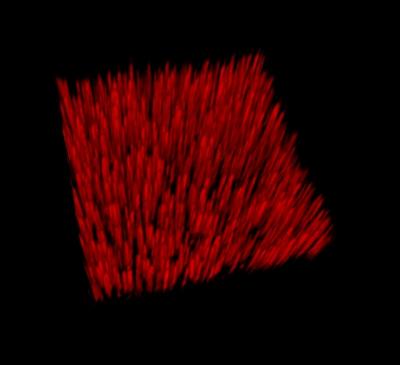
(Press-News.org) Vertical nanowires could be used for detailed studies of what happens on the surface of cells. The findings are important for pharmaceuticals research, among other applications. A group of researchers from Lund University in Sweden have managed to make artificial cell membranes form across a large number of vertical nanowires, known as a 'nano-forest'.

All communication between the interior of a cell and its surroundings takes place through the cell membrane. The membrane is a surface layer that holds the cell together and that largely comprises lipids, built of fatty acids. Inside the cell there are also various types of membrane, all with their own specific role.

Studies of cell membranes using nanotechnology have up to now mainly involved studying artificial membranes on flat surfaces, but because many membranes in the body have a curved shape, a different type of nano-surface is needed. In a new scientific study, researchers from Lund University have used vertical nanowires to create more varied surfaces on which artificial membranes can form. The Lund researchers have built an entire forest of upright nanowires on a one millimetre squared surface, on which they have succeeded in forming artificial membranes that are curved in the same way as many natural cell membranes.

"Our research demonstrates that artificial membranes can follow the curved surface formed by the nanowires, which creates unique opportunities to study membranes in a curved state", said Aleksandra Dabkowska from the Department of Chemistry at Lund University.

The nanowires also act as fine feelers that can measure how the membrane works. For instance, the vertical nanowires can be used to study different proteins that are active in the body's cell membranes. Because of their barrier function on the surface of the cell, these proteins are the target of a range of different drugs. The nano-forest could therefore be of great importance for pharmaceutical research, as well as for basic cell research, partly because the nano-surfaces are very precisely controlled as regards the length, thickness and spacing of the nanowires, and partly because the nano-forest multiplies the total study surface compared with a flat nano-landscape.

INFORMATION: The present study is a close collaboration between researchers within the Nanometre Structure Consortium at Lund University who come from the Divisions of Physical Chemistry and Solid State Physics at the faculties of Science and Engineering.

[Attachments] See images for this press release:
Nano-forests to reveal secrets of cells

ELSE PRESS RELEASES FROM THIS DATE:

Scientists find possible neurobiological basis for tradeoff between honesty, self-interest

2014-09-02
What's the price of your integrity? Tell the truth; everyone has a tipping point. We all want to be honest, but at some point, we'll lie if the benefit is great enough. Now, scientists have confirmed the area of the brain in which we make that decision. The result was published online this week in Nature Neuroscience. "We prefer to be honest, even if lying is beneficial," said Lusha Zhu, the study's lead author and a postdoctoral associate at the Virginia Tech Carilion Research Institute, where she works with Brooks King-Casas and Pearl Chiu, who are assistant professors ...

Researchers find Asian camel crickets now common in US homes

Researchers find Asian camel crickets now common in US homes
2014-09-02
With their long, spiky legs and their propensity for eating anything, including each other, camel crickets are the stuff of nightmares. And now research from North Carolina State University finds that non-native camel cricket species have spread into homes across the eastern United States. "The good news is that camel crickets don't bite or pose any kind of threat to humans," says Dr. Mary Jane Epps, a postdoctoral researcher at NC State and lead author of a paper about the research. The research stems from a chance encounter, when a cricket taxonomist found an invasive ...

Exceptionally well preserved insect fossils from the Rhône Valley

Exceptionally well preserved insect fossils from the Rhône Valley
2014-09-02
In Bavaria, the Tithonian Konservat-Lagerstätte of lithographic limestone is well known as a result of numerous discoveries of emblematic fossils from that area (for example, Archaeopteryx). Now, for the first time, researchers have found fossil insects in the French equivalent of these outcrops - discoveries which include a new species representing the oldest known water treader. Despite the abundance of fossils in the equivalent Bavarian outcrops, fewer fossils have been obtained from the Late Kimmeridgian equivalents of these rocks in the departments of Ain and Rhône ...

Surprising new role for calcium in sensing pain

Surprising new role for calcium in sensing pain
2014-09-02
DURHAM, N.C. -- When you accidentally touch a hot oven, you rapidly pull your hand away. Although scientists know the basic neural circuits involved in sensing and responding to such painful stimuli, they are still sorting out the molecular players. Duke researchers have made a surprising discovery about the role of a key molecule involved in pain in worms, and have built a structural model of the molecule. These discoveries, described Sept. 2 in Nature Communications, may help direct new strategies to treat pain in people. In humans and other mammals, a family of ...

Single laser stops molecular tumbling motion instantly

2014-09-02
In the quantum world, making the simple atom behave is one thing, but making the more complex molecule behave is another story. Now Northwestern University scientists have figured out an elegant way to stop a molecule from tumbling so that its potential for new applications can be harnessed: shine a single laser on a trapped molecule and it instantly cools to the temperature of outer space, stopping the rotation of the molecule. "It's counterintuitive that the molecule gets colder, not hotter when we shine intense laser light on it," said Brian Odom, who led the research. ...

NYU study compares consequences of teen alcohol and marijuana use

2014-09-02
Growing public support for marijuana legalization in the U.S. has led to public debate about whether marijuana is "safer" than other substances, such as alcohol. In January, President Obama also publically stated he is not convinced that marijuana is more dangerous than alcohol. Despite the recent shift in views toward marijuana, the harms of use as compared to alcohol use are not well understood. Now a new study "Adverse Psychosocial Outcomes Associated with Drug Use among US High School Seniors: A Comparison of Alcohol and Marijuana," by researchers affiliated with ...

Discovery hints at why stress is more devastating for some

Discovery hints at why stress is more devastating for some
2014-09-02
Some people take stress in stride; others are done in by it. New research at Rockefeller University has identified the molecular mechanisms of this so-called stress gap in mice with very similar genetic backgrounds — a finding that could lead researchers to better understand the development of psychiatric disorders such as anxiety and depression. "Like people, each animal has unique experiences as it goes through its life. And we suspect that these life experiences can alter the expression of genes, and as a result, affect an animal's susceptibility to stress," says senior ...

Simple awareness campaign in general practice identifies new cases of AF

Simple awareness campaign in general practice identifies new cases of AF
2014-09-02
Barcelona, Spain – Tuesday 2 September 2014: A simple awareness campaign in general practice identifies new cases of atrial fibrillation (AF), according to research presented at ESC Congress today by Professor Jean-Marc Davy from France. Professor Davy said: "Atrial fibrillation (AF) is the most common cardiac arrhythmia. It multiplies the risk of heart failure risk by three-fold and the risk of stroke risk by five-fold. Similarly, AF is responsible for ischaemic stroke in 1 of 4 cases. However, AF is often overlooked and diagnosed too late. In 20% of cases, AF is diagnosed ...

ROCKET AF trial suggests that digoxin increases risk of death in AF patients

ROCKET AF trial suggests that digoxin increases risk of death in AF patients
2014-09-02
Barcelona, Spain – Tuesday 2 September 2014: Digoxin may increase the risk of death in patients with atrial fibrillation (AF) by approximately 20%, according to results from the ROCKET AF trial presented at ESC Congress today by Dr Manesh Patel, director of interventional cardiology and catheterisation labs at Duke University Health System in Durham, North Carolina, US. The findings suggest that caution may be needed when using digoxin in complex AF patients but further studies are needed to confirm the observations. Dr Patel said: "In this subanalysis of the ROCKET AF ...

Health structures explain nearly 20 percent of non-adherence to heart failure guidelines

2014-09-02
Barcelona, Spain – Tuesday 2 September 2014: Health structures explain nearly 20% of the non-adherence to heart failure guidelines, according to the results of a joint ESC-OECD study presented today at ESC Congress by Professor Aldo Maggioni. Clinical variables explained more than 80% of non-adherence. Professor Maggioni said: "This is a unique evaluation which combines clinical data and health structure characteristics of different countries. It provides a fuller picture of the reasons some patients with heart failure do not receive treatment according to ESC guidelines." Heart ...

LAST 30 PRESS RELEASES:

ASU researchers to lead AAAS panel on water insecurity in the United States

ASU professor Anne Stone to present at AAAS Conference in Phoenix on ancient origins of modern disease

Proposals for exploring viruses and skin as the next experimental quantum frontiers share US$30,000 science award

ASU researchers showcase scalable tech solutions for older adults living alone with cognitive decline at AAAS 2026

Scientists identify smooth regional trends in fruit fly survival strategies

Antipathy toward snakes? Your parents likely talked you into that at an early age

Sylvester Cancer Tip Sheet for Feb. 2026

Online exposure to medical misinformation concentrated among older adults

Telehealth improves access to genetic services for adult survivors of childhood cancers

Outdated mortality benchmarks risk missing early signs of famine and delay recognizing mass starvation

Newly discovered bacterium converts carbon dioxide into chemicals using electricity

Flipping and reversing mini-proteins could improve disease treatment

Scientists reveal major hidden source of atmospheric nitrogen pollution in fragile lake basin

Biochar emerges as a powerful tool for soil carbon neutrality and climate mitigation

Tiny cell messengers show big promise for safer protein and gene delivery

AMS releases statement regarding the decision to rescind EPA’s 2009 Endangerment Finding

Parents’ alcohol and drug use influences their children’s consumption, research shows

Modular assembly of chiral nitrogen-bridged rings achieved by palladium-catalyzed diastereoselective and enantioselective cascade cyclization reactions

Promoting civic engagement

AMS Science Preview: Hurricane slowdown, school snow days

Deforestation in the Amazon raises the surface temperature by 3 °C during the dry season

Model more accurately maps the impact of frost on corn crops

How did humans develop sharp vision? Lab-grown retinas show likely answer

Sour grapes? Taste, experience of sour foods depends on individual consumer

At AAAS, professor Krystal Tsosie argues the future of science must be Indigenous-led

From the lab to the living room: Decoding Parkinson’s patients movements in the real world

Research advances in porous materials, as highlighted in the 2025 Nobel Prize in Chemistry

Sally C. Morton, executive vice president of ASU Knowledge Enterprise, presents a bold and practical framework for moving research from discovery to real-world impact

Biochemical parameters in patients with diabetic nephropathy versus individuals with diabetes alone, non-diabetic nephropathy, and healthy controls

Muscular strength and mortality in women ages 63 to 99

[Press-News.org] Nano-forests to reveal secrets of cells